
To see my post as text, scroll down.
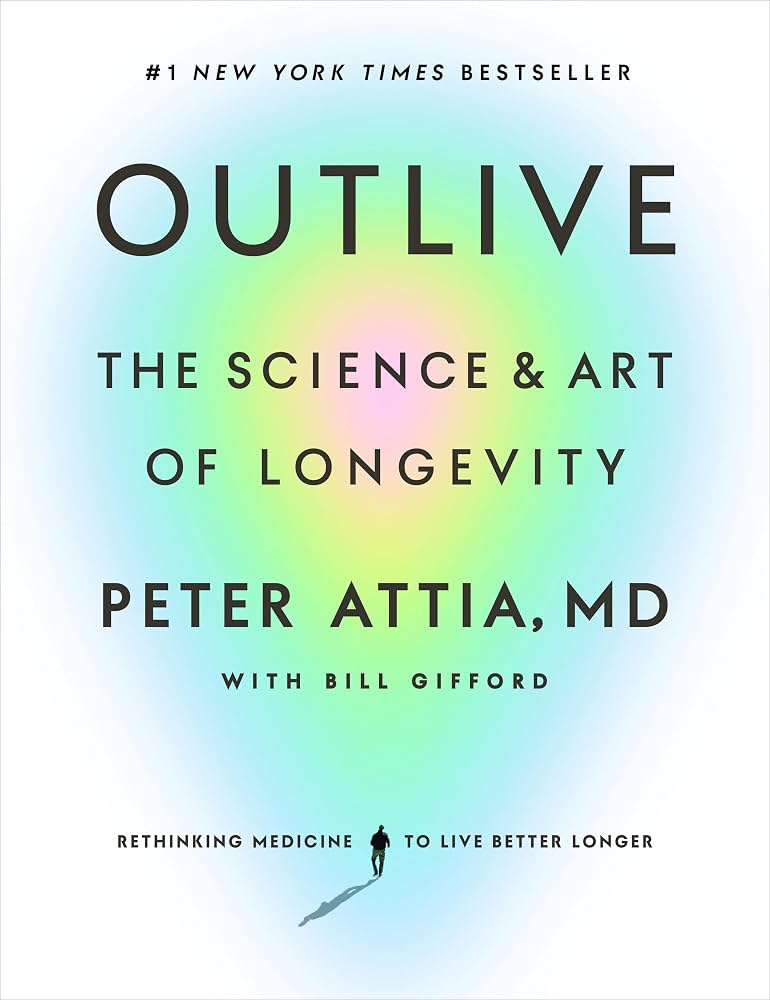
Hi, everybody. I just finished work. If you’re new here, I’m a sign language interpreter that mainly interprets phone calls. So if somebody’s calling the kind of place that has long hold times often, like a pharmacy, I’ll look at my second monitor and read. Recently, I started reading a book recommended by my nutritionist, a very kind nutritionist. She’s never like one of those people who food shame or tell you that there are forbidden foods or things like that. It’s more about being empowered to know how food affects you and not living to be thin, but for longevity. She recommended a book called Outlive: The Science and Art of Longevity by Peter Attia, MD. I didn’t finish the book because there are four sections covering metabolic disease, cholesterol, cancer, and dementia. I wasn’t quite as concerned about cancer and dementia as I was the chapter on heart disease and high blood sugar.
Those are issues that affect people my age, so I’m not really reviewing the book so much as I wanted to tell you interesting things that I learned because perhaps you will want to read more yourself. For example, Dr. Peter Attia discussed type 2 diabetes:
The standard-of-care treatment guidelines of the American Diabetes Association specify that a patient can be diagnosed with diabetes mellitus when they return a hemoglobin A1c (HbA1c) test result of 6.5 percent or higher, corresponding to an average blood glucose level of 140 mg/dL.
I don’t know what DL stands for, but basically the diagnosis of type 2 diabetes calculates your resting blood sugar and your three month blood sugar test. Are they both elevated? That’s how you get diagnosed with diabetes. Attia explains how those guidelines don’t really benefit you medically because crossing over 6.5 doesn’t mean one minute you weren’t diabetic, and now you are. How does a patient today tackle type 2 diabetes?
…the standard-of-care guidelines recommend mild amounts of exercise, vaguely defined dietary changes, possible use of a glucose control medication called metformin, and “annual monitoring” — basically, to wait and see if the patient actually develops diabetes before treating it as an urgent problem.
Really, the crux of Outlive is about you don’t wait until something is an issue. Attia calls that medicine 2.0 and wants us to move toward a medicine 3.0 — addressing things long before they become an issue.
Attia isn’t just finger pointing and fear mongering. He is highly relatable. In the chapter on diabetes, he shares, “On September 8th, 2009, a day I will never forget, I was standing on a beach on Catalina Island when my wife, Jill, turned to me and said, ‘Peter, I think you should work on being a little less not thin.'” Attia notes he was 210 lbs. and had a “dadbod” before he even hit 40. I really get irritated when I see somebody who’s obviously been fit their entire lives and their advices is “why don’t you just try harder? You lack motivation.”
In the next chapter Attia discusses cholesterol, which I really appreciate. Um, and a couple of points that I did want to share with you that maybe will encourage you to read the book:
Almost all “diets” are similar: they may help some people but prove useless for most. Instead of arguing about diets, we will focus on nutritional biochemistry — how the combinations of nutrients that you eat affect your own metabolism and physiology, and how to use data and technology to come up with the best eating pattern for you.
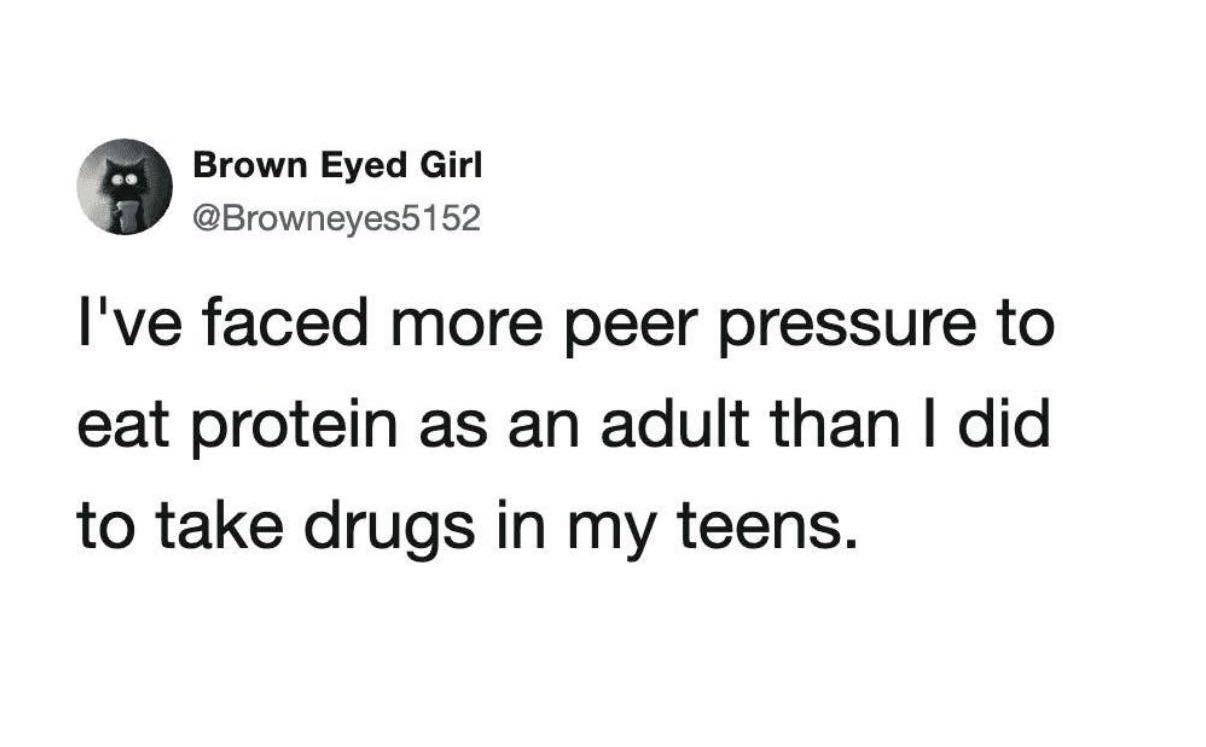
Attia is not telling you a specific diet. For instance, my husband and I eat the same diet, but he also has beer, yet his blood work always comes back fabulous, and I always get some finger wagging. And then another point that Attia makes is “One macronutrient, in particular, demands more of our attention than most people realize: not carbs, not fat, but protein becomes critically important as we age.” And I do know that protein is a big deal right now. I saw a meme recently about how much we are encouraged to intake protein:
Another thing I wanted to note about the cholesterol chapter is Attia’s point about exercise: “Exercise is by far the most potent longevity drug. No other intervention does nearly as much to prolong our lifespan and preserve our cognitive and physical function. But most people don’t do nearly enough and exercising the wrong way can do as much harm as good.” I grew up during “feel the burn” as a measurement of doing exercise right, and now I’m learning about basic exercise, like walking and biking, and doing weight-bearing activities to prevent future falls.
Attia admits, “Finally, as I learned the hard way, striving for physical health and longevity is meaningless if we ignore our emotional health. Emotional suffering can decimate out health on all fronts, and it must be addressed.” I loved that part because I started reading this book after I saw my primary care physician, and my cholesterol was a little high She literally said I need to cut out all animal products and start doing lunges. She didn’t ask me a single thing about my anxiety despite the fact that I filled out the form that you get at your annual physical about your mental health. I take anti-anxiety anxiety medications. She didn’t ask about those. Attia knows firsthand what happens when you ignore your emotional health. Proud of working for over twenty-four hours during his residency, the author learned about burning out quickly.
The reason Attia discusses longevity is because studies show we’ve actually improved very little since 1900 in terms of mortality rates if you remove the top eight contagious/infectious diseases. People, he argues, want to take a shortcut by saying “eat this, not that” (like the book series). If you’re curious and you want to know more, please make sure you get the book.
I also love the fact that Dr. Attia says he does advise getting off necessary medication: “…one thing that I will say is that I do not shy away from pharmaceutical drugs because they are not ‘natural.’ I consider many drugs and supplements, including lipid-lowering medications, to be essential items in our longevity tool kit, and I hope that in the not-too-distant future, we will have many even more effective tools at our disposal.” Right now, Americans love to buy crap online that is not FDA (Federal Drug Administration) approved, especially people are taking a lot of GLP-1 medications that haven’t been vetted by any medical professionals. However, medications that are safe and doctor-prescribed are a tool.
I know I’m dragging this out just a tiny bit, but I really just want this book to get into your hands. Attia explores problems with BMI as a health indicator:”…not everyone who is obese is metabolically unhealthy, and no everyone who is metabolically unhealthy is obese.” So in terms of metabolic health, there are five different criteria to have what is known as metabolic disease or metabolic syndrome. There are thin people who meet those criteria, and then there are fat people who don’t.
I have so much that I could go over that fascinated me, but I’ll stop. The real goal is that you stay healthy and then you have a dip in health and rapidly die whereas right now, the common pattern, at least in the US, is you are healthy and then you decline steadily for ten years during which an individual can’t do the things they used to enjoy and then they die. Get yourself a copy of Dr. Peter Attia’s book, Outlive: The Science and Art of Longevity.


I haven’t read the book but I’ve read numerous articles about Attia’s friendship with Jeffrey Epstein.
LikeLike
Oh, lordy, you are 100% right. 😑 Thank you for informing me.
LikeLike
While I was listening to your review, I kept thinking, why do I know that doctor’s name and why is he problematic? And then I read the first comment above and was like Oh yeah, that’s right. But from what you’ve said, he does make some good points.
LikeLike
Also, in my Jetpack app I can see the comments in the Reader without having to go to View in browser. So it was just on desktop where I had to view your blog outside of the Reader to see comments.
LikeLike
Thanks for letting me know 🙂
LikeLike
Yeeeeah, I’m now aware that I was reading the work of a potential pedophile.
LikeLike
Ok, I was initially surprised to see you review this book because he is controversial and not known to be a good person BUT I can also see how interesting this book would be. I do think the model of “health” that many of us grew up with needs to change and as I am now in my 40s, I spend a lot more time thinking about how the choices I’m making now will affect what I can do with my body later. So I’m interested in the book but I probably won’t read it because I don’t want to support Attia in any way. I wonder if there’s another similar author out there…
LikeLike
My nutritionist recommended it to me last year, so I didn’t know anything about the author before I read it, nor did she. Oddly, I didn’t hear anything about him in the news, either!
LikeLiked by 1 person
I only know it because it’s come up at the bookstore. His book was really popular for a while.
LikeLiked by 1 person
I had never heard of this author before so I’m not going to comment on the controversy about him. I have to say though that this his argument about mortality is an absurd one:
“we’ve actually improved very little since 1900 in terms of mortality rates if you remove the top eight contagious/infectious diseases“
I get the wider point (about trying to live a life that will allow for more healthy years), but if one of my students based an argument on a stat that required them to exclude the eight biggest contributing factors, I would not be very impressed. Frustrating that it’s made it into a published health book!
Out of curiosity, does he talk about the relationship between physical and emotional health (e.g. that is more difficult to maintain physical health if emotional health is poor, and vice versa)? Or is it more that he’s acknowledging that both are important, but not treating them holistically?
LikeLike
I should say that my complaint about the stats is about the author’s use of them, not about the review! The type of thing an editor should have caught…
LikeLike
Oh! I completely understood you. 🙂
LikeLike
I always love when you comment on my posts that have anything to do with medical health. I look forward to it! As for his point about not really improving mortality rates, I think he basically meant that we still haven’t cured cancer or dementia, though I don’t think it’s fair to say we haven’t made improvements in diabetic care. Anyway, knowing that this author is so controversial and potentially a pedophile makes me not trust anything that he has said. At this point, I can no longer remember specifically what he said about emotional health, but I do believe the point was about being holistic. Basically, if your emotional health is not good, the rest of your health isn’t good, either.
LikeLike
I’m glad you found some helpful information in this. Its good to hear that it brings up how mental health can play a role too as that can definitely get pushed aside by a lot of people. As can pain thinking about it. I think if something can’t be seen its very often dismissed. I wouldn’t have recognised the authors name like those in the previous comments. I’m not sure if thats a sign of me not reading enough news articles or if its being on the other side of the world.
LikeLike
I’m really surprised because when I googled him, he was let go as a contributor of CBS News, and I watched CBS News! I’ve had his name in my head for about a year, which is when the nutritionist recommended his work to me, long before he was outed as a friend of Jeffrey Epstein, so I’m really surprised I didn’t hear anything about this. I’m very glad that other readers brought it to my attention.
LikeLiked by 1 person
I liked the central point of your review – picking out pointers that might help us all – that was an interesting way to approach it.
I understand about exercise, it’s the doing it I have trouble with.
LikeLike
I always remember that you were quite the swimmer. Is there anything that you like to do when you’re working in your truck? Do you ever get out and walk around or make a pit stop near some hiking trails or something, or is that just totally unreasonable for a trucker and his schedule?
LikeLike
I was wondering why the author’s name was so familiar but couldn’t figure out why, so I am glad someone commented on that! The fact that he is an odious human being is unfortunate because he seems to have a mostly sensible approach to health. Though I feel like focusing on longevity is a problem that can turned into a personal fault. Because a person can do everything “right” and still get cancer or have a heart attack or other major health issue and not be privileged to live a long life so it can be turned to say they must have done something wrong. Does that make sense?
Still, it’s a good point, “the common pattern, at least in the US, is you are healthy and then you decline steadily for ten years during which an individual can’t do the things they used to enjoy and then they die.” This describes my mom almost perfectly. Sadly she ascribed her declining health over the years to “getting old” and made no intervention efforts since you can’t change getting old.
LikeLike
I think it’s kinda rotten that I’m expected to WANT to live until I’m 80 or 90. I remember my own great-grandmother finding her 80s quite a bummer because all her friends were dying. I’ve had some family members live so long that their children died of old age before they did.
LikeLike
I’ve been curious about this book! Glad you found it helpful, I may listen to it on audio. I LOL’d about that meme on protein, it’s so true. I just saw my grocery store selling protein muffins, which feels a bit weird. I’m just trying to eat more eggs haha
LikeLike
I ate more eggs and then my doctor chewed me out about cholesterol. Then again, she wanted me to go vegan, so what does she know.
LikeLiked by 1 person
Go vegan? Oh lordy who has time for that
LikeLike
🤣🤣🤣 I’m laughing so hard because I never thought of it as a time issue. It’s more of a how to navigate life issue. How the hell do you avoid animal products entirely?? I know people do, and I admire that they are able to be so involved with their food consumption.
LikeLike
Those were good points, and I agree with you about relatable authors. I’ve heard about this book, and it sounds interesting. I take Lipitor for high cholesterol, but otherwise, I try to eat healthy and exercise regularly. What you mentioned about mental health is also important.
LikeLike
My cholesterol was a bit high at my last appointment, and my doctor went nuclear. She suggested I become a vegan (she’s a vegan). Then she scrolled through my file and said, “I can find SOME good news….” Like, just tie me to a tree and shoot me already.
LikeLiked by 1 person
Wow, you probably need to find a new doctor. Mine told me to work on my diet, but after a year, he said I should start taking medication because my cholesterol was still pretty high. Sometimes, diet alone isn’t enough.
LikeLike
Yep, I fired her that day. She also looked at my blood work and said, “Why is your iron low??” Lady, you went to med school. You tell me.
LikeLiked by 1 person
Again, wow! Good for you! You definitely needed a better doctor.
LikeLiked by 1 person