To see my post as text, scroll down.
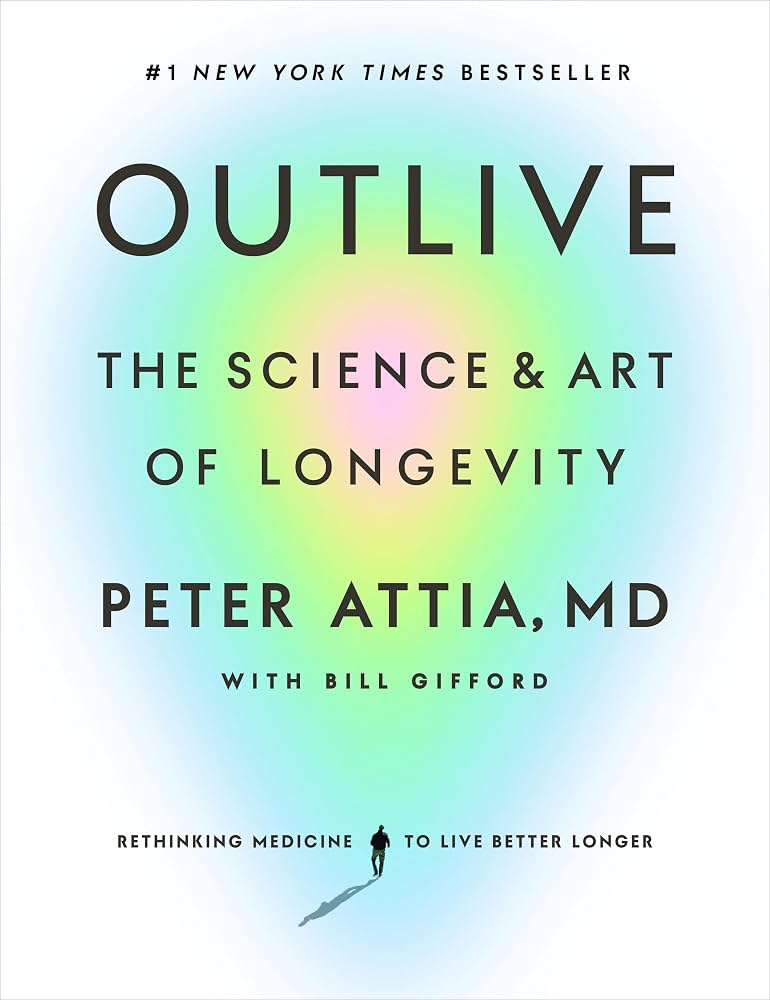
Hi, everybody. I just finished work. If you’re new here, I’m a sign language interpreter that mainly interprets phone calls. So if somebody’s calling the kind of place that has long hold times often, like a pharmacy, I’ll look at my second monitor and read. Recently, I started reading a book recommended by my nutritionist, a very kind nutritionist. She’s never like one of those people who food shame or tell you that there are forbidden foods or things like that. It’s more about being empowered to know how food affects you and not living to be thin, but for longevity. She recommended a book called Outlive: The Science and Art of Longevity by Peter Attia, MD. I didn’t finish the book because there are four sections covering metabolic disease, cholesterol, cancer, and dementia. I wasn’t quite as concerned about cancer and dementia as I was the chapter on heart disease and high blood sugar.
Those are issues that affect people my age, so I’m not really reviewing the book so much as I wanted to tell you interesting things that I learned because perhaps you will want to read more yourself. For example, Dr. Peter Attia discussed type 2 diabetes:
The standard-of-care treatment guidelines of the American Diabetes Association specify that a patient can be diagnosed with diabetes mellitus when they return a hemoglobin A1c (HbA1c) test result of 6.5 percent or higher, corresponding to an average blood glucose level of 140 mg/dL.
I don’t know what DL stands for, but basically the diagnosis of type 2 diabetes calculates your resting blood sugar and your three month blood sugar test. Are they both elevated? That’s how you get diagnosed with diabetes. Attia explains how those guidelines don’t really benefit you medically because crossing over 6.5 doesn’t mean one minute you weren’t diabetic, and now you are. How does a patient today tackle type 2 diabetes?
…the standard-of-care guidelines recommend mild amounts of exercise, vaguely defined dietary changes, possible use of a glucose control medication called metformin, and “annual monitoring” — basically, to wait and see if the patient actually develops diabetes before treating it as an urgent problem.
Really, the crux of Outlive is about you don’t wait until something is an issue. Attia calls that medicine 2.0 and wants us to move toward a medicine 3.0 — addressing things long before they become an issue.
Attia isn’t just finger pointing and fear mongering. He is highly relatable. In the chapter on diabetes, he shares, “On September 8th, 2009, a day I will never forget, I was standing on a beach on Catalina Island when my wife, Jill, turned to me and said, ‘Peter, I think you should work on being a little less not thin.'” Attia notes he was 210 lbs. and had a “dadbod” before he even hit 40. I really get irritated when I see somebody who’s obviously been fit their entire lives and their advices is “why don’t you just try harder? You lack motivation.”
In the next chapter Attia discusses cholesterol, which I really appreciate. Um, and a couple of points that I did want to share with you that maybe will encourage you to read the book:
Almost all “diets” are similar: they may help some people but prove useless for most. Instead of arguing about diets, we will focus on nutritional biochemistry — how the combinations of nutrients that you eat affect your own metabolism and physiology, and how to use data and technology to come up with the best eating pattern for you.
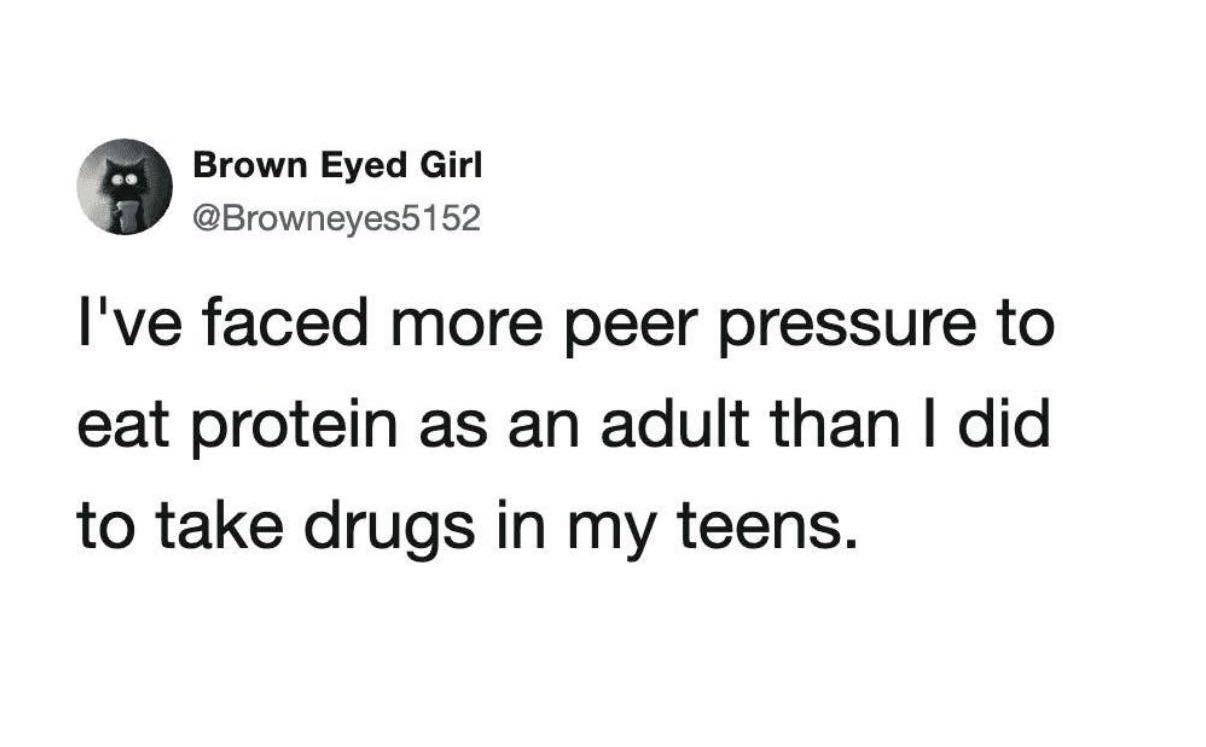
Attia is not telling you a specific diet. For instance, my husband and I eat the same diet, but he also has beer, yet his blood work always comes back fabulous, and I always get some finger wagging. And then another point that Attia makes is “One macronutrient, in particular, demands more of our attention than most people realize: not carbs, not fat, but protein becomes critically important as we age.” And I do know that protein is a big deal right now. I saw a meme recently about how much we are encouraged to intake protein:
Another thing I wanted to note about the cholesterol chapter is Attia’s point about exercise: “Exercise is by far the most potent longevity drug. No other intervention does nearly as much to prolong our lifespan and preserve our cognitive and physical function. But most people don’t do nearly enough and exercising the wrong way can do as much harm as good.” I grew up during “feel the burn” as a measurement of doing exercise right, and now I’m learning about basic exercise, like walking and biking, and doing weight-bearing activities to prevent future falls.
Attia admits, “Finally, as I learned the hard way, striving for physical health and longevity is meaningless if we ignore our emotional health. Emotional suffering can decimate out health on all fronts, and it must be addressed.” I loved that part because I started reading this book after I saw my primary care physician, and my cholesterol was a little high She literally said I need to cut out all animal products and start doing lunges. She didn’t ask me a single thing about my anxiety despite the fact that I filled out the form that you get at your annual physical about your mental health. I take anti-anxiety anxiety medications. She didn’t ask about those. Attia knows firsthand what happens when you ignore your emotional health. Proud of working for over twenty-four hours during his residency, the author learned about burning out quickly.
The reason Attia discusses longevity is because studies show we’ve actually improved very little since 1900 in terms of mortality rates if you remove the top eight contagious/infectious diseases. People, he argues, want to take a shortcut by saying “eat this, not that” (like the book series). If you’re curious and you want to know more, please make sure you get the book.
I also love the fact that Dr. Attia says he does advise getting off necessary medication: “…one thing that I will say is that I do not shy away from pharmaceutical drugs because they are not ‘natural.’ I consider many drugs and supplements, including lipid-lowering medications, to be essential items in our longevity tool kit, and I hope that in the not-too-distant future, we will have many even more effective tools at our disposal.” Right now, Americans love to buy crap online that is not FDA (Federal Drug Administration) approved, especially people are taking a lot of GLP-1 medications that haven’t been vetted by any medical professionals. However, medications that are safe and doctor-prescribed are a tool.
I know I’m dragging this out just a tiny bit, but I really just want this book to get into your hands. Attia explores problems with BMI as a health indicator:”…not everyone who is obese is metabolically unhealthy, and no everyone who is metabolically unhealthy is obese.” So in terms of metabolic health, there are five different criteria to have what is known as metabolic disease or metabolic syndrome. There are thin people who meet those criteria, and then there are fat people who don’t.
I have so much that I could go over that fascinated me, but I’ll stop. The real goal is that you stay healthy and then you have a dip in health and rapidly die whereas right now, the common pattern, at least in the US, is you are healthy and then you decline steadily for ten years during which an individual can’t do the things they used to enjoy and then they die. Get yourself a copy of Dr. Peter Attia’s book, Outlive: The Science and Art of Longevity.