
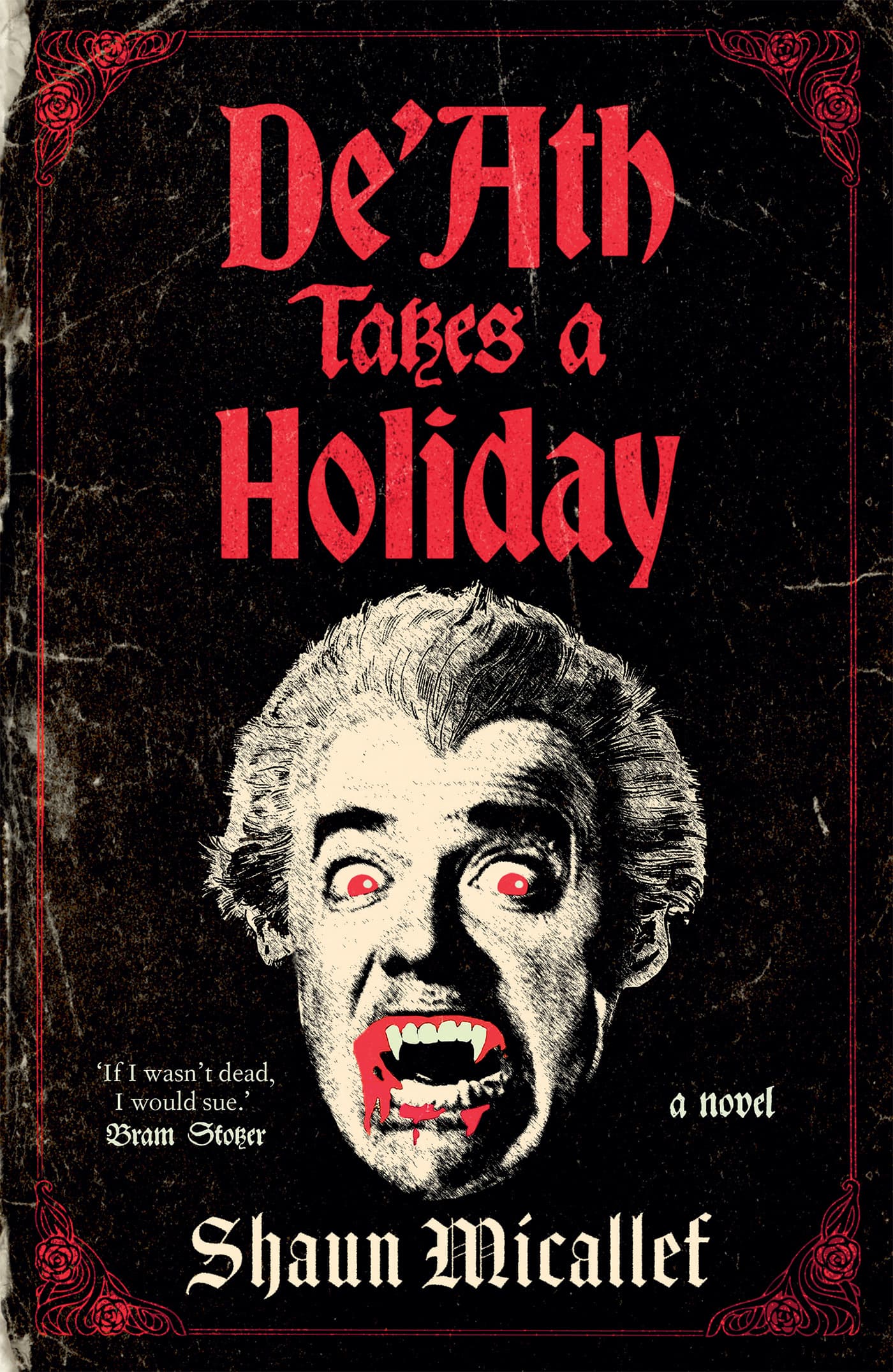
Sue over at Whispering Gums wrote on her blog about the new novel De’Ath Takes a Holiday by Australian writer Shaun Micallef. For many of us horror fans, the other side of the coin is humor, so I was excited to see a spoof on Dracula and asked Sue if she would like to read Micallef’s novel at the same time, email each other questions, and then post our responses. Here is the synopsis of the novel from the publishers website:
The trouble with immortality is that eventually you get sick to death of it, and so to soothe his sickened soul, the Comte De’Ath decides to take a trip. From psychoanalysis in Vienna to blood transfusions in London, the Comte learns that a holiday is as good as a change. On the way, he meets the Queen, brings her husband back to life, helps win the Second Matabele War, matches wits with the Elephant Man, inspires Henry Ford to pursue the American Dream, almost solves the crisis in the Middle East and even falls in love. Will he become mortal again in time for his funeral in Carfax Abbey? Ah – but what a fine book this would be if we gave away the end of the story in the blurb.
The following are questions Sue sent to me:
Sue: The book feels very much in Micallef’s voice, but if you are not Australian you would not know his voice. How did you find the voice?
Melanie: Well, let’s be honest. Every person from the US over a certain age only hears three Australian voices in their heads: Mick Dundee from Crocodile Dundee, Steve Irwin, or Nicole Kidman as she tells us how great AMC cinemas are right before the movie starts on the big screen (because “heartbreak feels good in a place like this.”). De’Ath Takes a Holiday was also my first Micallef book. Thus, the concept of the author’s voice is lost on me. If anything, I found it right up there in “silly British” territory.
Sue: The title and cover suggest horror though perhaps the Bram Stoker blurb hints of something else? Was the book what you expected?
Melanie: I was expecting we would get a silly retelling of Dracula, complete with brides and Jonathan Harper, and the poor, poor Mina. I thought it would all be funny and right in line with Dracula Dead and Loving It from 1995 with Leslie Nielsen and Mel Brooks.
Sue: Micallef alludes to many writers, historical figures, events. Did you feel that you had picked them all up and knew them? Did it bother you that you may not have? And, did you worry about whether he had played with the facts when referring to them?
Melanie: Well, I got lots of them, but they didn’t seem to stop coming, did they? After a while, it was like when you see one of those videos of a toddler picking up an easter egg to put in their basket, but bending over causes a different egg to fall out, so the poor tot is stuck there picking up the same two eggs over and over and over. Really, I felt like Micallef was going in circles by moving forward with new literary figures and unclear connections to what had just come beforehand.
Sue: Did the book make you laugh? Or cry? Or squirm?
Melanie: The book made me bored 😬 I didn’t finish it for that reason. I did get through about 50%. I also feel really icky about the vampire going on so much about how he owns black slaves that he’s turned into zombies for his plantation. I mean, did Micallef think that was funny, or was he aware of how gross that who plotline was? Our Jonathan Harker-type character finishes eating at the Count’s places and hears “the zombies in the fields singing their zombie work songs,” to which the Count replies, “…children of the night. What music they make!” This is a quote from Dracula (the children of the night part), but the slave songs is a references to, you know, enslaved people in the U.S. singing about their pain and sorrows. I don’t appreciate Micallef making it funny.
Sue: While author’s intentions are not always the most important point, they are still interesting to consider. Why do you think Micallef wrote this?
Melanie: I had that same question myself. I got the vibe that this person is used to being famous for his silliness — that classic British silliness that I do not get on with — and assumed that if he wrote hundreds of pages of spoofs, his readers would be rolling in their seats, holding their sides, tears of laughter streaming down their faces. Honestly, if Micallef had written a series of short stories spoofing on different literary characters, I might have gotten on with the story, but he was so intent on making them all connect in one narrative.
Sue: How would you — or would you — encourage someone who is not interested in vampires to read this book?
Melanie: It’s always interesting to read a new take on the zombie genre, but I don’t recommend De’Ath Takes a Holiday. If you want something funny with vampires, try Bloodsucking Fiends: A Love Story by Christopher Moore. If you want something unique, try The Gilda Stories by Jewell Gomez. Something more modern? So Thirsty by Rachel Harrison. I’m curious now about Dead Red Heart edited by Russell B. Farr. Ticonderoga, which is a collection of Australian vampire stories.


I read Sue’s review first. It’s surprising really how different your responses are. And I agree with you mostly. You’re quite right that Australian humour, especially for educated and older people, is much more British than it is American. Mind you, Crocodile Dundee from here is far more American than it is British. And I find it interesting that the other two best known Australians are Steve Irwin and Nicole Kidman. Could be worse I suppose.
Your take on zombie/slaves seems right on. Whatever Micallef’s intentions – and I’m sure he’s “liberal” by any definition – I’d say he got that wrong.
LikeLike
Yeah, Crocodile Dundee was a huge hit in the US in the 80s, I believe. I think the only other famous Australians I know are Keith Urban and Chris Hemsworth. So, no, everyone actually seems quite lovely by those standards.
As for the slave songs….yeah, I just don’t know how Micallef thought slaves songs were ripe for a joke. There is a whole section about why zombie slaves are better than making more vampires to work, etc. Other than that rather dark section that I did not find funny, the novel felt frantic.
LikeLike
Oh, I like the way you’ve set this out Melanie, with our names agains the questions and responses. Looks like we posted our responses pretty much simultaneously as I checked your blog just before I scheduled mine, and yours wasn’t there! I rather like that we’ve posted together.
Now, I must say that as I started reading this I thought, oh no, Melanie is not going to like this. It’s not at all, I think, what she expected, so I am not surprised you didn’t finish it and wouldn’t recommend it. However, I thoroughly enjoyed your responses, and I like your description that you ‘found it right up there in “silly British” territory’. I wouldn’t say I loved the read but I do like satire, so things like the zombies/slaves/exploited people work for me. I liked that far more than the silly comic aspects of the book.
LikeLike
I think that this book would appeal to anyone who loves Monty Python.
LikeLike
The would certainly be a target audience, I agree.
LikeLike
I was going to ask you if this is a Monty Python sort of book! 😀
LikeLiked by 2 people
I meant to comment on your comment that “I don’t appreciate Micallef making it funny”. This is the crux of black humour isn’t it? I have discussions with Son Gums, about this, because he can go further down that path than I can. Consequently, I completely understand why it doesn’t work for some.
LikeLiked by 1 person
I really enjoyed reading WG’s and your posts on the book and the different questions you asked each other and your different approaches and responses. I laughed at your Australian voice comment. I have been debating whether James would like this and I had decided no until you mentioned Monty Python, who he loves (I like them very much too, but only in small doses). So I’m going to tell him about the book. He will probably tell me he already knows about it, but maybe he will be surprised 🙂
LikeLike
I think he might be surprised because it’s brand new and out of Australia. I only knew of it because WG saw him talk at a literary event in Australia.
LikeLiked by 1 person
I told James about the book and he has not heard of it though he knows of the author. And he thought the book sounds like fun 🙂
LikeLiked by 1 person
I’m chuffed, as they like to say 😁
LikeLiked by 2 people
I know I’ve said this before when you review humerous horror novels, but I’m getting a real Grady Hendrix vibe here. Maybe it’s because I don’t tend to read horror/humour often, but that’s all I really have to compare it to!
LikeLike
I’ve only enjoyed one Grady Hendrix book 😬😬😬 I wish I enjoyed more of his work, and I’m appreciative of the spotlight he put on mass market horror paperbacks, but his stories, ehhh…
LikeLiked by 1 person
Ah yes ok I remember you saying that. In fairness I think I’ve only read like…two of his books maybe? So I’m not exactly a superfan. Not quite in the same vein, but I do really like Stephen Graham Jones too
LikeLiked by 1 person
And Stephen Graham Jones is the other one that I don’t get on with 😅 I just don’t know what he’s talking about, ever!
LikeLiked by 1 person
Yah that’s a fair criticism too! I thought you liked him though? Am I getting you mixed up with another blogger maybe? So weird…
LikeLike
Definitely mixing me up with another blogger. I’ve met him, and he’s lovely, but yeah, I just don’t get why he has an amazing idea for a story and then makes it as difficult as possible to read.
LikeLiked by 1 person
I feel like there’s lots of opportunity for humour in a vampire story because they are sort of mysterious and dramatic. Too bad this didn’t get there. The slave thing likely would have bothered me too. I wonder if the author being Australian makes him less aware/sensitive to using slavery as a subject of humour? Not to say Australians are ignorant about slavery but I think in N America we’re very sensitive to how those types of stories are told and I don’t know if that’s an international thing.
LikeLike
Dracula, Dead and Loving it is a really funny Mel Brooks movie, so you’re right about humor being right there for the picking.
LikeLiked by 1 person
I think there is a point about Americans having a particular sensitivity because of your particular experience of slavery, But I can’t help thinking there is also something cultural about humour. I think Australians and, particularly Irish (perhaps more than British) have quite a black sense of humour. I don’t think it means insensitivity but a belief that black humour can sometimes make points that other tones can’t, because it shocks you. There’s a fine line though between effective/clever and bad taste, and sometimes that line is down to the eye of the beholder.
LikeLiked by 1 person
I just heard an author talking about the use of dark humour to deal with difficult subjects, and comparing that to people who work in hard circumstances, like ER nurses who use humour to cope with the tragedy they deal with. I’m Canadian and our national sense of humour often seems to fall somewhere between that of the UK and the US.
LikeLiked by 1 person
Oh yes Karissa, thanks for sharing that. I have heard that too, that people who work with trauma do use dark humour a lot to cope. And they are clearly compassionate people. Do you remember which author? I guess a Canadian one.
LikeLiked by 2 people
The author was Charles Demers. He’s a Vancouver-based comedian and writer.
LikeLiked by 1 person
Ah thanks Karissa.
LikeLiked by 2 people