
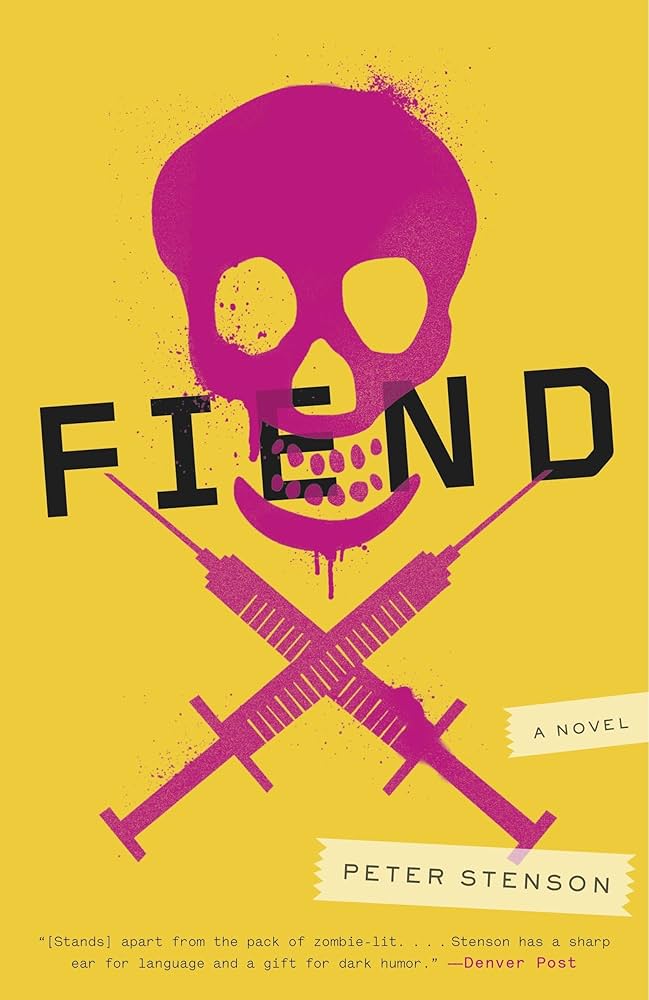
Peter Stenson is the author of We, Adults; The Sexual Lives of Suburbanites; Thirty Seven; and Fiend. I’ve asked Stenson a variety of questions, but my main focus is his debut, Fiend, which my Spooky Book Club read this summer and loved (with the exception of Carla–sorry, Carla). For a refresher, check out my review to reacquaint yourself with Stenson’s zombies and meth heads.
Grab the Lapels: Welcome! It’s been thirteen years since Fiend came out, and it’s still finding readers. Honestly, I found your novel when I was Googling “best zombie books” and found Fiend listed in a Reddit thread, like ya do. I do find it funny that the book I reviewed on Grab the Lapels before Fiend was Pride and Prejudice, and the book I reviewed right after was Paula Spencer by Roddy Doyle. Over the years, have you noticed a trend in who the hell is reading your anti-hero zombie book?
Peter Stenson: I try my best not to Google my books or myself, so I’m not sure who, if anyone, is reading them. I’m too insecure for all of that. I fell victim to that when Fiend first came out. Ugh. Like a lot of writers, I’m an egomaniac with an inferiority complex, so keeping tabs on sales and chatter isn’t all that productive.
With that said, I receive the occasional message from people who’ve stumbled across the novel. They usually mention they discovered it on Reddit. If there’s any commonality among the people who like the novel, it’s that they’re a little unhinged (as am I, obviously).
GTL: Our book club discussion was awesome, and one newbie mentioned that she was so into Fiend that she talked about it during a therapy session. Her conclusion was that Fiend humanized people with addiction problems. Was that something you aimed to do with Chase, Typewriter, and KK?
Peter Stenson: Yes, that was a big part of what I wanted to accomplish with this novel. Humanize addicts by dehumanizing the masses. However, I didn’t want to create some kumbaya-type depiction of addicts in the throes of active addiction, as these tend not to be the best of people (at least not making the choices they would otherwise be making). I’ve been there. A lot of my friends have been there. It was important to me to capture this duality of best intention and selfish action.
The premise of the world—the only people immune to zombieism are meth addicts—is something I’ve thought about over the years. Guilt was a HUGE part of my addiction story in my teens, so, to remove that constraint intrigued me. And not to spoil anything, but the characters in the Fiend discover the answer to that what if? scenario, which isn’t great.
GTL: One of the most memorable parts of Fiend for me, and I know this is weird, is when the whole group goes skinny dipping, and Chase notices that KK has no pubic hair. Near the end of the novel, when they are intimate, he mentally comments that she now has stubble. No one has wing-tipped eyeliner in this story, that’s for sure. Tell me more about your choice of when and why you add in details that are so normal to humans but that other authors skip altogether?
Peter Stenson: Lol. I don’t know. Part of this is probably due to me being weird. A large part.
But it’s also what I’m drawn to. That messy, gritty, unsexy part of being human. The beauty of things even though we’re bags of meat. I like exploring the things we keep hidden (feelings, thoughts, motivations, and yes, anything of the body). To me, any sort of thorough examination of a character’s experience—especially these characters in Fiend—is inauthentic without these details.
But maybe I’m wrong.
I used to have a bit where I would say something slightly off-the-wall, usually an observation of some sort, followed by saying, “We were all thinking it.”
It turns out no, nobody was thinking anything remotely close.
It could go back to how I started this response; maybe I’m slightly weird.
But even saying that, I still think it’s kind of bullshit. I suspect a lot of us are too [insert any restrictive adjective here] to comment upon the things we notice or think.
GTL: After we learn that the only people who didn’t wake up zombies one day are those who used meth, people who can make meth become valuable. Was there any dream to write a sequel in which these powerful characters become the elite class, or something like that? I don’t mean drag it out like The Walking Dead, but how the economy of drug creation and distribution would change the future for these characters?
Peter Stenson: Yes and no. No in the sense that I felt like I wrote these characters’ complete arcs, even if it’s not a traditional ending. This novel came out fast once I started. A matter of weeks for a first draft. And afterwards, I wasn’t all that keen on getting back into their heads. That’s true of pretty much everything I write. I want to move on. The generative process is the closest I’ve come to experiencing the sublime. The aftermath? Everything revolving revision, submitting, press, promotion? Kill me. So, once that process happens, the characters kind of become tainted for me. There are a million other voices in my head. I try to juggle reader’s thoughts, criticisms, and expectations while generating new material, which, at least for me, is a surefire way to write shit.
But also yes to your question, especially as of recently when a production company has been trying to turn Fiend into a series. I can imagine a slew of directions this narrative could extend (assuming the novel was the first season). But this also feels a little different, as it’d be a different medium.
GTL: After Fiend, you published three more novels. Has your writing “grown up” with you as you’ve aged, or are you still punk as fuck but maybe have a dedicated pill case on your nightstand now, like the rest of us?
Peter Stenson: hahaha. They don’t make pill cases large enough for what I have to swallow each morning. That’s more of a “drawer” scenario.
Nobody in middle-age (I’m 43) likes to admit they’re no longer the rebellious person they once were (I think I was 28 when I wrote Fiend, and a stunted 28 at that), but it’s probably happened. I’m old. I’ve been happily married for 17 years (maybe 18, I should probably figure that out). I have three kids. I live in suburban Denver. I wear a CPAP machine for fuck’s sake. There’s been some “growing up,” for sure.
But not all that much, at least with how I think about the world and its silly little inhabitants. And definitely not with my obsessions. And I guess not with my views on traditional publishing and its aversion to the ugly and obscene. I’m drawn to broken people doing the best they can. The specifics—genre, level of gratuitousness, premise—all change, but not the beating heart. And to me, there’s little more punk rock than a person’s desperate attempts to wrestle away enough esteem from the world to keep on living for another day.
GTL: After visiting your website, I’m guessing Fiend holds a special place in your writing journey? While it is the oldest book you’ve published, it’s still the “logo” of your home page.
Peter Stenson: Yes, without a doubt. It was my debut. It was a version of the addiction story I lived in my teens and wanted to share. And it was a little validation that what I was doing had a modicum of value.
GTL: I see you have a novel called Thirty-Seven. Is that a Clerks reference, or am I way off?
Peter Stenson: Lol. No. Although I love that movie! It was just the first number that came to mind. It’s a banger of a novel (my favorite of mine), and somehow a different level of dark than Fiend…yikes!


That book was a ride. It started a bit sideways and you just had to hold on and go. With the right crew, it would make a great 1 season show. The beats for the episodes are already in the book with a good mix of funny, gross, and zombie action. Nothing wrecks a good apocalypse like dead who keep on walking forever. Maybe it works out if you pit runners against tweakers. 🤔
LikeLiked by 1 person
I love limited series. Back when we paid for streaming, those were my jam. I like knowing a show won’t drag out from the onset. One thing I like about Dawn of the Dead from Snyder is that the makeup intentionally gets grungier as the movie goes on because these are reanimated corpses; they’re still rotting. In The Walking Dead, I guess they could make the argument that new zombies crop up, but ehhhhh…..
LikeLiked by 1 person
I can tell by this author’s responses to your questions that he’s hilarious. If he’s this funny in interviews, he’s gotta be a great writer! Honestly just reading his responses made me think I should read his book, because I just love his vibe.
LikeLiked by 2 people
I really loved Fiend. I would just die of happiness if you read it, too! One of the people in my book club is actually a pharmacist, and she kept commenting on how there was a scene in the novel that was set in a pharmacy, and she swore up and down that the author had to have been a pharmacist himself, because it was described so well. I sent him an email asking if he’d worked in a pharmacy because she wouldn’t stop talking about it, and he wrote back that he has never been a pharmacist, that he spends a lot of time standing in pharmacies waiting for his medications. I about died when he said he has a CPAP machine now 🤣
LikeLiked by 2 people
the CPAP machine thing was definitely priceless
LikeLiked by 2 people
I love the bit about “we were all thinking it.” It reminds me of being a teenager and doing stuff like walking into the Dairy Queen and shouting “DON’T DO ANYTHING TO BE CONSPICUOUS!”
LikeLiked by 1 person
🤣🤣🤣 like, doing that just to get everyone’s attention and then not being silly? This is probably back when everyone was more chill in general.
LikeLiked by 2 people
Oh yeah. It was 1978.
LikeLiked by 2 people
This was a very good interview! I know if I was a published author I would *never* Google myself or reviews. I couldn’t handle it.
LikeLiked by 1 person
Stephen Graham Jones wrote on his website that you never read the reviews the same way you never look back after you make something explode (he means in an action film when the hero walks away from a huge blast and doesn’t turn around).
LikeLiked by 2 people
These are great questions and great answers Melanie. Again, not a book I’m likely to read but reading this interview was so enjoyable.
I liked his answer to your question about writing more books on those characters. “No in the sense that I felt like I wrote these characters’ complete arcs, even if it’s not a traditional ending. This novel came out fast once I started. … And afterwards, I wasn’t all that keen on getting back into their heads. That’s true of pretty much everything I write. I want to move on.” I understand this. As a reader, I don’t necessarily want to read more about certain characters but prefer to move on.
Recently I heard a discussion with an actor who also did audiobooks. But when she wrote her own novel she did not voice the audiobook. She said by the time it got to producing the audiobook she was sick of the book she couldn’t face spending any more time with those characters. I understood that, even though an author with a good voice can really add to their book when they read it themselves.
LikeLiked by 1 person