
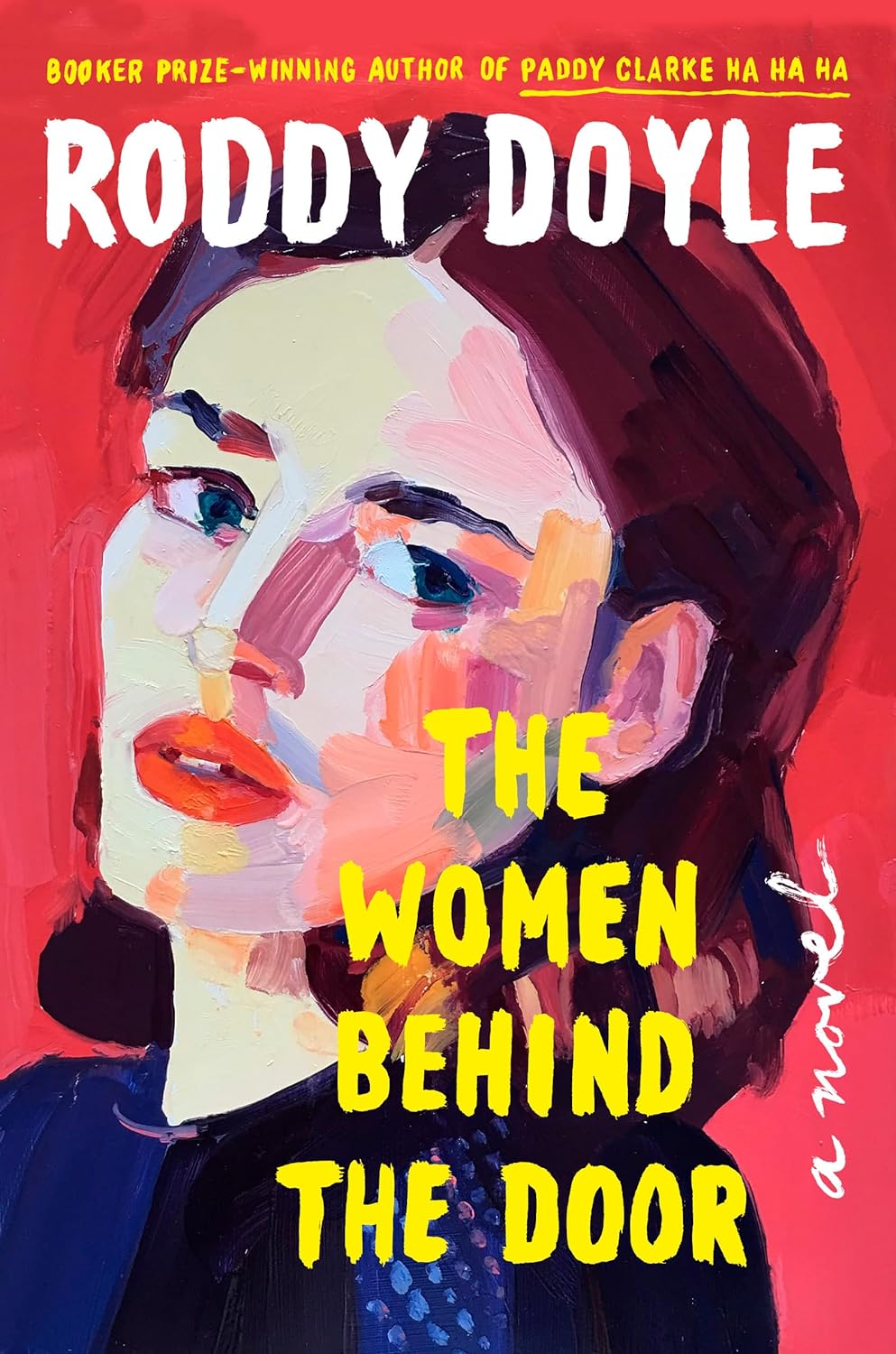
In the final book about Paula Spencer, The Woman Behind the Door by Roddy Doyle takes us another seventeen years into the future. Now, Paula’s own children are middle age. Her “baby” has moved out and become a professor in Chicago. Her middle children, both of whom had addition issues in the previous books, are leading sober lives. However, Paula’s oldest child, Nicola, the one who basically raised herself and her siblings, and has mothered Paula for the last sixty years, too, has claimed she hates her spouse and children and abandoned them, showing up at Paula’s door in the middle of the COVID pandemic.
From the very first pages, we know Paula is doing better. She has a job she likes, she lives alone and loves it, and her new best friend, Mary, keeps Paula laughing and smiling. I love that Doyle allows Paula joy after two books of struggling (in The Woman Who Walked into Doors, Paula living in a domestic violence situation and became an alcoholic; in Paula Spencer she held tight to her sobriety and repaired relationships with her children). I mentioned this before, but while I support people “staying in their own lane” when writing in an effort to hear stories from people with lived experience, I’m also not against books in which characters are well written with empathy and respect. Doyle does that with both Paula and Nicola, the main characters of this last installation.
I read the Paula Spencer trilogy with a book club, and we all agreed that it was strange Doyle chose Nicola to be the child who abandons her family. Why not continue with Leanne, whom we left a bitter, cruel alcoholic? It felt like quite a pivot. Also, just as a caution The Woman Behind the Door is set during the COVID-19 pandemic, so if you don’t want to be reminded of that time, this book is not for you. Two of my book club members were upset about the setting, though I wasn’t. It simply felt close in the review mirror, if you will. Also, the pandemic makes Doyle’s novel limited in settings, and the title phrase “behind the door” applies to Paula when she get sick and as she tries to coax her eldest child to talk to her from behind a closed bedroom door.
However, Doyle also explores the dangers of comparing suffering, what some call the “suffer olympics,” when Paula tries to say that her being beaten nearly to death for seventeen years is not the same as Nicola feeling done with her family. For instance, “—I don’t know what I feel, said Nicola. —I don’t know if I feel. I don’t know. And I don’t know why it’s all about Tony. What’s wrong with Tony, what’s right about Tony. There’s nothing wrong or right. I don’t want to be a wife. I think I know that much.”
Overall, this wasn’t quite the conclusion I wanted from Doyle, though I think it’s worth completing the trilogy to finally get Paula to a place of joy. The book is still hilarious in places, interesting, realistic, open, and heartfelt.


That does sound interesting, thank you for sharing your thoughts. I haven’t read any of Doyle’s books yet. Perhaps I will add these to my list. I’ve just started the Lord of the Rings trilogy, so perhaps I will be reading a lot of trilogies.
LikeLike
This is a great set of books, but I’ve honestly never read a bad Doyle book. He’s so good at what he does. I am biased toward his novels over his short stories, as I think he does novels better. If you want something lighter (sans domestic violence and alcoholism), check out Doyle’s other trio, the Barrytown triology.
LikeLiked by 2 people
Excellent! 🙂 Good to know. Thank you. 😀
LikeLiked by 1 person
Melanie- Nice review! Thank you for introducing me to Roddy Doyle. ~B
LikeLike
You’re welcome! I have more of his books on my TPR; he never slows down.
LikeLiked by 1 person
I felt a snort laugh coming on when I read the phrase “suffer olympics” because isn’t that the truth! For some reason comparing people’s suffering is something we can’t help but do as humans. Personally, it’s a good reminder to me to not feel too sorry for myself when things don’t seem to be going right, and I see others in a more dire situation. Mind you, there’s two sides to every coin, which I always remind myself of as well; there will always be those in a ‘better’ position than you, and always those in a ‘worse’ position than you. It’s all about attitude it seems…Doyle seems to be someone who can see that.
LikeLike
My issues is that my “coins” seem to have, oh, about fourteen different sides. I’ve learned lately that part of meditation and being calm is to think about this moment right now. Therefore, how I feel about my life is not applicable to others and what they’ve experienced because that is the past.
LikeLiked by 1 person
I feel like you’ve read these fairly quickly – commendable, because I usually take ages to read books in a series. And that’s satisfying that the main character is at a good place at the end.
LikeLike
The books are pretty heavy on dialogue, and the dialogue does not drag. However, it took me quite a while to finish the third one because my brain doesn’t want to do words right now. I’ve been doing weeks of intense training at work.
LikeLiked by 1 person
I do like a series that eventually rewards the main character readers have become fond of!
LikeLike
I do like that Paula found some semblance of contentment in her later years, but my fellow book club members felt like we didn’t really need this last book. It threw another problem into her lap, one that didn’t make sense to the three of us considering the daughter who shows up and has quit her family is the one who was rock steady in the previous two books. However, Doyle is a great writer and you can’t go wrong with his stuff.
LikeLiked by 1 person
You wrote “but while I support people “staying in their own lane” when writing in an effort to hear stories from people with lived experience, I’m also not against books in which characters are well written with empathy and respect.” Completely agree. As for Nicola, of course I haven’t read the book, but might it be that she had been the good girl, done all the right things, tried to keep things together for Paula, and suddenly felt that something was missing, that she hadn’t truly thought about her own needs?
LikeLike
That’s a great point about Nicola, one that escaped me entirely, I’m embarrassed to say.
LikeLike
Don’t be embarrassed … it’s just an idea. Hard to think of every possibility when we read I think.
LikeLiked by 1 person