
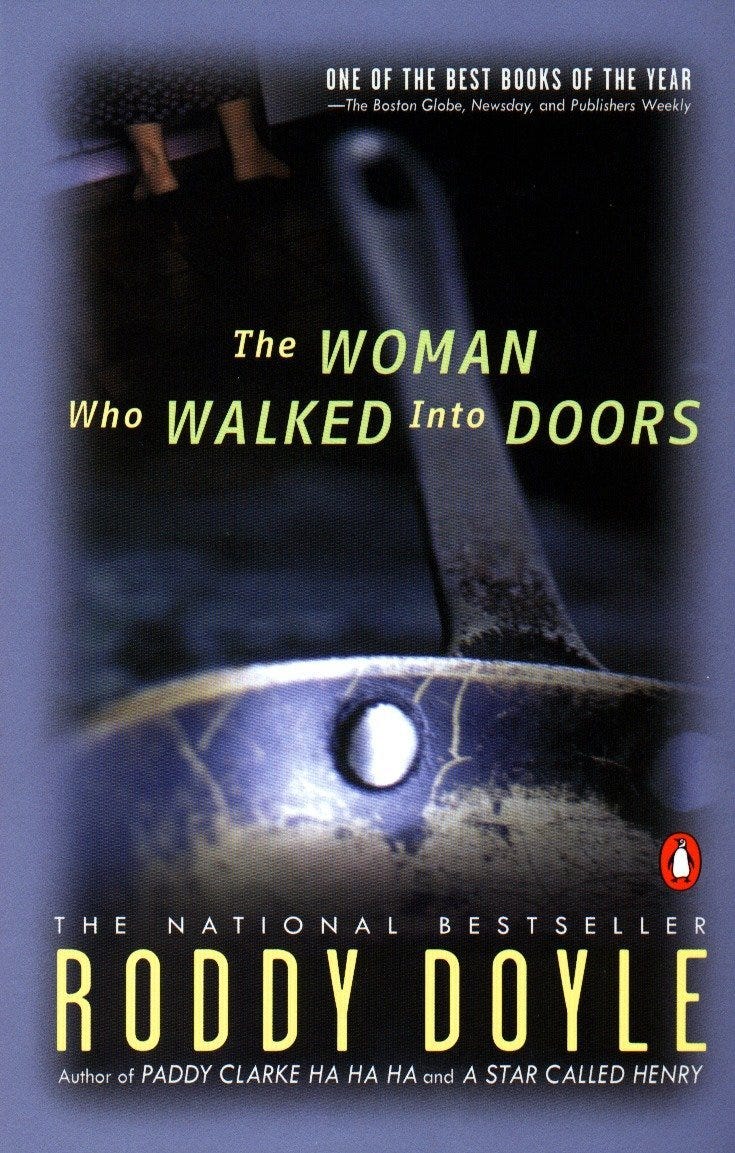
Roddy Doyle, prolific Irish author, always writes complex characters. He stuff is a lit professor’s dream (and I should know; I used this book in one of my classes). The Woman Who Walked Into Doors is narrated by Paula, a woman who, in her late 30s, has just found out that her husband, Charlo, is dead. She unravels what happened as the book goes on, but not in that way that Ruth Ware and her cohort do. The point is not to keep a mystery from you. Instead, doling out information is a reflection of the abuse Paula has suffered at the hands of Charlo, of seventeen years of reporting to the hospital (again) that she has clumsily walked into the door (again).
According to the book Just Mercy by Bryan Stevenson, repeated abuse can lead to brain damage. Not only traumatic brain injury from physical impact, but actual deterioration of brain mass. As a result, people who are victims of domestic violence, like Paula, often appear much older and are slow to react and think. Paula explains she’s missing teeth, has had her hair pulled out, and she a Charlo had four children. There’s no food, Charlo has lost his job, and the abuse continues, though it started long before the men of Ireland were largely unemployed in the 1980s.
The Woman Who Walked Into Doors is told in a zigzag fashion, not linearly, reflecting domestic violence victims and the way in which they tell stories about themselves. It’s not A to Z. More so, one abuse happened, Paula reflects on how she loved Charlo when they met, another abuse happens, Paula explains how it was her fault, some other abuse happens, but also so many “things” happened that they blur together.
Furthermore, Paula is compelled by alcoholism, which developed as she tried to emotionally save herself from Charlo. Although we know he’s dead and was out of the house for a year prior, the addiction is just barely manageable in the present. Years before, when Charlo took her to the hospital, doctors always said they could smell the alcohol on her. Set in the 1970s and 80s, people did not “interfere” in marriages, even medical staff. Plus, Charlo was right there. How would she survive without him? He made sure she thought she could not. I read The Woman Who Walked Into Doors for a book club with Biscuit and my cousin Jordie, and it was surprising how much we all had to say about what we’ve seen in our own lives with family members or friends. Leaving an abuser is never as easy as it seems when you’re safely outside the book, but Doyle writes so impeccably that you cannot help but think through everyone you’ve ever met and wonder.
My favorite part of The Woman Who Walked Into Doors is how Paula explains all the potential she had without knowing it. While I don’t have children, I am a firm advocate for children’s safety, development, and rights. Paula’s creativity, her interests, her intelligence — all of it is neglected over a period of time, placing her in more dangerous environments, and soon, she becomes more animal-like to survive the other children, or the teachers who touch her inappropriately in class. Doyle reminds us how precarious childhood is, how vulnerable all children are, and why we need to work within our communities to support the interests of minors.
When I first read The Woman Who Walked Into Doors in 2004, that was the end. Charlo was dead. Paula lived with three of her children. She was on better terms with her sisters. Now, there are two follow-up novels that my little book club will be reading, so be on the lookout for those reviews. If you want a fulfilling book club conversation, this is the book for you. Even without fellow readers to discuss, Doyle weaves an engaging tapestry that avoids formulae and tidy endings.


I so need to read this, but today I was looking at all the review copies that have come in this hear that I am not getting too and feeling, like, how do I do this? Do I stop them! A decision for the future!
Meanwhile, this book returned to my consciousness recently because Claire Keegan alludes to it in her story “So late in the day” and I looked it up to see why she might have chosen that book to mention. (Of course I had heard of it before, but didn’t know what it was about). Do people question the whole own-story thing here, given Doyle is not an abused woman? I wouldn’t, particularly if it is written well, but just wondering.
These issues are important, as you say. Just today, a resident in my apartment complex was (finally) found guilty on two counts of violence, one against his partner and one against the resident she called on to help her (for an event that happened in March 2025). The partner still lives with him, and has never spoken again, I understand, to the woman she asked to help her. We wonder about the 4/5 year old boy living in that home. He seems sweet when we see him occasionally in the carpark, but what is he learning? I won’t go on because this man is something else.
LikeLiked by 1 person
It’s just my opinion based on personal experience, but I would argue that Doyle wrote this book before people started talking about own voices. Own voices came to my consciousness about 10 years ago, maybe? Before that, everything was written by white men that was popularized. I believe it was around 2009 or 2010 that there was a study done by a group called vita that started looking at who reviews books and whose books are reviewed. The majority were white men, on both sides. Since then, publishers and magazines have felt called out, so they try to balance who it is that they publish and who reviews. So, all that is to say is that my understanding is Doyle would have been praised for his brilliant writing and characterization and not called out for being a white man writing a female character who is a victim of domestic violence. I think it’s a brilliant book. It almost feels like there is no author because you are so immersed in the characters. I just started the second one last night, and it’s set like 12 years later, I think? The writing style feels similarly to the first one, but there are noticeable differences that I think can be attributed to the experiences that this character has had over the last decade or so as an alcoholic with children who are watching her fall apart and try to bring herself back together.
LikeLike
Yes, I think VIDA is the org that did that and I think your timing is probably right. I don’t completely agree either the one voices thing but I understand it too of course particular when the isn voices have been locked out of telling their own stories.
I am loving the Irish book I am reading. I do think that Irish literature, overall, is my favourite after Australian. There’s something about their storytelling that I like. It can be dark and humane but also have a sort of self-deprecating humour.
LikeLiked by 1 person
I haven’t read anything by Roddy Doyle yet. I’d like to read this eventually.
LikeLiked by 1 person
I’ve only read Doyle’s humour (my kids and I read one of his books aloud which was super fun and silly) so this is a real departure for me. It sounds like a really hard read!
LikeLike
He’s published so much and has been publishing for decades. He just knows how to capture an audience. I forgot he does children’s books! What was it about?
LikeLiked by 1 person
It was last summer now, so I’m having trouble remembering, but there was some Xmas stories about flying dogs, and…lots of potty humour, which my kids loved.
LikeLiked by 1 person