
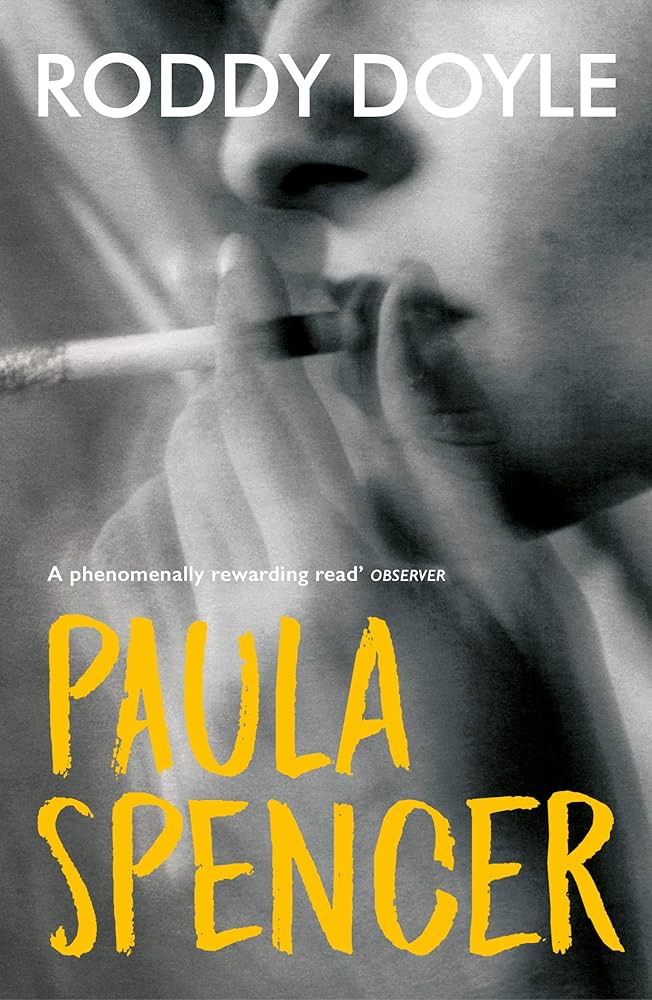
Paula Spencer is the follow-up novel to Roddy Doyle’s The Woman Who Walked Into Doors. It’s been ten years since Paula’s husband, Charlo, was shot by police after he botched a robbery and murdered someone. Eldest daughter, Nicola, is successful and patronizing. John Paul, absent in the first novel except in flashbacks because he ran away from home at sixteen, is trying to make a go with the newly-sober Paula. Leanne at twenty-two hasn’t left home and shows signs of alcoholism herself. The baby, Jack, is sixteen and trying to get through school with his head down. We open with Paula on her birthday, which almost no one has remembered, newly sober. Doyle ends the book one year later on Paula’s birthday, giving readers a clear timeline.
Where as The Woman Who Walked Into Doors felt like going up the first big hill on a rollercoaster, knowing that it has to come charging down, Paula Spencer feels more circular. The problems are there, and it’s easy for one day to blur into the next because Paula’s life is about repetition. Work, home, worry, don’t drink. And although the first book was about Paula’s experiences, this next edition puts Paula front and center. We feel even more in her head that we did last time, which means the title was rightfully chosen. In other words, The Woman felt like it had set pieces and scenes, but Paula Spencer feels like a dream that makes sense, that is not abstract. For example, little moments stand out: “She takes the waffles from the freezer. There are eight left in the box, and three more days to payday. She’s two waffles ahead. She’ll leave them to Jack in her will.” I love that aspect because when we are trying to avoid something (in her case, alcohol) and fix things that feel unfixable (in her case, her relationship with her children), life doesn’t feel neatly laid out.
Watching Paula try to connect to her children is both painful and emotional. She obviously has a favorite (Jack) and a least favorite (Leanne), though the wonderful Nicola won’t stop mothering Paula. We understand it; Nicola has been the mother since she was a kid, but Paula feels belittled. The relationship with John Paul is new since he decided that he wants his children to know their granny. When she has hard feelings against him, she corrects herself: “[John Paul] smiles. He decides to smile. She’s being unfair; she’s being a bitch. She’s watching a miracle. She should be down on her fuckin’ knees.” Doyle repeats this theme — how grateful Paula should be because she was a horrible mother — which is something our little three-person book club disagreed about. I felt she should explain to her four children how coping through domestic violence can make a monster of the abused person, too. I was outnumbered; the other two readers were glad Paula took responsibility for everything, never bringing up Charlo once.
While the relationships with all four children are drastically different, Paula struggles with her least favorite, the child who reminds her most of herself and Charlo: Leanne. Doyle is a genius at writing characters and especially dialogue. As Paula carefully tries to ask Leanne if she has a problem with drinking by asking if she has troubles getting up in the morning, Leanne lashes out, going for total emotional annihilation: “Remember when I woke up once and you were beside me and you were asleep? And your face was stuck to my pillow with your vomit. . . . Because I don’t feel nearly as bad as that when I wake up. . .” Everything Paula says is an opportunity for Leanne to remind her mother that while readers like me think Paula deserves sympathy, the lived experience of Leanne and her siblings was abuse and neglect at the hands of their mother.
Doyle still includes funny moments, though not as often because it wouldn’t land well in Paula Spencer. She tells a man on their first date that her husband was shot by police, so the news crews showed up at her house even though the husband hasn’t lived there in a year. The date replies, “I hope you had the grass cut, Paula.” Other moments aren’t funny so much as odd, like Paula asking Jack who The White Stripes is because she’s been hired to clean the concert venue. For the rest of the story, she’s a The White Stripes fan, buying a radio and their CD. Little moments like these are that good ol’ Roddy Doyle shining through, keeping things from being bleak the entire reading experience.
What Doyle does best is making you feel like these are real people, which is great because there is one final book about Paula Spencer, and I’m looking forward to her moving in a positive direction with her job, relationships with her children, and dating.


Oh man that line about Paula waking up in her vomit stuck to the pillow is so painful to read. Painful to think of what it would be like to be in that position, but painful to think of how hard it would be to wake up and see a parent like that. Tough tough stuff, glad Doyle can insert small bits of humour occasionally.
LikeLike
I’m wondering what’s going to happen in the last book, whether this daughter will forgive her mother and ever into recovery herself or what. Having an alcoholic in your family is hard because even when they want forgiveness, they are often not worthy of it because too much damage has been done. In this book at least the son is trying to have a relationship with Paula despite his anger.
LikeLiked by 1 person
This sounds tough…I feel like I would want to sympathize with Paula and her kids because there are no easy fixes after years of these kinds of broken relationships.
LikeLike
Doyle never makes it tidy; he makes it realistic, which is the challenge and appeal of his novels. Have you ever read any? Anne was saying she’s read his children’s books to her kids.
LikeLiked by 1 person
No, I’ve never read him. I kind of associate him with those male writers like Irvine Welsh and I’m not generally drawn to those guys.
LikeLike
Oh! No, Irvine Welsh is the drug guy (Trainspotting). Doyle has a much more sensitive portrayal of humans and is especially good at writing women.
LikeLiked by 1 person
You wrote that “Doyle repeats this theme — how grateful Paula should be because she was a horrible mother — which is something our little three-person book club disagreed about. I felt she should explain to her four children how coping through domestic violence can make a monster of the abused person, too. I was outnumbered; the other two readers were glad Paula took responsibility for everything, never bringing up Charlo once.”
Are you saying Doyle thinks Paula should be grateful? What to her kids for talking to her now? I agree with you. I think Paula’s children need to understand why Paula was the way she was? They need counselling, family therapy. This is tricky stuff. You can’t change the past, you can’t change what you did, but I believe talking about things, explaining things, and then trying to behave differently can help. It sounds like Paula is trying to behave differently? Surely her kids know, anyhow, some of what she went through. Weren’t they there too? And, Paula has favourite children?
LikeLike
I don’t know what Doyle thinks, but Paula herself is grateful that her children speak to her because she was so awful to them growing up. I suppose I was led to believe in the first book, The Woman Who Walked into Doors, that Paula was horrible due to survival and alcoholism; however, I’m guessing that there are parts of her that were resentful, such as the way children tied her to her abuser. She definitely has favorite children (Nicola and Jack), and it is the ones she does not favor (John Paul and Leanne) that she’s trying to rekindle relationships with.
LikeLike