
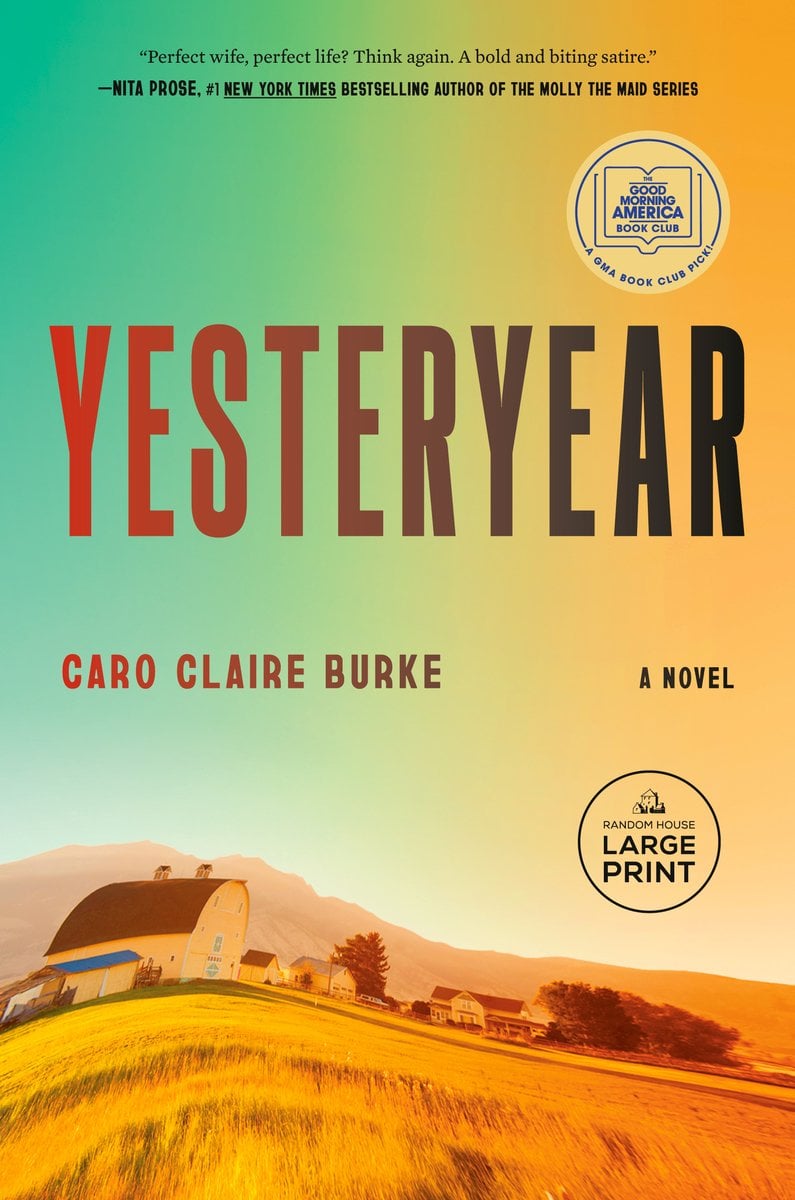
I ended up reading Yesteryear by Caro Claire Burke because it was chosen for a large book club I attend monthly for which I never read the books. I’m just there for the vibes because the attendees effectively pick a book whose synopses includes the words “missing” and “secrets,” and I don’t read those. However, Yesteryear, I figured, would be a good companion to Trad Wife by Saratoga Schaefer, which I read recently.
In case Yesteryear hasn’t hit your radar yet, it is wildly popular in the U.S. Several book club members were not able to read it because there were still waiting for a library hold, some claiming to be about 60th in line. Our first-person narrator tells us, “My name is Natalie Heller Mills, and I was perfect at being alive.” Raised a fundamentalist Christian, Natalie goes to Harvard where her roommate is your typical freshman looking for freedom: lots of parties, lots of besties, lots of one-night stands. Natalie, the total opposite, starts dating that first year and marries a U.S. Senator’s son named Caleb. She’s intentionally pregnant while still a freshman and drops out of school for the baby. It’s all going according to plan.
When we meet her, Natalie looks like a typical “trad wife” influencer. Her hired help is carefully kept off film, the children are shared on video only when they are perfectly behaved, and Caleb can’t keep the few farm animals they have alive. Caleb’s father, the senator, keeps them afloat financially. It’s Natalie’s new videographer, a nineteen-year-old college student with colorfully-dyed hair and thoughts about the message Natalie is sending that changes everything. It starts with Natalie distrusting her eldest child, twelve-year-old Clementine, who has just turned twelve and randomly asked, “What’s a trad wife?” Natalie thinks, “Practically a woman now. She couldn’t be trusted.” From this moment, readers go on a journey to explore how Caleb and Natalie ended up on a ranch they call Yesteryear with four children.
Somewhere in Natalie’s retelling of how she became a trad wife influencer, she wakes up in a place where Caleb looks like himself but different. Her children look the same but are not quite right. The house and barn and fields look the same but are run down. Has she time travelled to become an actual traditional wife as punishment for pretending motherhood is easy and keeping the chaos behind the camera a secret?
I loved Yesteryear. Firstly, I will tell you I don’t have to like any main characters to enjoy a story. Natalie’s thinking reminded me so much of Patrick Bateman in American Psycho that I was pretty excited to have that recent connection to make. While she cannot stop smiling, on the inside, she’s thinking some vile things about people. Natalie describes, “That innate instinct to love a child, especially one who looks like you, coupled with the overwhelming desire to kill the needful thing, to bash its head in and run.”
However, once Caro Claire Burke takes Natalie out of the present and has her explain the past, you get more nuance to the character. On the one hand, she turned out exactly as she was raised. On the other, in some ways she was tricked into marrying the best version of Caleb while his family knew he wasn’t really that person. Sadly, the ignorance includes their sex life: “We tumbled backward into our bed and had breathless, missionary, mushy-penised sex. Afterward, in the darkness while Caleb snored beside me, I cried silent tears at the beauty of the Lord’s bounty.” Burke is both poking at a certain version of Christianity and showing readers that her character is serious about her role as that kind of Christian wife. You laugh and think “Oooohhhh, noooo” in the same breath.
However, there are times when Natalie spouts off her theories about non-traditional, non-Christian women, about how their lives are so predictable. While what she says is horrible, I had to cringe because she’s not completely inaccurate. For example, Natalie feels her college roommate from Harvard, the one who partied, probably led a pre-ordained life. The roommate probably fought to get an internship and a job that would make her work twice as many hours as any human should, put off any kind of work-life balance, get tiny raises, get married and realize she wants a kid but at this point she needs IVF, which is just when her husband decides to leave her for a less “broken” woman.
Then, in contrast, Natalie explains what it was like to give birth, how awful it was because she was ignorant, and how she just wanted to chuck the baby away, so she’s really fair, perhaps unknowingly, about how awful both versions of life are in her mind. While Natalie has chosen the extremes, the women she’s describing are not unknown to me. Actually, one book club attendee had been raised exactly like Natalie and had lots to add.
No one in the book club had accurately guessed the ending of the novel, and while some readers may feel like the author tricked them unfairly, I do find the conclusion satisfactory in the way Caro Claire Burke makes Yesteryear funny at times and frustrating in others (really the only likeable character is about six years old), but the ending demonstrates the best possible outcome for the people in the novel who need it. Overall, there are so many layers to what is happening to Natalie that make Yesteryear rich for a group discussion, and you can puzzle through the nuance of a woman trying to make her dreams work while meeting expectations, navigating the unique circumstance of having a father-in-law running for U.S. President while trying to keep a specific family-friendly image, and completely raging on the inside. On the other side, she’s stuck in some kind of time warp without electricity or indoor plumbing where she continues to bake bread, churn butter, make candles, and figure out how she even got there.
 Grab the Lapels
Nice summary, and I love the irony of the fact that the one character you found likeable is [redacted for spoilers]. The others are certainly not doing anything good with their intelligence.
I wondered why her bread-making didn’t work when she had no staff and no modern conveniences.
LikeLike
Natalie describes her little girl as a sweet, attentive, five-year-old. She’s the one who doesn’t seem like she’s laughing or shouting at Natalie. The description of Maeve also connects to Natalie’s earlier assertion that young daughters are sweet, so we’re primed to side with Maeve.
LikeLike
Great post Melanie. This book has intrigued me, but you have really made it sound like one I would like to read. I loved this summation “you can puzzle through the nuance of a woman trying to make her dreams work while meeting expectations”. My daughter really enjoyed it too. I wonder if my baby boomer reading group would like this one. I’d love it if they did!
LikeLiked by 1 person
I mean, if they did want to read it!
LikeLiked by 1 person
I think it’s going to be pretty evenly spit split with people who love it and hate it, which makes a great conversation. There’s so much nuance that you can really dig into what exactly is going on with this woman. I think the people who just straight up don’t like Natalie, and hate her for the entire book, are the people who miss all the nuance of what it means to try and live and get through life based on how we were raised and what we have in front of us that we need to deal with. I discussed this with a book club, and one woman absolutely hated the entire novel because Natalie is not a great person, and this woman’s daughter is named Natalie. I just can’t imagine reading a book with that approach.
LikeLike
No, I agree with all you say of course. If you judge books on whether you like a character you are pretty much lost in terms of getting the most out of a book.
LikeLiked by 1 person
I loved this book as well. I know some readers were annoyed by the ending – not me. There was enough happening along the way that I thought the ending was fitting (and by then I had SO MUCH to think about). I have had so many discussions with people who have read it about the idea of ‘authenticity’ and what it means (for Natalie, for life online, for the father-in-law…).
It’s certainly a book of our time (wonder how it would have landed ten years ago, or in ten years?) and one that will be in my faves for the year.
LikeLike
I think for the average reader, the ending might stretch their credulity; however, I do know that stress and anxiety negatively affect us in ways that are long-lasting, not temporary to the moment. I really loved how Natalie found a clue in that setting about what may have been going on, and what that clue meant at the very end. I also found it interesting that in the book club that I read this with, we had a member who had been raised just like Natalie had been, so she had a lot to say about the authenticity of what it means to be raised in a fundamentalist household, and how people either pivot or embrace it. I think Natalie tried to do both. And all the nasty things that she thought about women who weren’t fundamentalist Christians sort of played out accurately, and we’re never totally proven otherwise. I found that part interesting, too (regarding her roommate).
LikeLike
Amazing to get that insight from your book group member! I would love it if my book group did this book – I’m busting to have some convos with people about the detail (but as you can appreciate, it’s a difficult book to talk about without spoilers).
LikeLiked by 1 person
America really sounds like a foreign country some times. I take it a trad-wife is a woman on social media performing wifehood and motherhood as my mother and grandmother did (when I was little my grandmother had no choice but to churn her own butter and bake her own bread – without electricity).
I checked Yesteryear on Libby. They say they have 65 copies with 5 holds on each. I put in a hold. I hope I remember why when I get to it. Which reminds me, I’m listening to An Italian Island Summer by Sue Moorcroft. Is that because of you?
LikeLike
I giggled at your first sentence because you are in Australia; thus, the US is, by definition, a foreign country! But I know what you mean. I think this weird traditionalist thing is in response to progress made for minority groups, and straight, white people want to show that they are “normal.” It’s horribly performative. You talk to anyone who is 80 or older, and they would never go back to that kind of work. I do think some people have missed the subtle satirical element of Yesteryear, so keep your ears peeled for that.
No, the Moorcraft book wasn’t me. I’ve never heard of it.
LikeLike
No, turns out it was Liz Dexter. At home I’m reading Jess White’s Silence is my Habitat, about her experience of being deaf – review soon.
LikeLike
Nice! I read Sue’s review a while back and have White’s new book on my TBR.
LikeLike
I just checked and 321 people are waiting for this at my library system! I just don’t think it’s a book for me. But I am so glad you got a lot out of it.
LikeLike
Do the libraries across Tennessee share a system? That’s the issue in Michigan. In Indiana, we don’t share, so if there’s a long line, it means it’s all from my local library system.
LikeLike
The 4 big cities (Knox, Nashville, Memphis, Chatt) are their own separate entities. The rest of the state shares a system called Tennessee Reads. So this list is just our system.
LikeLiked by 1 person
So I’ve heard of this book obvi, but not actually read it. Not sure if I will because I think I”ll find it too disturbing -influencers disturb me, I hate reading about them, I just find it such a depressing thing. Anyway, like you mentioned in your review, I was also thinking “Ohhhhhhh noooooooo’ in the same breath as I read the summary. Yikes all over this.
Also for the library copies – one of my jobs is literally raising money so we can buy more books and clear our enormous waitlists. For instance, some of our waitlists have 1000 people on it for books. But that’s another convo entirely hahah
LikeLike
I didn’t realize that was part of your job. That’s really cool. What specifically do you do? Is it fundraising to buy books or are you also contacting publishers or authors or groups who are willing to donate books, too?
LikeLiked by 1 person
I have to fundraise for a bunch of things for the library – mostly programs that are additional to what our taxes pay for. We have a ton of stuff for the public – free mental health counselling, a program that sends free books to kids in the mail to keep, free job counselling etc. It’s new that we have to fundraise for money to buy more books. We can’t accept donated books because they need to be in top condition and already part of the library system, so they all have to be bought new. We raise about 5-7 million a year, so it’s a big job. I love it though!
LikeLiked by 1 person
You’re amazing!
LikeLiked by 1 person
well gosh thank you! Right back at ya girl
LikeLiked by 1 person
I’m glad you enjoyed this one! I don’t think it’s for me – I would be really in the market for a book like this, but none of the reviews I’ve read make me think that Burke is interested in engaging with the bad theological underpinnings of the tradwife stuff. But it does seem like a very good book for a book club discussion!
LikeLike
There is some engagement with the bad theological underpinnings of the tradwife stuff, but not nearly enough that would satisfy you, I think. It does lean pretty liberal despite the fundamentalist narrator. It feels like even though she’s behind the wheel of the story, we’re all laughing at her a bit.
LikeLike
I think you got on with this one better than me! I was fine with not liking Natalie but I wanted the author to delve deeper and it overall felt more like the story was about figuring out what was happening to Natalie than really dissecting the culture she’d chosen to participate in.
LikeLike
I love that everyone in the comments is saying that they wouldn’t read this book, and they give amazing reasons. For instance, I hadn’t thought about how the whole mystery of the book is whether or not Natalie time traveled. Lou, in a comment in this thread, noted that she would not read this book because it doesn’t actually delve into the harm caused by religious groups that aren’t designed with loving kindness and how religion is being used to prop up the trad wife movement.
LikeLiked by 1 person
I thought the religious aspect of tradwifery (is that the word?) was not explored as much as it could have been. To me, a lot of the book read as being written by someone who didn’t have much familiarity with religion and Natalie didn’t feel like a character who had any genuine religious experience.
LikeLike
Yes, I think that is what Lou is also saying, if I’m reading her comment correctly. It makes a mockery of religion without exploring why being a tradwife has connections to a certain kind of Christianity.
LikeLike
I’ve no intention of reading the book because the story doesn’t interest me 🙂 I know several people who have read it though and it seems like one of those love it or hate it sorts of books. One friend couldn’t finish it, another read it for her book group and began by hating it but also liking that Natalie is so horrible, and then ended up really liking the book in the end. So I have been enjoying hearing about all the different reactions to the book 🙂
LikeLike
Don’t you love that part of bookish friends? They are surrogate readers! Some books I AM interested in but I don’t have time or don’t want to get involved in a series (I’m looking at you, MurderBot).
LikeLiked by 1 person
100%!!! 😀
LikeLike
I keep hearing about this book, so thank you for the review. I’ve heard some bad feedback from Christian circles, but it doesn’t sound like a bad story.
LikeLike
Yes, if you see some of the other comments here on this book review, you’ll notice that my Christian readers ers are turned off by what I’ve described. However, I do live in Indiana, which the land of some pretty fanatical Christians, and I can see how the author is persecuting those folks. On the other hand, to the point that some of my readers have made in the comments, it’s perhaps not clear from my review whether the author was criticizing that kind of religion. I think very clearly she was. In fact, two characters that you wouldn’t expect to change in terms of their religion do.
LikeLiked by 1 person
I haven’t read it, but based on a review I saw in The Gospel Coalition, she was. I think these kinds of books are good because they bring up a perspective that needs to be discussed. The problem with some Christians is that they maintain a narrow view of things and miss the big problems inside the church because of it.
LikeLiked by 1 person
MSP: I just finished this book. GASP! I feel like I have just taken the wildest ride on our country dirt roads swerving toward the end of the world without any attention to reality. Everyone should read Yesteryear. ~B🤦🏽♀️
LikeLike
The big book club I went to where were discussed Yesteryear were so divided between 1 and 5 stars. Why do you feel like everyone should read it? I’m interested to know!
LikeLike
Yesteryear shook up my idea and expectations of a good read taking me to places I did not expect intersecting motherhood, family, hoaxes, religion, cults, reality, social media, conspiracies and mental health. Yesteryear left me breathless! ⭐️⭐️⭐️⭐️⭐️
LikeLike