
Grab the Lapels: After Articulate was published, how did your personal life change? Did people in your memoir approach you and say something about how you felt isolated or frustrated and kept it to yourself? Alternately, were there positive changes in your personal life?
Rachel Kolb: I’m very grateful to have had the opportunity to go through the experience of writing and publishing a book, and then being able to see it out in the world. And I’m also grateful to have many meaningful relationships in my personal life, both before and after publication. I honestly feel like that part of my life hasn’t changed, except now I’ve gotten the opportunity to meet even more people and have even more shared conversations about communication and language. That part of becoming a published author has been one of my favorites.
I do think that reading Articulate was eye-opening for some people I have known for a long time, including people who do appear in my memoir. (No one is named in my memoir, because I believe in granting others their privacy.) I’ve had some good discussions with those people since my book came out. Mostly, we’ve chatted about how they just never realized certain things about my experience of deafness, or we’ve compared perspectives on particular situations we were both in together. For instance, a few hearing people I knew when I was young have told me that they do remember me off in the corner reading a book at various social gatherings my family went to when I was growing up. They’ve said that they never understood how much of an escape books were for me in those moments, or that they rarely paused to consider how isolating an all-hearing social gathering would have been for me as a kid. Other people have confessed that they never realized that lipreading isn’t actually like reading, that it actually is a lot of hard work for me and not entirely accurate, or other things like that. I think there’s a lot about deaf experience that isn’t immediately obvious to hearing people, especially given the pressure that deaf people can feel to “pass” in the hearing world, as well as the invisibility of many of our private perceptions. Revealing some of these inner realities was part of what I was trying to do while writing this book.
Really, I’d say that all of these personal conversations have been positive, certainly for me and I hope also for others. It’s meant a lot to me to have such open and thoughtful discussions, especially since I’ve believed for a long time that writing can be a space to express many experiences and ideas that may not otherwise be apparent. I’m glad that I’ve been able to connect more with readers, including people I have known for a long time.
GTL: In Articulate, you describe a situation during which an interpreter could not keep up with the academic discourse and specialty vocabulary at a social event for graduate students and professors. Tell us more about your relationship to academia now.
RK: I spent several years in academic settings, first as a graduate student and then as a postdoc. I learned a lot during those years, both about the discipline of literary studies and about wider academic culture, which for me included communicating with specialist audiences through working with ASL interpreters. That task can indeed be challenging! Deaf academics often discuss the importance of finding suitable interpreters and building strong professional relationships with those interpreters, especially while incorporating the specific words and frameworks that tend to come up in academic discourse.
Really, I credit many of the interpreters I met in academia for diving right into a field that they didn’t know, where they had to pick up many new ideas and words on the fly. The best interpreters I’ve met are consistently curious and capable of learning and incorporating new terms into their lexicon, both in ASL and in English. Sometimes I’ve gotten to work with interpreters with existing experience in the fields I’ve worked in, but not always. During my PhD and postdoc years, I often ended up figuring things out with my team of interpreters as we went along. I’d make sure they got appropriate prep material for the classes and lectures we went to, we’d meet up and talk about vocabulary words, sometimes we’d crowdsource specific ASL signs from other people we knew or from online or just make those signs up ourselves. We often spent a lot of time debriefing and finding what worked in certain situations and what didn’t. Over time, I found who I worked well with and built those relationships. I think many deaf professionals (not just academics) end up doing this, too, in their own ways. There’s something special about developing a deep professional interpreting relationship over the years.
During the time I spent in academia, I also was figuring out many things about my own language choices, including when I wanted to use ASL (versus spoken English) to express myself. Yes, spoken English has many complications for me, which is a big theme in my book — but I’ve also had so much practice with speaking by now that I am comfortable with expressing my ideas that way, for the most part. Yet, when I was a grad student, I realized that sometimes presenting in ASL feels more appropriate to me, because of audience or subject matter or just because I want to have the option to sign my ideas as well as speak them aloud. I do like the opportunity to be bilingual in my life. When I choose to sign during presentations or professional social interactions, though, I have learned that I can wind up spending a lot of energy thinking about how my interpreters are going to voice for me. I think a lot about whether the interpreters are going to incorporate the kinds of English words that I would want to use, whether they’re going to make me sound the way I want to sound. This pressure feels especially acute when I’m presenting to a specialist audience that is all hearing and that often has certain expectations about academic and professional authority, which can be tied to using very specific words and turns of phrase. “Academese” is really its own language! I felt such pressure all the time when I was in university settings (where, to be honest, I often did end up speaking for myself).
I still do express myself in both ASL and spoken English, depending on the situation and the audience, and sometimes also depending on how much I trust the interpreters to voice for me. Over the years, I’ve had many conversations with other deaf friends who also use both sign and speech in their professional lives: when do we choose to sign, and when do we choose to speak? People make all kinds of decisions about this, including in different professional contexts, and I continue to learn from others and their perspectives.
I’ve since left academia, to focus on more general-audience writing and other projects. Even though I benefited greatly from the ideas I learned in university settings, as well as from my advisers and fellow grad students, I feel like I’ve always been more of a generalist than a specialist. Still, I’ve enjoyed the opportunity to return to several university campuses in recent months to chat with students about writing, and I’m currently getting started on some new material for future book projects. Those ideas are still in the early stages, so I’m looking forward to continuing to write and discover more.
GTL: As part of my process for becoming a more aware interpreter, I read a lot of books by D/deaf/hard-of-hearing authors. I’m always cognizant that some stories go untold, though, because the individual’s first language is ASL, and they may not be fluent in English. Some books, like Orchid of the Bayou and I was Number 87, have a co-author who interprets the subject’s ASL into written English. Have you considered becoming a translator?
RK: If there are ever more opportunities to translate from ASL into written English, I’d love to do more of that! Over the years, I’ve realized that I really do enjoy translation, especially into written English. I love writing and wordplay, as well as experimenting with ways to capture an idea on the page. Translation certainly is one place where that creative wordplay can happen.
Over the years, I’ve had the opportunity to do a few published interviews with other deaf people, where we’ve had our conversation in ASL and then I go and translate into written English. The most recent example of this was an interview with the artist Christine Sun Kim in the spring issue of The Believer. For this interview, I recorded our signed conversation on Zoom, translated into English, and then showed my written transcript to Christine for approval before the piece came out. This is a practice I follow whenever I interview deaf people in ASL, just because I know how important it is to be able to choose your intended wording in English, as I talk about above.
I hope to do more of this kind of translation-based work in the future, however that arises. You’re right, it indeed could be one way to chronicle more stories for more different audiences.
GTL: In what way might Articulate be challenging for some readers? Have some readers pushed back against parts of your journey?
RK: This book does go deep, and I know some of its topics may feel heavy for some readers. There really is so much heavy stuff in the history of the Deaf community, even when there’s a lot of joy and resilience, too. I believe in trying to incorporate and honor both of those truths, to hold both hands open as well as I can and not shy away from complication and even self-contradiction, so this was another of my goals while writing Articulate.
When I was drafting this book, I was very aware that I was unpacking a lot in my own life, from asking myself why I worked so hard to assimilate with many speaking-and-hearing ideals to chronicling some of those harder parts of Deaf history, like oralism and the banning of sign language to how many hearing families nowadays still don’t learn to sign with their deaf children. It was hard for me to write those parts, and I did feel heavy, too, mostly about how inaccessible the world still is, how sad and angry I still feel about that. I also wanted my readers to feel those things when they read this, and I was searching for a language that could capture those emotions. Literature is a place I personally turn to when I’m looking for words that can capture deep feelings, to be honest.
Since my book came out, I’ve had a few readers tell me that they still need to unpack some of their own life experiences while reading it — for example, experiences with assimilating into hearing culture or growing up oral or mainstreamed, or encountering different barriers and learning how to advocate for themselves in such an inaccessible world. These readers have said that they’ve sometimes had to pause and take space to reflect before they continue reading. Good for them. I honestly believe that books find us whenever the right time comes for us to read them.
And, no, I haven’t had readers push back against parts of my journey, even if I’ve appreciated having several conversations about how other people’s perspectives or experiences differ from mine, sometimes in very significant ways. That’s part of life: we’re different people, we have different backgrounds and upbringings and journeys into language and how we express ourselves. I was always aware, while writing Articulate, that I really could only write about one perspective: my own. That’s it. I can’t represent the entire Deaf community, even though I also am interested in putting my own experiences into a wider context. I tried to be clear about this throughout my book. I’m grateful that the conversations I’ve had with readers have, indeed, recognized that there are so many ways to be deaf in the world. There’s a lot of vitality and richness in that.
Also, I hope to see even more books out there in the coming years, across different genres and forms of storytelling. We need more of that, because no one book (or movie or play) can capture everything. I’ve been heartened to see more creative people working on their projects and getting them published, and I’m excited to keep reading more.
GTL: You recently returned from a writing retreat. What is it that makes a retreat successful in your estimation? Is it certain personalities that come to the retreat, the setting, …..?
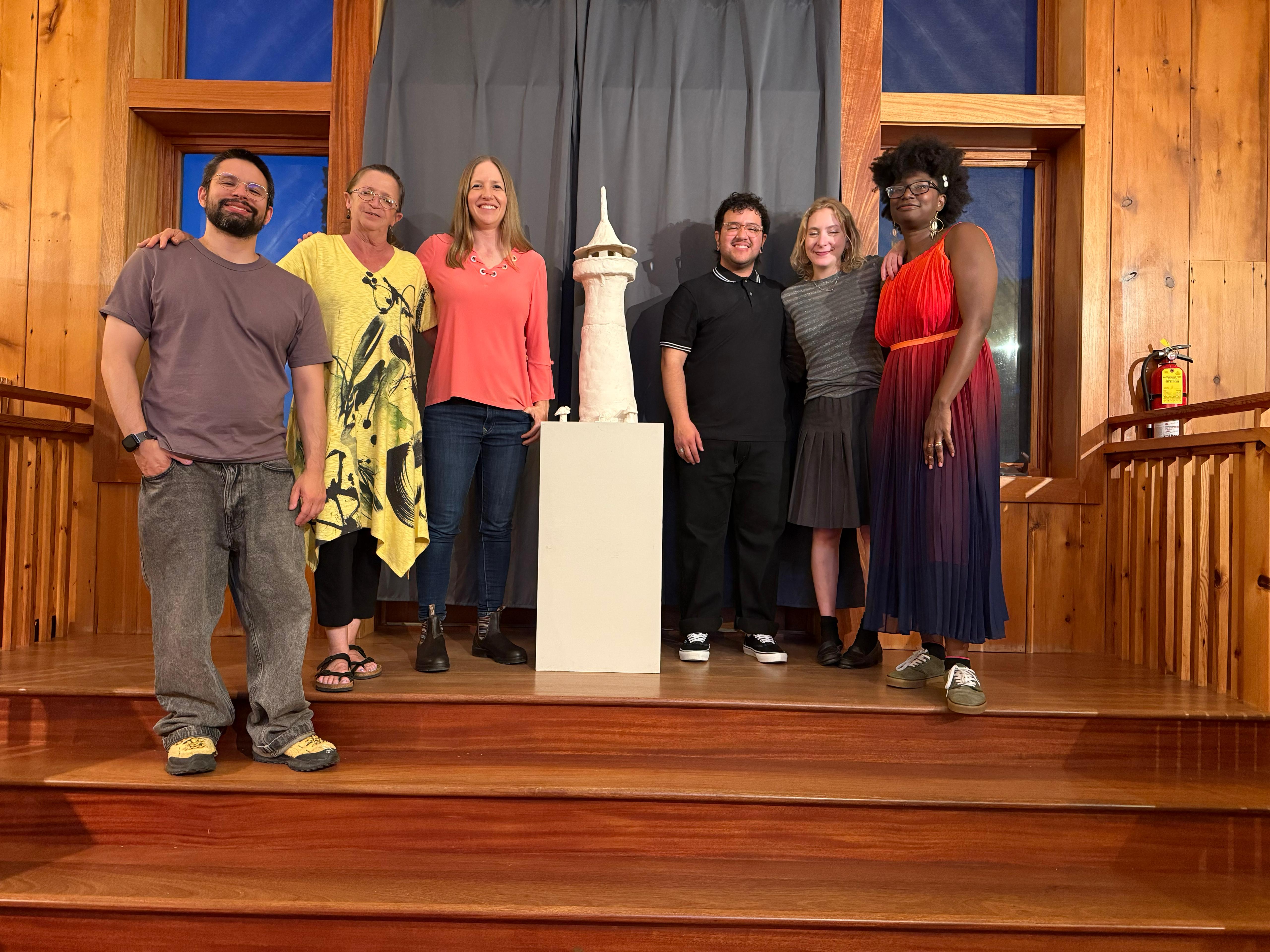
RK: Yes, I was recently one of the residents at the Deaf Artists Residency at the Anderson Center in Minnesota. It was lovely to spend the entire month of May out in that setting: the Anderson Center is on an old estate near Red Wing, which is a historic small town near the Upper Mississippi River, about an hour southeast of Minneapolis. It’s surrounded by beautiful woods and marshland, and I enjoyed getting out on some local walking paths and bike trails when taking breaks from my writing. Being able to have that reflective environment was important for my process.
Also important was the ease of communication I found with the other residents. I loved spending the entire month in ASL, swapping ideas with the other artists, who were working on projects that ranged from photography to film to clay to theater arts. Everyone else there was very insightful about their own artistic processes, as well as very kind and encouraging to each other. It was helpful for me to grab time with them and chat over delicious meals and around the Anderson Center grounds, but also have my own space to think and write.
So, absolutely, I’d say this residency was successful because of the environment, the level of support I and the others got from the arts center staff, and the thoughtful stimulation we got from each other while pursuing our projects. This was my first residency, and I hope to attend more in the future.
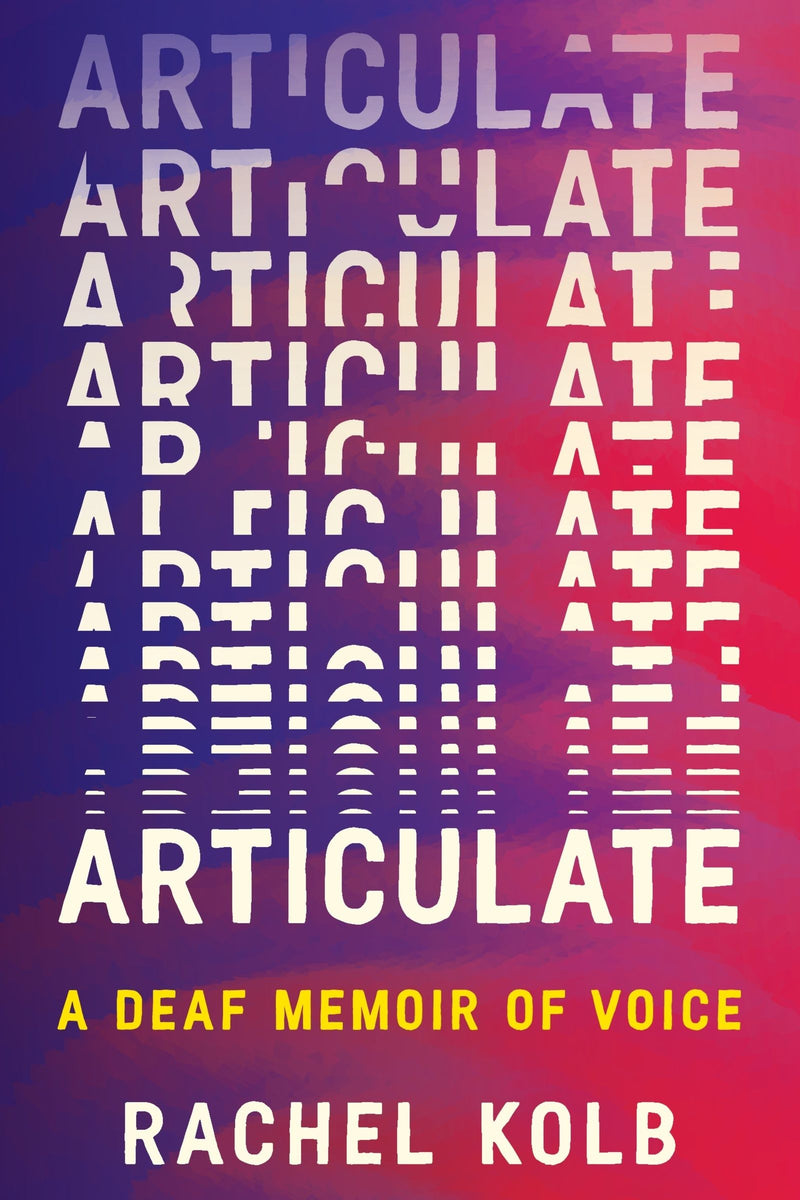
GTL: Thank you so much, Rachel Kolb, for responding to my questions. You can get your copy of Kolb’s memoir, Articulate, by clicking the book title. For my review of Articulate, click here. You can follow Kolb in a few ways: her Substack newsletter (loads of great interviews and articles there!), Instagram, and her website.


This is a fascinating interview Melanie, so thanks to you and Rachel for doing it. I liked her comment about the inner realities she was trying to do reveal while writing this book.
I was also interested in her comments about how signers/translators were presenting her. I don’t think I’ve thought of that before but of course that’s a thing isn’t it? It’s similar to why I always have a little concern about reading translated literature. I’m reading someone else’s interpretation of the work, not the work itself. An ASL signer (who is not the speaker) is of course a translator and thus interpreter … so whatever they sign (and how they sign, their expression etc) is how the audience watching that perceives the speaker. I can understand her concern.
LikeLike
A translator is someone who works from the written word. You can confer with the author about their choices and any nuance they want. An interpreter works in real time. You have to make the interpretation and deliver it as it’s being given to you, repair errors when possible, admit errors, seek clarification if able, and do so with 100% transparency to your deaf consumer. I can’t even begin to explain how hard it all is.
LikeLike
Oh I can understand that Melanie. Following your journey over these years has taught me so much more than I had realised never having had to think seriously about it.
BTW I understood that about translation vs interpreting but was likening them to each other in the sense that both operate as a middle person between the creator and the receiver. You are right that a translator might be able to confer with the author, if the author is alive and depending on their communication skills. But the principle I think still stands that the receiver is perceiving the creator through that middle person. In a live situation I do appreciate that all this is trickier.
LikeLike
Maybe it’s just something with small presses, but everyone I’ve met who has translated work that was not in English into English, communicated a good deal with the author. It’s more collaborative than one way. You make an excellent point about working on a text by a deceased author, though.
LikeLike
Yes I think you are right, that if the author is still alive there’s often good and hopefully enjoyable collaboration but is probably more common with small presses than the big publishing houses translating the big commercial authors.
LikeLike
Great interview! I loved hearing (reading) her perspective, what an incredibly positive and understanding person she seems like. The layer of complicated academic language is something I would never have thought of, but makes sense that you’d need to create specialized relationships with translators to make this work.
LikeLike
When I was still in school, we learned about designated interpreters who work with deaf professionals in specialized areas. You have to know that deaf professional really well, understand their signing style and preferences, and have a good working understanding of the vocab and information that they are communicating.
LikeLiked by 1 person
What a great interview! It’s awesome that you were able to feature her on your blog to discuss such an important topic.
LikeLike
If possible, I like to get to know writers better. No one is stopping you from reaching out, which I think surprises some readers.
LikeLiked by 1 person
That’s good to know. I always think that famous authors are too busy, but maybe they still have a little time for us.
LikeLike
Totally! Also, unless someone is Stephen King, “famous author” isn’t really a thing anymore. They’re hustling just like we are.
LikeLiked by 1 person
That’s true.
LikeLike