
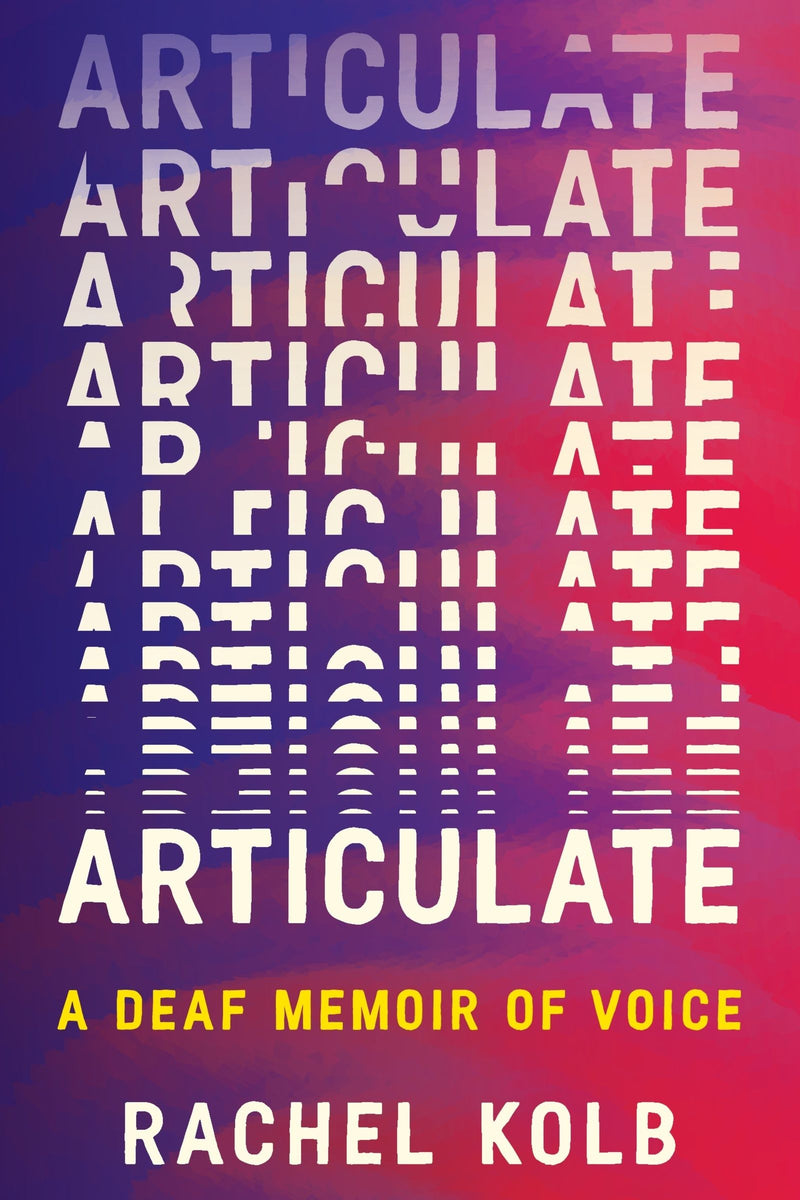
The second quarter book for my interpreting book club through my job, Rachel Kolb’s memoir, Articulate: A Deaf Memoir of Voice, is a must read. Kolb was born deaf, and as soon as her parents knew this, they started learning sign language. Because she was born in 1990, Kolb was a first generation beneficiary of the ADA — Americans with Disabilities Act — that would guarantee her right to equal access, including American Sign Language interpreters in school. While most deaf babies at the time were quickly sent to surgery for a cochlear implant, Kolb’s parents felt only she should decide. At home, her parents made sure all communication was accessible to Kolb, meaning everyone, including Kolb’s sister, signed, and objects throughout the house had note cards with the English word for each item taped to it. This is the dream that many Deaf people want to see come true!
However, being set up beautifully does not ensure a smooth journey, and that’s what Articulate is about. Note that the word “articulate” can function as an adjective meaning to express yourself clearly or as a verb meaning to voice clearly. If you remember Marlee Matlin voicing her acceptance speech at the 1987 Academy Awards, you know how contentious it is when a Deaf person speaks. The Deaf community loses access to that speech and feels the Deaf speaker has turned his/her back on their identity. Hearing people feel no burden because they don’t have to learn sign language to communicate with that Deaf person (so long as the hearing person has little to say…) and say things like, “You speak so well. I just wanted to tell you. I would never have known you were deaf.”
Kolb analyzes her communication journey, from being told her signing is too Englishy and not truly ASL to hours of speech therapy during which she memorizes the placement of the teeth, tongue, and lips to create the right sound (remember, the Deaf person doesn’t hear the sound!). Kolb writes, “Follow what [the speech therapist] tells you do to, and you will get there eventually, even when it makes no sense why you should be practicing this skill…” She decides to get a cochlear implant. Although the implant works, it does not make her like a hearing person. In fact, in college, she continues to tell people she can read lips (and this is dodgy at best), but she has to either remind everyone to talk one at a time, don’t talk behind their hand or napkin, and to look directly at her, OR she misses out on everything, something called Dinner Table Syndrome in the Deaf community. Kolb doesn’t write an easy-answers book, which I love. Instead, she demonstrates that communication is a journey for everyone, including her hearing friends that try to learn ASL and attend awkward “voices off” dinners and her Deaf friends that encourage Kolb to stop taking on all the burden of communication. “Good speech can be a trap, you know,” her Deaf friend reminds her.
From Stanford for undergrad to Oxford for a masters and then Emory for a PhD, followed by a fellowship at Harvard, Kolb never stops exploring her communication preferences. What would happen if she stopped voicing for herself, relying on interpreters instead? As a person in love with the English language, could she let go like that? The following scene is disastrous and embarrassing to interpreters like me when a new interpreter was sent to a social event for academics. The interpreter makes Kolb sound unsure and uneducated because he/she didn’t have the same expertise in the topics at the event, meaning that interpreter was not a good fit. Sometimes, social events are given to new interpreters because they are “low-stakes events,” but for a Deaf person, this is their life.
Without writing a chapter called How You Can Get Involved, Kolb explains how you can get involved. Before you invite anyone with accommodation needs to a place or event, YOU call ahead and ask what’s available. Do they have a wheelchair ramp, will they hire an interpreter, are there closed captions, or braille menus? When Kolb explained the work she had to do in college to get accommodations to attend events outside of class, I was surprised that she was basically her own secretary working with the Disabilities Office, which was like a part-time job on top of academics.
I do wonder the impact Articulate would have on a reader not familiar with the Deaf community, but I think you should go ahead anyway and give yourself that exposure. You can always Google whatever you’re unfamiliar with, if anything, because Kolb is an eloquent writer with her PhD in English.


I have a good friend who, partly because she worked at a college on events with invited speakers, is always great about making sure I can attend when she invites me to an event. It is so nice not to always have to do all of that.
LikeLike
I saw a Facebook post by a disability advocate recently that said we should always ask prior with disabilities what they need instead of assuming, so I realized I should first ask my friends and then call ahead to the location and ask about specific accessibility needs.
LikeLiked by 1 person
This sounds like an interesting and useful book. And I certainly understand, partly from following you for a few years, the complexity of living with deafness and the diversity in the Deaf community about how they would like to communicate and how they are able to communicate. I was interested in that issue about interpreters interpreting in specialist areas that they don’t understand nor really know the terms. That’s really tough and I understand that the interpreter would come across as less articulate.
I am interested however in this point: “Sometimes, social events are given to new interpreters because they are “low-stakes events,” but for a Deaf person, this is their life”.
I do understand this, but I think there also needs to be some give and take. People have to learn and where best do they learn the final skills but in real situations? I’m thinking of an experience I had a few years ago. We were holidaying in a tropical part of Australia, and I was bitten by some insects and reacted badly to the bites (which had never happened to me before). Within a few days my skin had many big blotches that had bubbles on them. It looked scary, and so we asked the First Aid Officer at the evening markets we were attending. She was anxious about it so told us to go to the hospital. There, I had a trainee doctor who was asked to take some blood for testing. She made such a mess. I had blood on my clothes and sheet. She felt pretty awful, and it wasn’t pleasant, but I realised she had to learn, and there’s a point where the learning has to be on real people? I think we all need to accept that? It’s very easy to see things from one perspective sometimes, I think??
LikeLike
You are 100% correct and beautifully describing the push and pull of my profession. Everyone everywhere wants the best, most qualified person to help them, but we obviously can’t have that all the time. We have to learn somewhere, and to me, it feels like interpreters need a residency, or whatever they are called, when doctors have that year or two before they go off on their own to become more proficient and specialized. Being an education interpreter is nothing like being a medical interpreter. I’ve met people who emphasized that a novice interpreter never belonged in X, Y or Z situation, but the situation was not life or death. Where do we learn or begin our careers? It’s very chicken and egg.
LikeLike
Glad I made sense … it’s not easy is it. And requires a bit of goodwill and understanding from all.
LikeLiked by 1 person
Oh, and to reply to both you and Bill, I used to get my haircut at a beauty school. One time, the student paused and freaked out because she thought she’d cut my ear off.
LikeLike
Oh poor girl! That’s a good story … our local Technical College used to run a restaurant for the hospitality students – cooks, bartenders, servers – to practice so you’d only pay the actual costs. I don’t think anyone died of food poisoning.
LikeLike
Fingers crossed none of the students sneezed into their hands and then continued to handle food. I mean, you wouldn’t die from that, but you might throw up a little in your mouth.
LikeLike
Haha yes!
LikeLiked by 1 person
Following on from WG, I attended the dental hospital when I was in uni and had two molars removed by students. I had to return so that a surgeon could clean up the mess (teeth broken beneath the gums).
Kolb was fortunate in her parents. Would I have known to do all that (10 years earlier)? I guess it would have depended what interaction we had with professionals – one child had a cleft lip and palate and the help we got from the childrens hospital was amazing.
LikeLike
See, we are trying to avoid that mess and the second visit as much as possible. In the US, at a dental clinic, after the students finish, a professional checks the work before you leave. Same with haircuts. With interpreting, there is no one there to check your work. How can someone prove you messed up (unless there is a record of what was communicated, and in some cases there is).
LikeLike
Wow, her schooling alone is incredibly impressive, so I can only imagine how strong of a writer and communicator she is! At first it was interesting to me that there was so much division within the deaf community about the ‘best’ practices, but really I shouldn’t be surprised, because every community has a variety of voices and opinions, so why should the deaf community be any different? We’re all just people, even when they struggle with the same challenge / or set of challenges.
LikeLike
True. It reminds me of what I’ve read about what it means to be Black in America. Is a person Black enough? Do they sound too white, listen to the wrong music, enjoy the wrong shows, etc. Did they grow up in a predominantly Black or white neighborhood, go to a HBCU, were they southern Baptist, etc. All these cultural elements mirror what I’ve read about and seen in the Deaf community. I haven’t studied other cultures enough to say much.
LikeLiked by 1 person
This sounds like a really interesting book. And a reminder that even with a pretty ideal family set up, there are still going to be challenges and divisive choices.
LikeLike
Over the years, I’ve become convinced that there’s no such thing as a smooth life that’s totally set up for someone. Even when I was at Notre Dame, I learned that it’s not uncommon for students to bring in plastic water bottles filled with vodka to try and calm themselves down from the stress they feel. Then, there are students who get through that University perfectly fine. They graduate; they go out into the world and realize that their road was made too smooth and they don’t know how to do anything. I recall one article from the Notre Dame magazine in which the students didn’t know what dryer lint was, or that you can’t put wax paper in the oven. They’re basically out in the world, helpless.
LikeLiked by 1 person
Oh gosh, this is actually something I worry about as a parent! That I’m not going to equip my children properly for life and I’ll forget to teach them something really basic like emptying the dryer lint trap! Though really I feel the more damaging thing is when you meet young adults/adults who struggle to make their own choices, however minor. There was a girl in my dorm who would call her parents about what she should have for breakfast. She seemed to have no ability to problem solve on her own. I still think about her and wonder how she’s doing now.
LikeLike
I see something insidious now, that I think is similar to your doormate. It’s adults, people in their 30s, who are very skittish at work because they are terrified of “getting in trouble.” Like, are you 2 years old?? You don’t get in trouble at work, you experience consequences either of your actions or the feelings of someone else who maybe is overreacted, but there is no such thing as “getting in trouble.” Maybe if you work for your mom or dad…. But still.
LikeLiked by 1 person
That’s interesting…it seems like a fear of taking risks. I feel like sometimes among my kids’ peers they’re not afraid enough of getting in trouble! Like, they need more consequences! But those are literal children. By your 30s you should be able to figure out what’s an appropriate action to take and then deal with the fallout, good or bad.
LikeLiked by 1 person
I’m watching her TED talk right now, and I’m in tears listening to her.
LikeLike
Oh, wow! In what way did it affect you? I must confess I didn’t listen to the TED talk, and I should.
LikeLiked by 1 person
You have to watch it and you’ll know right away. Too powerful. Here is the link just in case: https://www.youtube.com/watch?v=uKKpjvPd6Xo
LikeLiked by 1 person
I just watched it; your link encouraged me to do so! As someone who knows a lot of Deaf people and is fluent in ASL, I just wanted so badly for her to sign instead of speak. ASL is so expressive and because speech therapy teaches Deaf people how to move their mouths, tongues, lips, etc. without hearing the results, it’s an exercise in mouth moving. That’s the focus. She even writes in the book about practicing sounds that are harder to get for this speech. I noticed she sounds rather flat in her affect, but I know from her memoir that she has a big, wonderful personality. Though the words came out, I feel like signing would have captured who she is more clearly. The consideration is she would have to trust an interpreter to get her words just right for her. Letting go of your voice is hard for anyone.
LikeLiked by 1 person
I agree, but there is a reason she did it that way. She is trying to push the boundaries and get people to see the possibilities. Like she said, people need to see the abilities, not just the disabilities.
LikeLike
Absolutely. I also see that she spent 18 learning mouth shapes because hearing people don’t learn ASL. I do see your point, and I agree.
LikeLiked by 1 person
Oh, I wanted to add this, which I read this morning, from Rachel Kolb’s substack:
I finished reading Mother Tongue the day that some more “amazing gene-therapy developments for deaf children” hit the news. It was a headline that honestly made me go “ugh.” Again.
Why can’t the world just let deaf people exist, already? Why isn’t it obvious that it’s perfectly okay if deaf kids grow up as what they are, deaf, instead of trying to “cure” them or to make them assimilate as hearing?
LikeLiked by 1 person
Interesting. I guess it contradicts what she is doing.
LikeLike
Fitting in is an awfully big motivator, unfortunately. She did the Ted talk when she was in her early twenties. I’m not sure she would make the same choice today.
LikeLiked by 1 person