
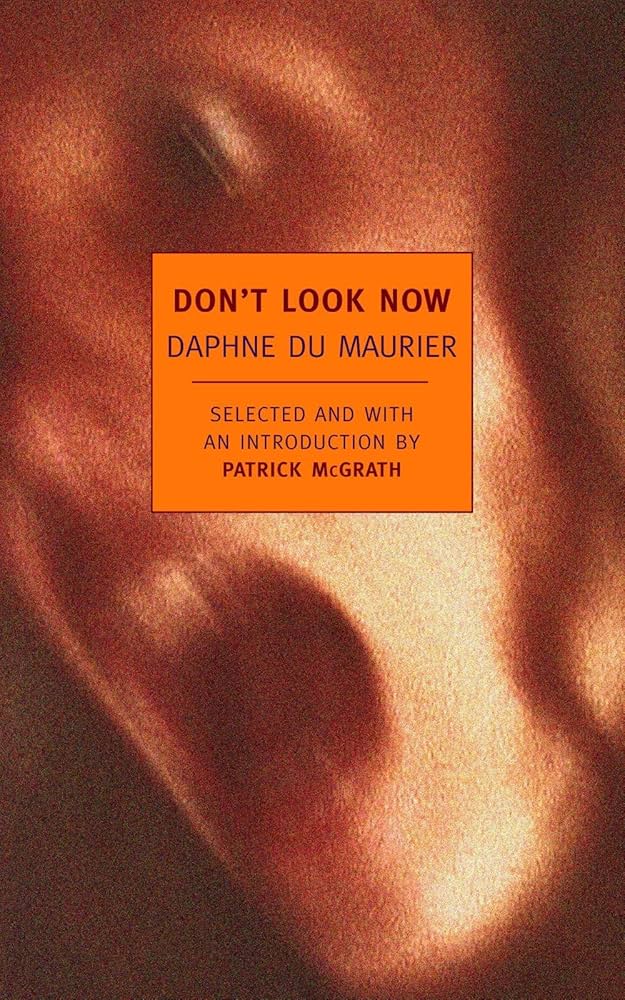
Unfortunately for those of us who organize book clubs, there are two Daphne du Maurier collections entitled Don’t Look Now. One has a purple-ish, foggy cover and contains the short story “Don’t Look Now” plus four others. The second book is orange with a still shot from Roman Polanski’s 1965 movie Repulsion and includes “Don’t Look Now” plus eight other stories. Today, I’m discussing the orange book with stories selected by Patrick McGrath, who also wrote a forward that I didn’t read because that’s where academic-types like to spoil the stories before you’ve even read them.
In her most popular novels (Rebecca, My Cousin Rachel, and Jamaica Inn), du Maurier doesn’t like to give readers easy solutions. We’ve been debating for decades what Rachel’s designs truly were or whether Maxim’s claims on Rebecca are accurate given she’s no longer alive to defend herself. Similarly, readers face nine cerebral chillers in this collection, and while you may get a conclusion, that doesn’t mean you’re given a resolution. Eight of the tales are set in England. Six are longer short stories. All nine are affected by the end of WWI and the freefall into WWII.
I found the plotting highly effective for convincing readers that these characters are not in control of what is happening to them. Sometimes, it’s stated directly: “The cabin seemed very musty, very dark. I felt faint and queer, and something like a sob rose in my throat which I could not control.” Other times, characters are at odds with their environment, seeming to have slipped through time like a Twilight Zone episode. In the titular tale, husband and wife cannot agree on the trustworthiness of elderly twins, one of whom goes into a trance and tells the wife their deceased child is with them on their current trip. In “Monte Verita,” a husband loses his wife to a religious cult in the mountains, returning yearly for a glimpse of her. Did the suspect villagers take her, or is she really behind the rockface living in paradise? In “Split Second,” a fastidious mother leaves her apartment for a walk only to return to it populated by photographers who have stolen her worldly possessions and tied up her housemaid. Maybe.
Du Maurier is also a master of setting. Contemporary British novels often let me forget I’m not in America, but du Maurier never allows it. For instance, a narrator comments, “…I went down to the picture palace, and taking a look at the poster saw it was cowboy and Indian stuff—there was a picture of a cowboy sticking a knife into the Indian’s guts. I like that—proper baby I am for westerns—so I paid my one and twopence and went inside.” Granted, this is a rather violent preference for our narrator, but the British terms, like “picture palace,” “proper” and the money type, kept me in the setting.
Furthermore, you cannot forget that these stories are set between WWI and WWII. You get fatigue of misery, the PTSD written in metaphor. In “The Birds,” a father who fought in WWI and was injured, is now a farmer. When flocks of birds attack humans, people shelter in place, but the larger birds begin pecking away at wood-covered windows. The farmer’s daughter takes note:
“I can hear the birds,” she said. ” Listen, Dad.”
Nat listened. Muffled sounds came from the windows, from the door. Wings brushing the surface, sliding, scraping, seeking a way of entry. . . . “Some of them will kill themselves that way,” he thought, “but not enough. Never enough.”
You can’t help but think of the sky darkening with bomber planes, kamikaze planes crashing themselves, but always more following behind.
Du Maurier’s humor is wild when she uses it, and her mechanism changes depending on need. Sometimes, the humor is a unexpected honesty. In “Kiss Me Again, Stranger,” as a man buys an ice cream in the cinema, he asks the employee if he can buy one for her, too. She replies “no thanks” because she “saw them made.” I about died laughing at the surprise of her answer. After she leaves, he laments, “…and there I was sitting with a great sixpenny cornet in my hand looking a fool. The damn thing slopped all over the edge of the holder, spilling on to my shirt, and I had to ram the frozen stuff into my mouth as quick as I could for fear it would all go on my knees…” Who among us hasn’t struggled with frustrating drippy cone situation? Du Maurier makes good use of relatable situational humor.
Sometimes, the humor is facetious. In “The Blue Lenses,” Mrs. West gets her eyes operated on, and after the bandage is removed, everyone has a different kind of animal head with a human body. In the medical facility, one nurse looks like a kitten. Mrs. West keeps trying to point out that her vision is not normal for post-op, but it hurts the nurse’s feelings.
The kitten turned. “A joke’s a joke, Mrs. West,” she said, “and I can take a laugh with anyone. But I can’t stick rudeness.”
“Miaow,” said Marda West.
Although I felt all nine stories were successful, I found the shorter two, each about ten pages only, less memorable compared to their immersive counterparts. They read more like a “ha-HA!” than a full story, giving you a punch at the end rather than a sustained journey.


Ooh, I want to read this! I am not surprised to hear that du Maurier would be an excellent short story writer.
LikeLike
I hope you read it soon, so I can read your review and remember what I read. I just love how atmospheric and thoughtful her writing always is. The only work of hers I didn’t enjoy was a readalong I did with Lou from Lou Lou Reads. It was about time travel, and I personally struggled because the characters traveled so far back in time (I think the 1200s, if I remember correctly) that I had no historical information to ground myself.
LikeLiked by 1 person
LOVED this collection. “The Birds” is one of the best short stories I’ve ever read. Must read more of her short stories.
LikeLike
Yes, and it’s confusing that there are two collections with the same name — Don’t Look Now. I need to get the other one without the orange cover because literally the only story the two collections share is the titular one.
LikeLiked by 1 person
Oooh, I like that the title story refers to necromancy!
LikeLike
Du Maurier is great. Her work is so polished and immersive.
LikeLiked by 1 person
I read The Blue Lenses a few years ago and loved it. I don’t think I’ve read any of du Maurier’s other short stories, although I have a collection on my bookshelf! This is a good prompt to get to it soon. How confusing about the two different collections having the same name, though.
LikeLike
I’m not sure who controls her short stories, family, an estate, or what, but having two collections of the same name is annoying. Which collection do you have?
LikeLiked by 1 person
My collection is an old mid-century Penguin – The Birds and Other Stories.
LikeLiked by 1 person
Gosh I really need to read this, the collection sounds so good! I’ve still only read Rebecca, which I finally got to because of the blogger buds who loved it, and I loved it too, but I also really want to read Jamaica Inn. She’s the best kind of spooky and funny mix!
LikeLike
I absolutely love Jamaica Inn, but if you’re looking for a shorter experience, this collection is for you. You can pick it up and put it down if you want.
LikeLiked by 1 person
You know i love a shorter read! haha
LikeLiked by 1 person
I think I have this collection on a shelf somewhere. Maybe one of these days I will actually find it and read it because you make is sound like such fun!
LikeLike
It’s great fun! It’s totally the kind of book for which you can read one story, set it down, and then pick it up later and read the next one. It feels like one of those books that you put on your nightstand; that sort of thing. Happy reading!
LikeLiked by 1 person
Reading your reviews is such a joy Melanie, because you have a wonderful way of saying things, starting with “a forward that I didn’t read because that’s where academic-types like to spoil the stories before you’ve even read them”. I always read Forewords after I’ve read the book because I don’t want to be told how to think about a work before I’ve read it. However, with classics, I don’t mind them being at the beginning (I can choose when to read them, after all) because I think it’s probably ok to assume that people know the endings of classics and might in fact be coming at them from an academic angle. They might be looking for new ways of reading a book or story they know.
The other thing that jumped out at me from your review was the issue of whether writers keep you in the setting or not. I wonder whether, in those books/stories where they don’t, it matters? In other words, is it that they have assumed – perhaps a bit ethnocentrically – that we will know the setting, in which case it could matter if we forget it. Or, is it that the specific setting is not essential to the meaning, so it doesn’t matter if we aren’t so conscious of place? This is hypothetical, of course, because I think you feel that Du Maurier does situate her stories in place very well, and that, for me, is usually one of the joys of reading.
LikeLike
I somehow havent read anything by Daphne du Maurier yet but I have seen a few adaptations of her work. I was actually leaning towards picking up one of the collections with The Birds in to try out first actually as thats not one I’ve seen and I do love a creepy short story collection. This sounds like a varied mix of titles for sure with some rather unusual ideas like the animal heads one. The titular story particularly has me intrigued by what you’ve said about it.
LikeLike
I think I read only one novel of hers that made me feel kind of meh, but the rest just blow me away: Rebecca, My Cousin Rachel, Jamaica Inn, Frenchman’s Creek, etc.
LikeLiked by 1 person