
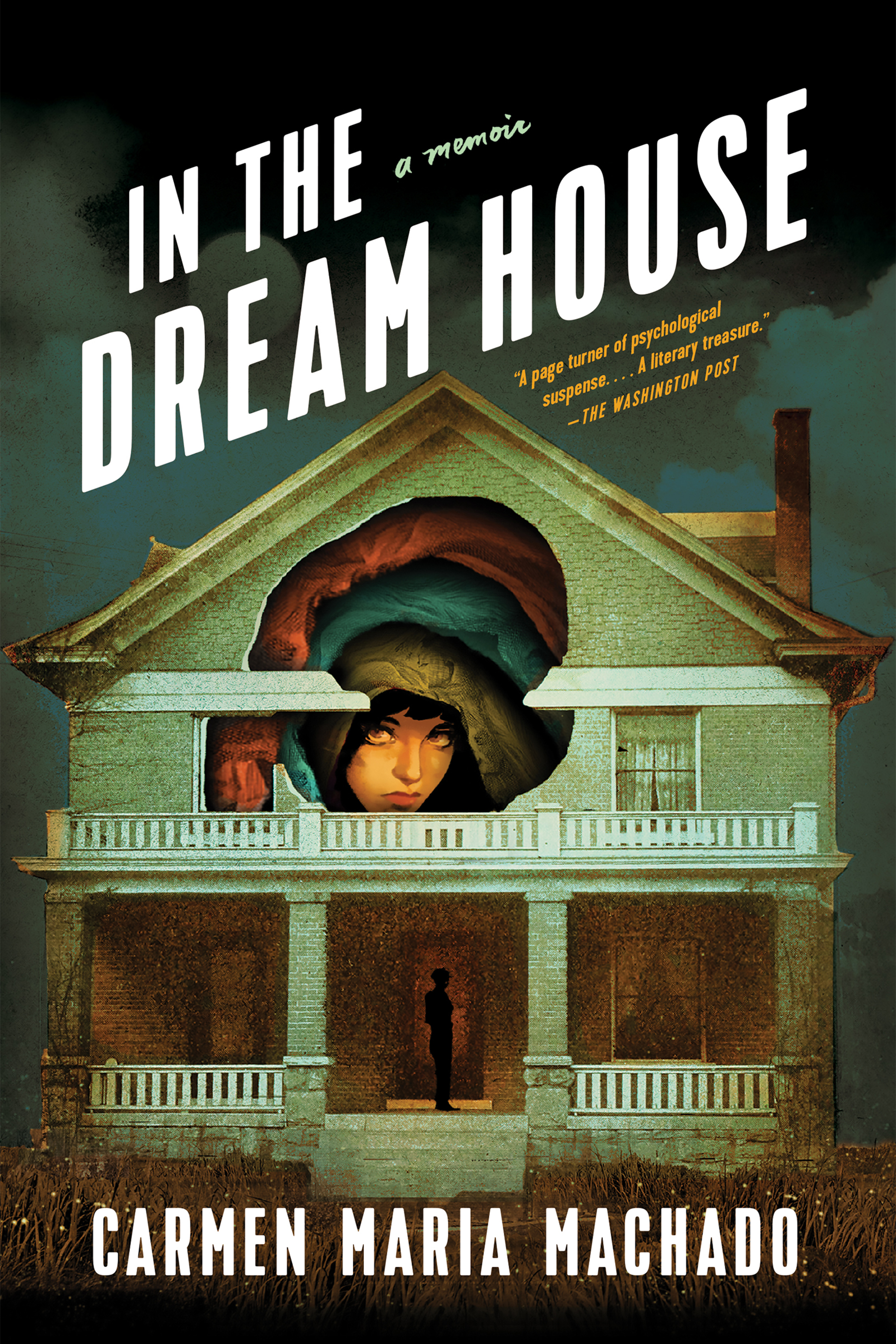
The memoir In the Dream House by Carmen Maria Machado is a poetic, academic narrative of the years Machado was in an abusive relationship. Growing up extremely religious and in a family that despised LGBTQ+ people (I used “despised” intentionally rather than “homophobic”), Machado had little experience with serious dating relationships. It was during her time at the infamous Iowa Writers’ Workshop that she dated a woman who gaslit, screamed at, and endangered Machado repeatedly. The girlfriend did not get accepted to Iowa, but she was accepted at a college near Bloomington, Indiana. Thus, though they were in a long-distance relationship, Machado put thousands of miles on her car visiting her girlfriend.
The book is a fast read largely because many pages have but one paragraph. Most chapters are titled “Dream House as [theme of chapter].” In those chapters, readers know Machado will separate herself from the narrative by using second-person point of view to describe her relationship with the abusive girlfriend. I was reminded of old choose-your-own adventure books, and surprisingly, one section is a choose-your-own adventure, the point being that you cannot escape domestic violence as you circle through the same pages repeatedly.
Other chapters pause and reflect on the lack of literature about domestic violence in the lesbian community. Society, Machado notes, must make it make sense by imagining one partner as butch, and therefore the “man,” to sort of straighten out (yes, phrasing intended) the relationship between abuser and abused. Machado also includes fairy tale references, sometimes telling a whole story to demonstrate her affinity with the victimized character and her girlfriend with the villain.
My main driver was learning how Machado escaped the relationship; we know she’s now married, so an exit did happen. But as I neared the end, the relationship (on the page) fizzled while the academic side (facts, creative narratives, slice-of-life events) pulls ahead. There was no final brawl nor screaming match, no restraining order nor parting words. Although my focus isn’t on the rubber-necking tendency to want to see the drama happen, the girlfriend was finally accepted into Iowa and moved to Machado’s town, meaning they were in the same place and circles. Awkward and scary, right? What happened?!? We get chapters about Machado writing this book. We get a chapter of a squid and an evil queen. We are told she went into a sensory depravation chamber. We know she went to Cuba with her brother. We’re told male writers, like David Foster Wallace and William Burroughs (and then men in general), have a long history of abusing women. It hit me that I felt like I was reading a Ruth Ware book. You know that part when we’re about to get back to The Moment It Happen that the present-tense timeline has teased for 300 pages, and then the author pulls on the reins and dilly-dallies around in the present for another 50 pages, not telling us what actually happened?
Finally, Machado writes a chapter called “Dream House as Ending” and asks, “Where to stop this story? . . . Some narratively satisfying confrontation between the woman from the Dream House and me?” Yes, I thought, exactly that. I thought, Is she literally responding to workshop feedback about the story not concluding? But In a Dream House attempts to make you recognize that time continues, and the story never ends until all the people in it are dead. I was still unsatisfied despite the philosophical question, especially because Machado writes that she wants her memoir to serve as a guide for lesbians in domestic abuse situations because not much literature on it exists (and the fills the ending with lists of books and articles about lesbians in domestic violence situations).
In a Dream House is probably best read with a book club for exciting discussions about the author’s writing style. Also, the chapters are full of sexual activity and way the girlfriend abused Machado. I would want to know what folks thought about how the relationship was portrayed; Machado and her girlfriend are either having sex or in a domestic violence situation, meaning either those are the only two ways they were together, or much is left out that could give a clearer picture of how a person feels compelled to continue in an abusive relationship. Machado’s experience is unique because her abuser lives several states away in her own dwelling, yet Machado continues to make the drive back. Despite my support of victims telling their stories how they want, I felt Machado spun a web of fairy tale ambiance that actually separated me from the events. When she conceived of herself as a ghost in the Dream House, instead of feeling the Hitchcockian mood, I thought, “Yeah, but you have your own apartment with two hippy roommates.”


That sound s like an interesting book, in the almost interactive way it’s written. Do you think she was responding to feedback as she went along? I’m not sure how comfortable I’d be reading about a closely described lesbian relationship. Though I am currently reading Anais Nin’s Henry and June. But I find that though Nin talks constantly about relationships, and implies sex, she doesn’t describe sex.
LikeLike
It reads like she’s responding to feedback of some kind, and she was in a creative writing program during the abusive relationship. If I remember correctly, she started writing her memoir while on a writing retreat/residency. It IS hard to write when people are required to give you loads of feedback; I can speak from experience on that one.
LikeLike
I enjoyed this one. I like a book where the structure adds to the narrative and I think that’s done well here.
LikeLike
I can see how readers would like form and content married this way.
LikeLiked by 1 person
I haven’t felt the pull to read this and your review makes me think this is a good choice. Not for me.
LikeLike
It was like a forest fire on a windy day when it was first published. I didn’t read it then and I’m glad because I think being the odd person out in the midst of hype is rough.
LikeLike
I’ve read a few reviews of this book now and while I can see the value of telling this kind of story, I think I would probably feel the same frustrations. Of course life doesn’t work that way, but we DO want some sort of conclusion. I wonder if she would write it the same way now, with a few more years having passed.
LikeLike
Were the other reviews more negative or positive? In general, this book is beloved by most readers. I have to remind myself that at this point in my life, with my education and history of reading, I’m not a casual reader, so I tend to notice things that make other people say, “Whaaa?”
LikeLiked by 1 person
Almost all positive. But even the positive reviews never made me super excited to read this so it’s probably just not for me!
LikeLiked by 1 person
Basically what Karissa says. In a memoir, and given her aim re domestic abuse in lesbian relationships, you would expect more clarity about how a person feels compelled to continue in an abusive relationship (as you say) and how you might get out of it. It’s hard to understand why there isn’t this clarity.
LikeLike
I guess the “dream house” goes several ways. She wanted her dreams to come true there but it was also dream-like/hazy in regards to what happened and how. That would be my guess?
LikeLike
Very interesting, and I think your use of “despised” was adequate, especially if she grew up in a Hispanic family.
LikeLike
I’ve been rethinking my use of words that end in “-phobic.” I read a book by a fat activist who was saying that people who use the word “fatphobia” are doing a disservice to individuals who have true mental health issues around phobias, ones that seriously impact their quality of life. These individuals who hate fat people are not “afraid,” the author argued. They are vocally hateful. Therefore, I was thinking how Machado’s family isn’t “afraid,” they are disgusted.
LikeLiked by 1 person
That makes sense, and the author is probably right. If people keep adding “phobia” to everything, then mental health awareness is diminished.
LikeLiked by 1 person
I had heard of this book and its focus when it first came out, and felt like I wanted to read it. And then I ended up seeing this author speak in person, and I was shocked at how HILARIOUS she was. For some reason I assumed she would be dark, sort of sad, and quiet, but she was the complete opposite; vivacious, loud, and funny. It’s ongoing proof that ‘victims’ and ‘abusers’ don’t always fit into the stereotypes we set for them.
LikeLike
I love that detail, Anne. I never would have thought she was funny, either. Both the book and her author photo are totally morose. It’s sort of the opposite of the book that I just read by Lindy West. She was going through some traumatic stuff in her marriage, and the entire thing was like one big stand-up comedy bit. I love how funny it is, but it also makes you realize that she’s talking about really sad stuff.
LikeLiked by 1 person
1
LikeLike
The style of this one intrigues me, especially with the fairytale comparisons and choose your own adventure style chapter – I’d never have imagined that. I do think overall I’d find the ending unsatisfactory too though. I can understand that theres no ‘ending’ but surely there came a time when the relationship broke apart and she realised she needed to get away 🤔 I can see how this could help people in this kind of situation become aware of what’s happening to them and stop seeing it as simply how a relationship should be. But I dont see how that helps them escape it, which feels like a major factor. I probably will read it eventually for the style and uniqueness. Its just a shame that it sounds as if it needs more throughout.
LikeLike
To be fair, this book is highly beloved and I think has won a bunch of awards, too. If people hadn’t heard of her before, this memoir definitely put her on the map. I just know that I frequently can’t read with my emotions alone, possibly because I did an MFA in creative writing or because I’ve been reviewing books for so long, I don’t know. I also taught rhetoric, so when somebody is trying to appeal to my sensibilities through ethos, pathos, or logos, I noticed that too, especially pathos. A lot of times when a book is supposed to be emotionally impactful, I start looking at the ways in which they try to impact my emotions, and doesn’t make sense or is it overstepping; those are questions I ask myself.
LikeLiked by 1 person
I’ve definitely seen it around a lot and knew that it was a memoir about an abusive relationship with a creative style but didn’t really know of some of the details. I can definitely see how being that familiar with that side of things could lead you to view things through a slightly different lens. I still think I’ll want a little more from the ending in somr regards but it’ll be interesting to see if thats true.
LikeLiked by 1 person