
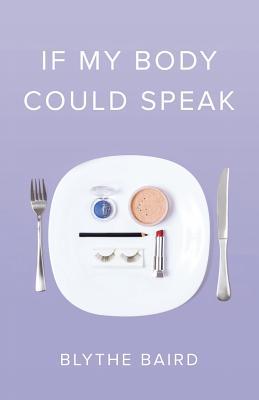
It’s not often I review collections of poetry here, but Blythe Baird’s book came to my attention because she’s published by Button Poetry. Their work is thoughtful and accessible, and I’ve enjoyed three poetry collections in the past by another author in Button Poetry’s stable, Rachel Wiley (Fat Girl Finishing School, Nothing is Okay, and Revenge Body).
Baird’s collection doesn’t read like poem after poem; instead, it builds collective energy and intensity by pairing like poems. Firstly, she ruminates on fatness and disordered eating then feminism, sexuality followed by her sexual assaults and her reactions to them. The result is like being on a train going faster and faster still until you come to a much-needed depot to exit for a moment.
If My Body Could Speak was published when Baird was twenty-three, and there is a young person’s sensibility running through the collection. Surviving high school and sexism, coming out as lesbian and doubting her own identity, etc. These are not poems that look far into the past from a wiser place; they serve as a reaction, a veritable “Did that just happen to me? Why??” That not to say that the poems lack depth. Baird writes truths that we ignore because in America, whatever is normal to us is normal. Consider this line:
if you develop an eating disorder
when you are already thin to begin with,you go to the hospital
if you develop an eating disorder
when you are not thin to begin with,you are a success story
There were moments when Baird made me, almost twice her age now as when she published her collection, realize the difficulties of the human body in a few simple words. She notes the disordered thinking of people with eating issues, such as pride that in a warm room they feel cold. Her rationale is so convincing that you must believe her relationship to the content of her poetry is intimate. One moment about the burden of the human body that struck me, something I hadn’t considered, was: “To live in the body of a survivor / is to never be able to leave / the scene of the crime.” Our bodies do not have an eject button, a little door through which our thoughts escape while we leave our flesh behind.
You may wonder if it is challenging to read a poetry collection so full of anger, the stuff of content warnings. When Baird writes about violence, she still does so through a poet’s perspective, explaining, “Once, an adult man made a necklace / out of his hands for me.” It doesn’t take much to figure out what she means, but she’s still indirect, still creating imagery out of a horrific moment of violence, giving the reader a small bit of distance.
In general, I could tell If My Body Could Speak was written by someone in their early twenties; however, her work cries out through the page, demanding your attention for what young women suffer in silence, insisting upon being heard and seen in a way that hijacks you through the collection.


Great post Melanie … I love the sound of these poems. But that necklace image is horrifying, yet so clever. I hate that such good writing comes off the back of such horrific experiences.
LikeLiked by 1 person
I think I have a few more poetry collections that I own. I should read them especially because they are e-books that I can access on my phone. It’s so simple to read a poem while standing in line at the grocery store vs. a page from a novel.
LikeLiked by 1 person
This sounds like a powerful collection. Sometimes when I read memoirs, I think that the author should have waited longer, should have gained more perspective on their life. But I actually think poetry is a great way to ponder and react to moments of our lives like this.
LikeLiked by 1 person
That is an amazing observation, Karissa. I never thought of that myself. I think you’re right, though, because a poem can be reactionary, whereas a memoir tends to be reflective. I think reactionary might be a great word to describe this poetry collection.
LikeLiked by 1 person
I’m sure there are a lot of people who will find commonality with this poet and find solace from her work. Sounds powerful and a bit harrowing.
LikeLiked by 2 people
I’m not sure about solace because it’s like she’s screaming through the pages, but validation, yes. That.
LikeLiked by 2 people
Ooof, that quote you included. YES!!!! I don’t read alot of poetry myself, but I do enjoy it when I slow down and actually read poems, because I always find them so…illuminating. I know that’s cliche but here we are haha
LikeLike
Man, cliches are funny because they’re often true. I think stand-up comedy works the same way. The comic tells you something horribly embarrassing, and you sit there giggling because you’ve experienced the exact same pants-shitting kind of moment.
LikeLiked by 1 person