
*Scroll down for the text review.
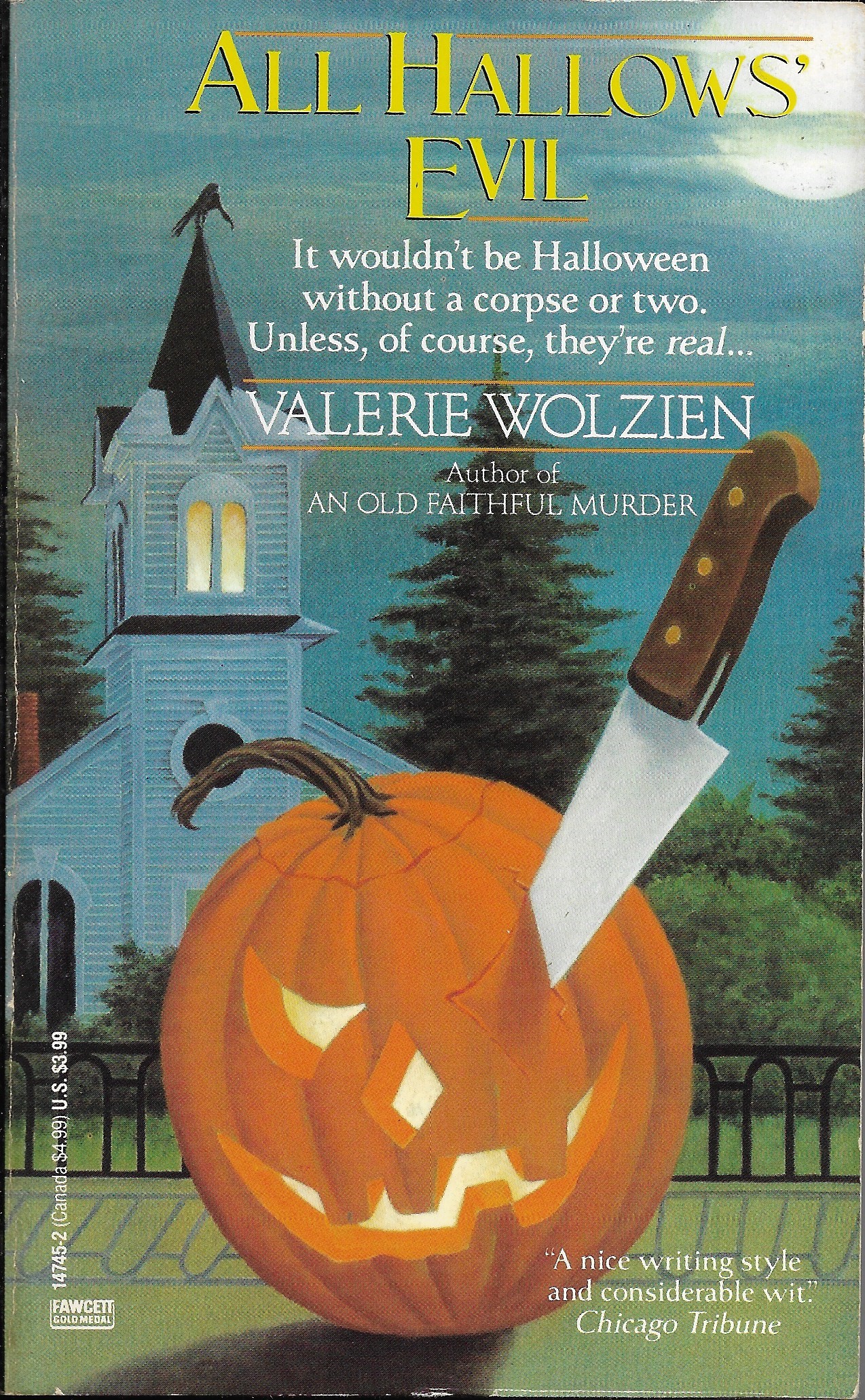
Hi, everybody. Today I am reviewing this adorable little mass market paperback called All Hallows’ Evil by Valerie Wolzien. I picked up this book at Goodwill or someplace like that. The cover is fitting because we’re in October, and you can see I’ve got my Halloween stuff up (see the image above from my YouTube review). That is some of it. There’s definitely more.
But this is not a horror novel. It’s not a spooky book. It is a mystery novel that takes place on Halloween and then the three days afterwards. I want to say it’s kind of a cozy mystery, but not really. It doesn’t have all the cozy vibes that you might be accustomed to: cafes and baking, somebody very Angela Lansbury. I like to see some variety in my mysteries that aren’t hard-boiled detective novels, but also aren’t cozy mysteries with, you know, dessert-themed titles. I enjoyed All Hallows’ Evil more than I thought I was going to, thanks in large part just to the writing and how aware it is of a change in attitude at the time.
Wolzien’s novel is set in the 1990s, and our main character is Susan. This is actually the third book with Susan. It doesn’t matter; you can just go ahead and read this one. Susan is married to Jed. She has two teenage children. She has a friend who used to be a police officer, but now has a baby, and the baby’s nickname is Bananas, which is adorable. She’s also friends with this man whom, I’m guessing, knew each other in a previous novel and different city, because he has recently moved to Susan’s small town and is the chief of police now. Therefore, Susan has different police connections but is not a police officer herself, which is what made me think this was cozy mystery territory.
One morning, Susan is in the library and goes around the stacks where she sees a a man with a knife in his chest, and at first she thought it was a prank because it’s Halloween. Kids are running around in costumes, but it turns out no, he’s legit dead. Later the same day, another man is murdered: husband and co-host of Rebecca. They host a morning television show that’s nationally syndicated, meaning they’re both famous. Rebecca decides she can’t stay in the house by herself and moves in with Susan and her family. And then mystery solving-type stuff ensues.
It’s not really the mystery that I cared too much about. It was more that I could see like a change in mindset for the time period. For instance, right after the first murder, there is a lot of commotion about a homeless man who hangs out at the library, and if you’re in the US, you know that’s very common. After Susan finished speaking to the homeless man, this exchange occurred nearby:
“My next-door said neighbor is a lawyer, and he says we have to let them in here — something to do with accepting federal or state funds or freedom of information.”
“There’s always a way around that type of thing. Someone ought to do something. It’s not safe having people like that in the library.”
“It’s not sanitary having people like that in the library!” Both voices dissolved into giggles.
Susan looked around at two women she recognized from PTA and board of education meetings. It had occurred to her before that their main enjoyment in life came from laughing at other people. Personally she found them stupid. She refused to have eye contact with either of them, returning to the magazine she still held. Even floppy discs, modems, and emulators were more interesting than habitual bitchiness.
I like this main character. She’s socially aware that this this homeless person doesn’t have a lot of options. As soon as the murder happens, this homeless man’s like, “Yep, they’re going to blame me.” And they do.
I mentioned that one of Susan’s friends is a former officer who has a son nicknamed Bananas. Published in 1992, All Hallows’ Evil acknowledges that people started to feel like their children were exceptional. Susan’s not playing that game. Her friend, a first-time mom, tries to boast:
“He’s an early riser, you know.”
“Most babies are.” Susan hated to destroy her friend’s image of her child as unique, but the truth was the truth.
“But Bananas wakes up just in time for me to watch the Armstrongs [Rebecca and her husband’s TV show] every morning.”
“What a talented child,” Susan agreed. “Maybe he’ll be able to help us solve this murder.”
Because Susan’s own children are teenagers, I’m guessing she’s about 45 — not too far off from my own age. Every cozy mystery that I’ve read is a sweet, plump older lady, but at one point Susan was wearing a short blue jean skirt. Thus, I did have a hard time picturing her, but her personality definitely shined through.
Another positive aspect of All Hallows’ Evil is that it highlights ageism, not only comparing Susan to her beautiful houseguest, the morning TV show co-host, but how ageism happens on the street:
In fact, Susan might have discovered the person who stole her purse if she hadn’t fallen over a hideous metal urn dripping coleus. She landed on a walk of crazy paving, shredding her stockings as well as her knees and palms.
“Hey! Are you all right?” a tall scarecrow [it’s Halloween] called from the street.
“She’s fine. She’s getting up,” his female companion assured him. “Don’t embarrass her. People her age don’t like to have attention drawn to their frailties. There was an article about it in People magazine.”
This idea that Susan’s doddering, but she’s probably my age. The comment about People magazine adds a level of humor, so Wolzien doesn’t take her message too seriously, but readers can’t miss it, either. I find that pretty hilarious.
Susan isn’t doddering. Susan ain’t playing. When her husband, Jed, refers to a woman as a “rather determined lady,” Susan replies, “No, she’s a bitch. And worse than that, she’s one of those people who thinks that a woman who chooses to stay home and raise a family is inherently inferior to all professional women.” So, I really appreciated it. I mean, that’s peak feminism, right? Susan stayed home to raise her children, but she’s also very involved in the community. She has solved murders in the previous books that I haven’t read. When she comes up against a very career-oriented woman, Susan points out that there there is no inherent inferiority between these two decisions. They’re personal decisions, and that’s the point of feminism.
Susan also is not easily threatened. When the morning television co-host Rebecca comes to stay with Susan and her family, it’s very obvious that Rebecca’s gorgeous. She’s fit. She runs. Everybody thinks she’s smoking hot. And at one point, Susan catches her husband Jed fawning over Rebecca. I thought that was going to be a moment when Susan broke down into self-consciousness or question if he still loves her. But again, Susan’s not playing that way. Jed explains, “Um you know, in person she’s pretty hard to resist. She’s beautiful and has lots of personality and right now, of course, it’s hard not to feel sorry for her, but when she’s not right here, I don’t know. I guess I’m not explaining very well, am I?” This couple has an adult conversation about the fact that he was fawning over a beautiful celebrity and the wife caught him, but she’s not mad. She’s almost saying “you massive goofball.”
In addition, a lot of the visuals in All Hallows’ Evil were familiar and relatable. After gets her purse back from the police, she wants to see what’s missing. She picks up her purse and dumps it out on the table and of course, we’re all picturing the same purse:
She poured everything out on the table. They [the police and her husband] grabbed to keep pens, breath mint, tubes of lipstick, and a silver pill box rolling to the floor.
“Every time she does this, it reminds me a little of those cars at the circus that dozens of clowns pop out of,” Jed commented, picking up a Swiss Army knife that had toppled into his lap.
And so, I think that the author excels at writing relatable visuals. I can picture that purse. I’m sure you can picture that purse. I love that Jed is poking fun at her, but he’s never cruel about it. Readers see a healthy relationship that’s also not idealized or just too good to be true.
And lastly, I want to leave you with a quote once again about how this book is um feminist but not aggressively so. It feels very natural. Um there was a part during which um Susan and her nosy neighbor were frightened by a sound, so they called the police, who found nothing. The neighbor says, “You know how we women are. . . .” Susan don’t play that way! She fires back, “That’s because so many strange things have been going on, not because we’re women…”
The ending’s a little tidy — a James Bond feel, like “let me tell you my whole plan!” I didn’t love that, but if you can ignore the last five pages in your assessment of the book, I think you’ll enjoy it. I highly doubt All Hallows’ Evil is in your local library. It’s older. I mean, in the back you can sign up to a subscription to get the books for $3.95. Can you imagine?


Im glad you enjoyed this one so much. It sounds like it includes akt of meaningful topics throughout but works them into the story naturally. I love that it has humor woven in too and Susan sounds like a fantastic lead. Its such a shame that it falls into that trap with the ending though.
LikeLike