
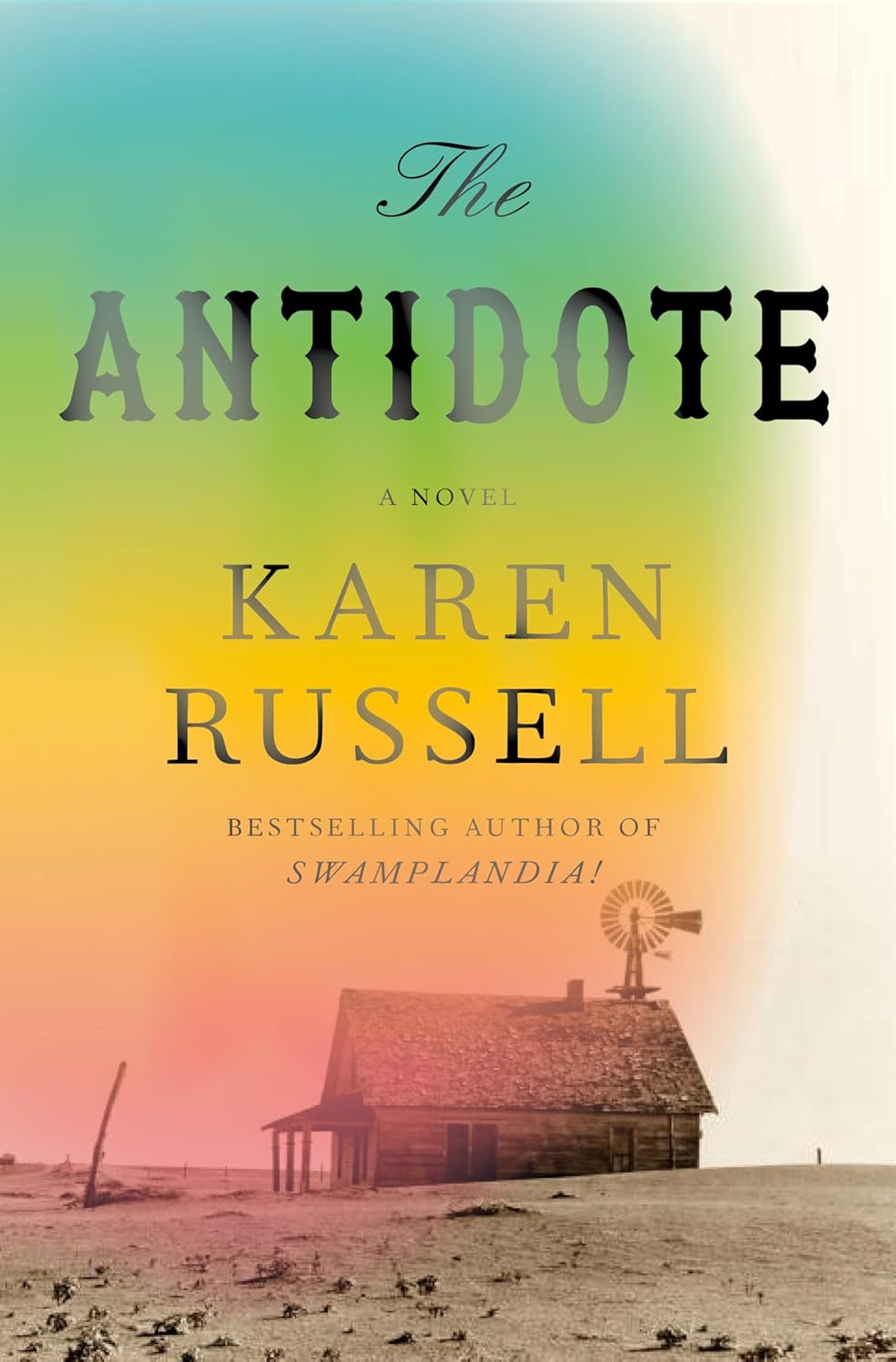
The Antidote by Karen Russell clocks in at 424 pages, including a land acknowledgement, photo credits, author notes, and general acknowledgments. A sprawling novel, The Antidote is difficult to whittle down into a simple plot description, but the titular character is what’s known as a prairie witch, a person who can store information in her body like a vault and give it back when the secret-giver returns with his/her receipt. Some people store horrible memories so they can breathe easier; others deposit good memories to bring back later, perhaps after they would have naturally forgotten a beautiful moment decades later.
Russell’s setting is 1935 in Nebraska after a violent dust storm known as Black Sunday, and later the flooding of nearby Republican River. A sprawling story, the list of characters is vast, the timeline shifts to flashbacks, the points made (climate change, oppression, treatment of unwed mothers, stolen land, racism, political corruption, Queerness, disability, animal plagues, sexual assault, etc.) are numerous, and the writing is poetic. If an author leaves out any person/group, is the book not worthy? It feels like Russell’s answer is a nervous gulp on the page.
For all of the above reasons, I did not finish The Antidote, though I did get to page 317. I saw a comment on The Storygraph that suggests Russell writes as if she’s gunning for The Booker Prize because she didn’t win with a previous entry, and it makes sense to me. Every hot issue is there in the novel, causing it to bloat. For example, in Nebraska the local tribes had their land stolen to make way for newly settled white families, some refugees from Poland persecuted by Germans. Thus, Russell writes a flashback from a Polish man’s point of view, describing his family under German rule, moving to the U.S., and the watching the Native tribes persecuted while he remained silent.
Perhaps Russell worried that she would be called out for writing from the point of view of a Native character when she herself is not, but there is also the risk of ignoring the presence of Native tribes in Nebraska, too. Therefore, I never read a Native character from his/her own point of view. It seems like trying really hard to cover all her protentional reader complaints. On the other hand, I could be wrong; Russell writes from the perspective of a black woman, a photographer hired by the US government to take photos of resettlement efforts as a form of propaganda.
If you Google online, you’ll see the list of characters is impressive, and many get their own points of view: the Antidote prairie witch, the photographer, a farmer magically unaffected by the dust storm, the farmer’s niece, a scarecrow, etc. That’s not so many, yet these characters have flashbacks that tell the story of other people. For instance, the Antidote remembers her time in a home for unwed mothers and explains the backstories of some of the girls there. When the farmer collects a memory his father deposited with another prairie witch, we get that back story. I found myself skimming the secondhand stories because I understood the point was to make a point.
Right around 300 pages, I realized I didn’t want to keep reading. I’m not into sprawling narratives because the more interesting parts get delayed, and it feels more protective than genuine. If Russell doesn’t include everything, someone would make noise about erasure and white privilege. To be honest, I’m making assumptions, but fiction is not meant to be read as a historical text, and as the focus widened, the story’s strength waned.
Lastly, although the narrators were in first-person point of view, they all sounded the same: poetic. In one moment, the Antidote notes that the farmer is writing a speech and wants her feedback because he can’t spell. A few pages later, from the farmer’s point of view, he notes, “Outside the window, Venus was a brilliant pinprick over the wheat fields. Its color shifted as I stared, from violet to sapphire to red. Gem-like sparkles reached my old eyes from the depth of space.” I’m not saying that a lack of education means a lack of intelligence, but this is a dust bowl farmer who likely did not receive many years of education, and here he understands planets, that light travels from space, gems, etc.
I’m curious what my book club will have to say about this book — the meeting is a few hours away, and I wanted to write my thoughts before we had our discussion.


Hmm. You may have saved me from wading into this one. I’m wading reluctantly into Mieville’s new doorstopper, The Rouse, right now so I don’t need anything else too sprawling.
LikeLike
I know it’s not very “literary,” but this novel could have easily been a super sweet trilogy. Instead, it just goes and goes and changes characters and changes topics and focuses on way too much stuff. Actually, he would probably be an interesting limited TV series on Netflix or something. But as a book, yeah, it’s easy to get exhausted and lose interest.
LikeLiked by 1 person
I read this one! Sprawling it definitely is and often slow. It does pick up towards the end and has a big finish though it didn’t turn out to be enough to make up for all that came before and overall I felt meh about the book even though I really wanted to like it. I found the photographer’s story the most interesting and she plays an important role in the finale. I will be curious to hear what your book group thought.
LikeLike
Well, my cousin Jordy just kept saying, “What the hell is with the cat???” I did not get to the cat.
LikeLike
Oh yeah, the cat. Totally forgot about the cat. 😀
LikeLike
Its a shame that this one tries to do too much and gets a bit heavy handed in its messaging as the actual idea of a prairie witch sounds fascinating. The lack of distinction between perspectives sounds strange too. I love lyrical writing but it needs to suit the narrative voice at the same time. I am oddly curious to see how the scarecrows point of view is worked in though.
LikeLike
The scarecrow perspective was always about a paragraph long, and that’s it. My book club told me what the scarecrow was at the end because I didn’t read that far, and it still didn’t make sense.
LikeLiked by 1 person
Oh thats a shame both length and explanation wise. It sounds like you probably made the right choice to DNF it.
LikeLiked by 1 person
Interesting novel. The part about Native Americans is interesting. Many of the issues we’re facing are the result of failing to use resources with the same respect that Native Americans did.
LikeLike
Absolutely, and I wish the book had covered that aspect more instead of introducing characters. In the opening, the farmers know they’re in trouble due to being poor stewards of the land.
LikeLiked by 1 person
Oh, wow, a missed opportunity there. Yes, I think a lot of people still don’t understand how good stewards were the Native Americans.
LikeLiked by 1 person
A regular library patron of mine raved about this book, but I’ve just not been enticed yet. Still haven’t, ha ha!
LikeLike
Now I wonder what the patron loved about it! Maybe just that the idea is so different, which I agree with, but the idea got lost amongst the other stuff.
LikeLiked by 1 person
I can’t remember, ha ha! But she has quirky taste.
LikeLiked by 1 person
If I had a prairie witch which memories would I wish I had stored (of course I can’t remember now). I remember meeting Milly (17 Dec 1977), I remember the kids being born. Still, it’s an interesting question.
I don’t imagine I’ll ever read this book, but I agree that the author has seemingly tried too hard to cover all the issues; and about ‘poetic’ authors not managing ordinary dialogue
LikeLike
Awww, I love that you shared your memories and considered what you might give to a prairie witch. I think any of those situations that happened years ago that I fixated on for years after could go.
LikeLike
“If an author leaves out any person/group, is the book not worthy? It feels like Russell’s answer is a nervous gulp on the page.” This is a great couple of sentences – although I’ve never read this I have definitely read this kind of book, and know exactly what you mean. Such a shame as this is a really interesting premise – although I’m not much for magical realism I do love stories about storing memories, and I think I’ve only seen it in short story form before!
LikeLike
I like magical realism used wisely, and it can’t tip over into fantasy. The use must be focused.
As for books with too many issues addressed, I feel like this is a problem as a result of social media mobs. I still distinctly remember an author addressing a group of readers screaming that she didn’t write Romany people correctly when she herself is Romany.
LikeLike
I have this on my TBR but also have never pulled it off the library shelf to actually read it. I had thought it was a sort of re-telling of the Wizard of Oz – is that completely off base??
LikeLike
My mom caught on that it was a wizard of Oz inspired story, but it’s not inspired enough to make you want to pick it up. The scarecrow seems completely thrown in there just to have a scarecrow. I have no idea who the tin Man would be, I have a guess for the cowardly lion, I don’t remember any dogs. Who would be Dorothy? Would it be the prairie witch or the girl? Both are prominent narrators. The city name is spelled Uz instead of Oz. I dunno…..
LikeLiked by 1 person
I feel pretty neutral on the Wizard of Oz so that wasn’t really a selling feature. But could have been interesting if it was done well.
LikeLiked by 1 person
I don’t blame you for not finishing this one, it sounds like ALOT. I think I’d get frustrated with all the various characters, especially if you’re learning all their backstories too. I think she needed a more substantiative edit here. What did your book club have to say about it?
LikeLike
Well, my mom and cousin both finished on audiobook, and I don’t think they loved it. My cousin mentioned that in a later chapter, all of a sudden a cat is the narrator. I had flipped through the last 100 pages and noticed the cat is like “bet you didn’t think you’d hear from me again?” What is with the cat? My cousin said it’s never explained.
LikeLiked by 1 person
I mean, I love cats. But surprise cat narrator? That’s a bit wacky for my tastes
LikeLiked by 1 person