
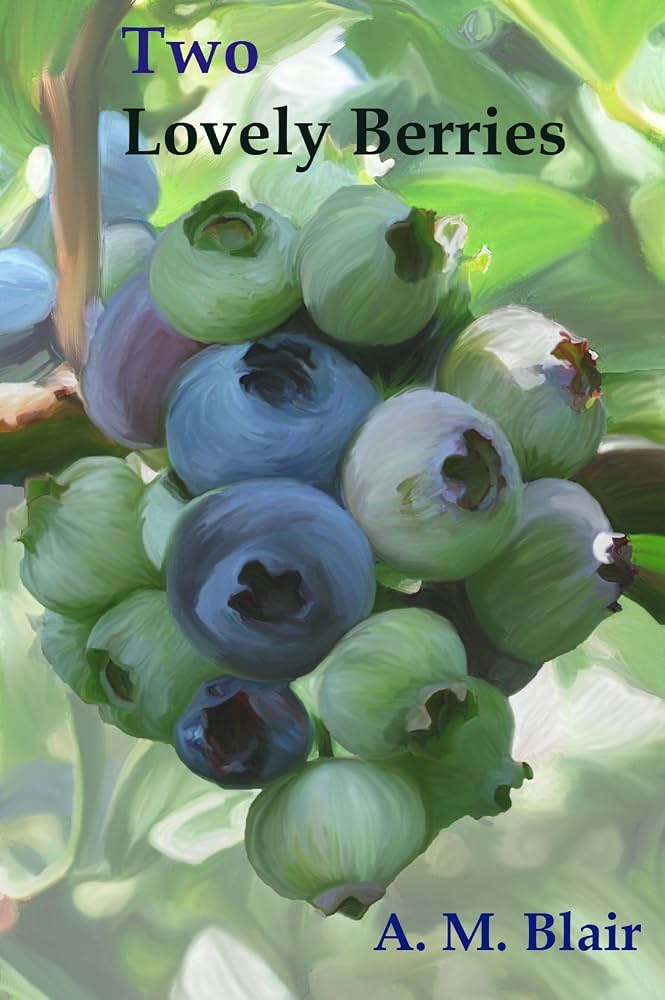
A.M. Blair is a self-published author, lawyer, and mother of twins. I know her through her blog, The Misfortune of Knowing, which hasn’t been updated since 2023. I recommend you go back and read her posts. I miss her work dearly. A fan of Jane Austen, Blair used her legal knowledge to examine books she read, applying recent cases to fictional works and educating her readers in the process. Two of her novels I’ve read are both Jane Austen retellings: A Case of First Impression and Nothing But Patience. Never mind you that her work is self-published because Blair is a competent writer. She has a degree in history from Yale and law from Harvard. Characters are updated in legal settings and made of Sri Lankan heritage, like the author. Because both novels I’d read were charming in that Jane Austen sort of way, I expected something similar in Two Lovely Berries. What I got was completely different.
The novel opens in 2011. Nora is working at some sort of specialty boutique when she notices twin toddlers demanding their parents buy them over-priced spatulas. While the parents try to swap the spatulas for some cookies shaped like animals instead, the twins refuse, clinging to their new favorite items. Nora tells the family that she “had a twin, too.” Immediately, my brain started guessing: did the other twin die in utero? As a little girl? As an adult? Was she murdered or have an accident? Blair holds that info until the very end of the novel, though not in the way that authors like Ruth Ware withhold information. You know, basically keeping the “reveal” a secret for 400 pages.
The second chapter opens by explaining that Nora and her twin, Aubrey, were monozygotic. Nora was a follower, doing whatever Aubrey decided. We learn that Nora and Aubrey’s parents had several miscarriages before the twins were born, but afterward, the girls lived a life of luxury afforded by their father’s, a divorce attorney, income. Their mother stayed home, overseeing staff, such as a cook for the family. Nora and Aubrey attend Yale where Aubrey is awarded and recognized, and Nora is but a “mere” student by comparison. Shortly after graduation, Aubrey is engaged to George Wilcox, a pre-med student whose education continues in California, the opposite side of the country from her family. Nora is lost without her twin. Who is she if she’s not following Aubrey?
I am pleased that Two Lovely Berries is told from Nora’s perspective alone because through her eyes, she’s just living her life. As the reader, I saw her more as a hapless villain, and some of the characters’ actions suggest they did, too. Nothing about A.M. Blair’s novel is right in your face. It’s so subtle because Nora is the narrator, and you start to wonder why you’re uncomfortable when you’re just reading a typical tale of recent college grad getting used to adulthood and fumbling her way through. I don’t want to spoil the trajectory of the plot, but one example that Nora fails to consider carefully is the consequences of sleeping with her brother-in-law’s brother. George’s older brother, Greg, is an attorney, and by entangling herself with him, Nora lives day by day instead of predicting what would happen if she and Greg had a nasty break up, or if Aubrey and George divorced.
Along the way, the twins’ parents keep up the facade of “good family” despite us readers seeing infidelity in every high-power man: staying at the office late, a touch that lasts too long, a young female intern hanging around, etc. When Nora doesn’t see what I suspected, I started to wonder if these doctors and lawyers were really just busy at work. Nora considers how her mother encourages her post-graduation: “It wasn’t that she wanted me doing something useful with my life; she merely wanted me to find someone useful.” You start to understand why Nora and Aubrey operate as they do, because they’re in the weeds of that kind of thinking and lifestyle. Women marry into a good family with money and respect; men maintain high pressure jobs and relieve tension in any way they see fit. Something happens with Aubrey that I did not predict — not all at once, though — which is why Nora uses the past tense “had” when we get back to the present in 2011.
I hope I’ve done Blair’s novel justice in my description and enjoyment of it. When I wasn’t reading Two Lovely Berries, I wanted to be reading Two Lovely Berries. It’s so weird to follow a narrator whom I like but don’t trust. Nora doesn’t make stupid mistakes; she follows what’s in front of her, leading her from place to place in a way that never looks like ennui. If there’s one thing I can’t stand, it’s a novel in which a privileged person mopes around for years, and this ain’t it. My only criticism is that the title (the twins aren’t “lovely”) and cover image don’t capture the mood of the novel. Perhaps something like a female silhouette leaning against a brick apartment building smoking a cigarette moodily would have been more appropriate.


I remember that blog; I liked it too. It might be nice to reconnect with her writing in a novel.
LikeLike
If you have Kindle unlimited, it’s free. I think the cost of you don’t is only a couple of dollars, so definitely worth it.
LikeLiked by 1 person
Based on your description I’m not sure about that cover either! I love that feeling when you miss a book when you have to put it down. I do remember that blog as well.
LikeLike
I got the vibe that she stopped coming around as much shortly after the 2016 election. I assumed she was busy doing lawyer things related to people who felt emboldened to be domestic terrorists, to be honest…
LikeLike
This does sounds fascinating – now I want to know what happened! I agree that the cover and title don’t convey the type of book you’re describing.
LikeLike
I hope you get a copy. Amal Blair is a fellow blogger and self-published author whose work is professionally done. It’s on Amazon for a couple of dollars.
LikeLiked by 1 person
This does sound like a good book, I think I would want to read it in a few years once my love life has settled down a bit. And agreed – that cover does not do what’s inside justice!!! You’ve definitely piqued everyone’s interest with this review.
LikeLike
It seems like it, and Amal is a gem, so I hope readers pick it up just for the satisfaction. I can see why you wouldn’t want to read it. I’m curious how things are going with you. If you want, I would love a reply, or you can email me, if you like. Or, if you wanna just namaste this whole thing away today, that’s cool, too!
LikeLiked by 1 person
haha I’m sort of in the namaste period right now, but honestly, I’m doing pretty good!!!
LikeLiked by 1 person
Interesting review Melanie. Does the cover have some symbolic meaning? I am intrigued by twins, so I’d love to know the story here. Anyhow, this really tempted me, “When I wasn’t reading Two Lovely Berries, I wanted to be reading Two Lovely Berries. It’s so weird to follow a narrator whom I like but don’t trust.”, particularly the last bit – you like but don’t trust. An unreliable narrator?
LikeLike
Because Blair is self-published, I’m guessing the cover was simply two berries in public domain. The author has twin girls, little red heads, in fact! The narrator wasn’t unreliable so much as she didn’t seem to make good decisions. Like, if we were friends, I wouldn’t trust her to do something logical/right according to my perspective.
LikeLike
I was going to suggest it was to do with being self published. Ah, that sort of trust. I guess if a character did everything that we think would be right they might not be very interesting?
LikeLiked by 1 person