
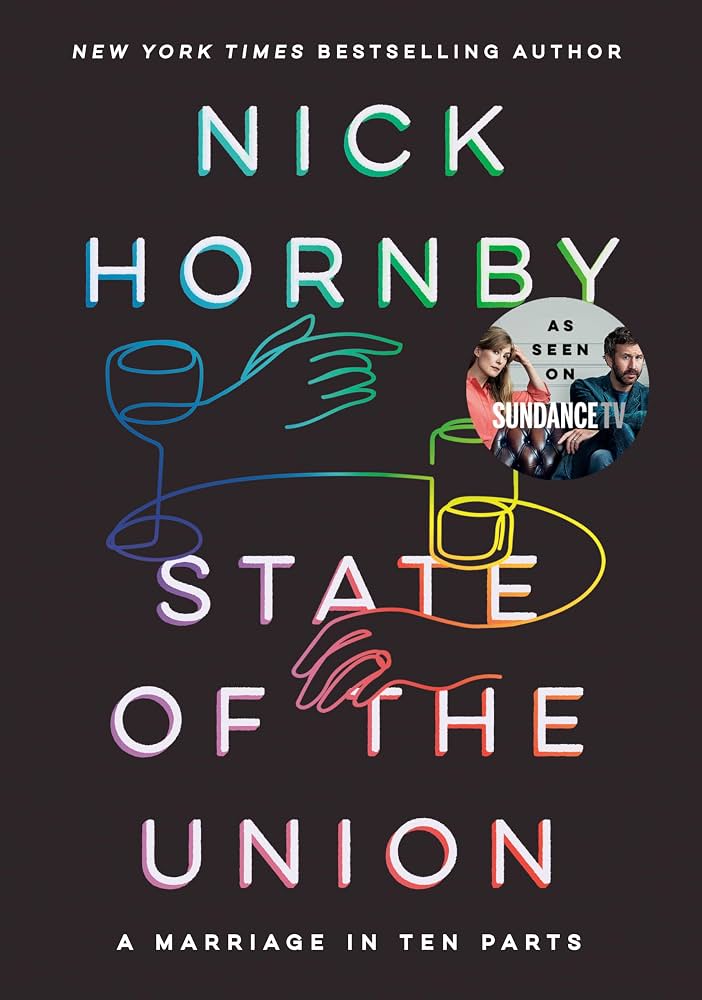
I don’t think I’ve read Nick Horby since I was 19, and that was for a college lit course in which we were assigned About a Boy. I remember nothing other than we also watched the movie starring Hugh Grant, back when Hugh Grant was a thing. I know Horby is famous, though, so I had no quibbles about purchasing the novella State of the Union: A Marriage in Ten Parts at the $1 library sale.
The plot is quite simple. Tom and Louise have been married for years and have two children, but when Tom stopped having sex with Louise, she had a brief affair. The novella reads more like a play, completely set in a bar and the street outside. Each section begins with Louise and Tom entering the bar, what they’re wearing, where they sit. Really truly, set up like a play. The rest of the section continues almost entirely in dialogue. It’s a play, Nick Horby! You’re not tricking me!
Okay, we can call it a novella. Anyway, the dialogue shines, giving readers insight into the complicated nature of relationships. I don’t mean it in a flippant way, because all relationships are complicated. My god, the nuance. Instead, Hornby highlights the ways in which we want many things to be true at the same time. When Tom tries to change himself to be more desirable to Louise, she finds him creepy. He’s not trying enough, he’s trying too hard, he’s not trying like himself, etc.
Louise isn’t the villain here; Tom doesn’t really want to do therapy. In a later section when they finally start having sex again and she questions its validity (was the sex too good, meaning he was performing as if she were someone else?!), he says, “Don’t start on the sex. Leave it alone. We’re having it. Don’t knock it. It’s my only accomplishment of the year.”
The origin of the marital issues is not sex, but on the surface, that seems to be the problem. One conversation asks what the importance of sex in a marriage is:
“But take the sex away, and all you’re doing is . . . sharing a house with some bloke who moans a lot and pokes fun at my bedtime reading habits. I mean, what’s he even doing in bed with me?”
“I’m just trying to encourage you to branch out. There can’t be that many Scandinavian women left to kill, surely?”
“Do you understand? Sex is the thing that separates you from everyone else in my life.”
“Nearly everyone, anyway.”
At the end, Tom makes a dig at Louise for her affair, so while we’re laughing as readers, the characters are taking this seriously, which makes for a juxtaposition I did not expect and truly enjoyed. You have to ask yourself why some marriages work while others just limp along. When Louise admits that she’s been recording their therapy sessions and then re-listens to them when she goes on a walk, Tom is astounded, not believing he gave her consent to do that. And why would she relisten to them? He asks, “Like a BBC radio drama sort of thing?” She replies, “Yeah. Except there are some credibility gaps. Like, wow, these two people would never get together in real life.”
We don’t know if Tom and Louise make it or not, and that’s not the point. Hornby gives us a snapshot of a broken marriage that has a lot of heart in it, and those pre-therapy pints and the pub across the street are deeply engaging and darkly funny. Go ahead and get this one — you’ll finish it in a couple of hours.


I haven’t read any Hornby for ages either but this one sounds like exactly my thing.
LikeLike
It was so readable. At first, I put the book side to put in my giveaway box, but I took it back out and put it on my bookshelf. I’m going to see if there is an audiobook with a male and female voice narrator.
LikeLike
My favorite writing of Hornby’s is when he writes about books and reading (Ten Years in the Tub). Which is not surprising, considering I generally am a sucker for writing about books and reading, LOL!
LikeLike
I think I tried to read that one when it came out and didn’t finish, but I can’t remember why. Was I in grad school??
LikeLiked by 1 person
I’ll take your word Horby is famous but when did Hugh Grant stop being a thing? I saw an interview recently where he had grey hair. Is that the problem?
I’ve done marriage therapy – and it worked – but taping and relistening? That would be excruciating.
LikeLike
Hugh Grant was the leading man in most everything in the 90s, and then there was a scandal when he was caught with a prostitute, so it’s like no one could see him as the adorable cheeky British man in the US falling in love with an American girl anymore.
I can’t fathom relistening to any therapy session, especially a marital session.
Speaking of you having been married, I haven’t heard much about Milly in a while. Is she okay?
LikeLike
Milly’s fine. I’ll see her tomorrow and tell her you asked.
LikeLike
Wonderful, thanks!
LikeLike
I have read a couple of Nick Hornby books but not this one. He does relationship really well, so I’m not surprised you enjoyed this!
LikeLike
I put the book in the Goodwill box when I was finished, like I typically do, but then I kept thinking about it, so I pulled the novella back out and put it on the shelf!
LikeLike
I’ve never read a Hornby book even though I enjoy reading his Believer book essays from time to time. Wait, I take it back, I have read TWO Hornby books, but they were both collections of his Believer book essays 😀
LikeLike
Ha, yes, and there is the omnibus, if you will, of his articles called something like Ten Years Reading in the Bathtub.
LikeLiked by 1 person
This sounds interesting. I read a bunch of Hornby in my teens but haven’t gone back to him in years.
LikeLike
I wonder what about his work appealed to you when you were a teenager. I read About a Boy when I was in college, and I don’t remember anything about it except for that it was a Hugh Grant movie. I wonder if Hornby is known for being a pessimistic romance writer? That’s kind of how I’ve always stuck him in my head.
LikeLiked by 1 person
I think a lot of Hornby’s characters/plots felt very hip and cool to me and at the same time were so different from any of the adults I saw around me. Maybe it felt like a glimpse into a future life I might have? I’m not really sure now. A couple of his books were made into movies – High Fidelity was one.
LikeLiked by 1 person
I’ve never read Nick Hornby, or watched the Hugh Grant movie, but it sounds like I would have liked to have read this book before my marriage ended. I think I would find it sad now. (sad horn noise here)
LikeLiked by 1 person
At the end we’re not even sure if they stay together, and that seems beyond the point. It’s more about their interactions, a snapshot of their marriage just before therapy, always in the pub.
I know exactly what the sad horn noise is because that’s the sound I chose for my Google calendar whenever I have a task.
LikeLiked by 1 person
omg that’s hilarious!!! I didn’t know you could choose noises for google tasks LOL
LikeLike
The number of times people have laughed because it went off at the perfect moment? Too many to remember!
LikeLiked by 1 person