
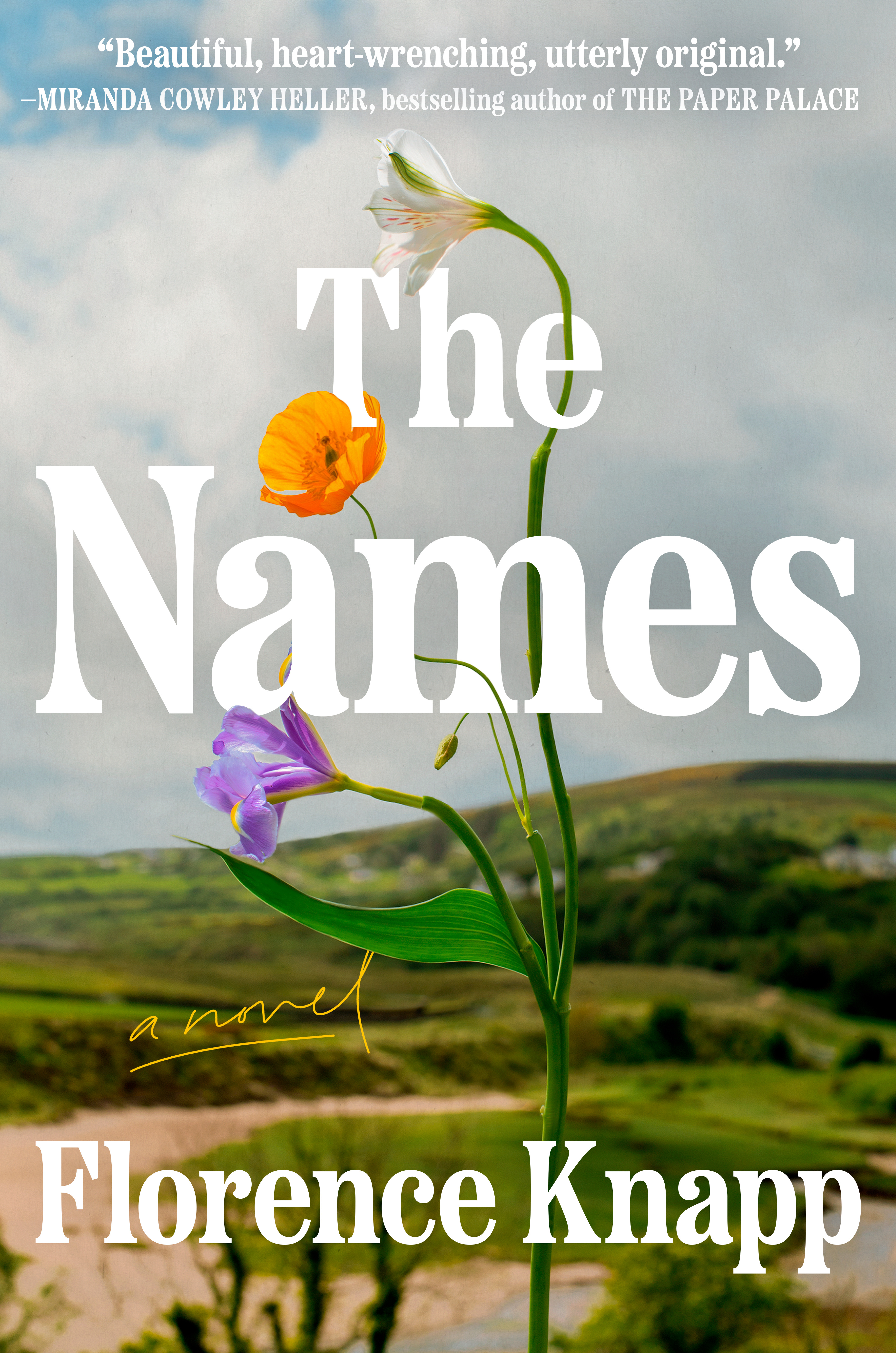
The Names by Florence Knapp is a novel that begins with a woman married to a doctor, who has a newborn son and a nine-year-old daughter. The husband, Gordon, tells his wife to go register the baby’s name, fully expecting she will comply with his decree that their son be named after him and his father. However, Gordon, though a well-liked and respected doctor, is a domestic abuser, and his father is manipulative, condescending. The little girl, Maia, does the best she can to hide from her father, but she knows what’s going on, even at her young age. The woman, Cora, is from Ireland but moved to England to further her ballet studies. It’s there that she met Gordon, meaning she’s alone in a foreign country with a husband that everyone else adores but abuses her relentlessly.
As Cora and Maia walk with the baby toward the registrar’s office that important day, mother and daughter talk about what they would name the baby. Maia shouts out Bear, evoking cuddles and comfort but also strength. Cora thinks Bear is too much for her husband and waffles towards Julian, a name she says means “sky father,” to both appease her husband and prevent her son from carrying on the name of toxic men. That will be enough of a tribute to Gordon, right? What follows is a rotation of three chapters based on the name Cora registers: Bear, Julian, or Gordon. Author Florence Knapp pushes the story ahead seven years after she’s written about each of the three iterations of Gordon learning his son’s name, rotating one version of the boy, then the next, then the next.
I don’t know that I would have picked up The Names on my own, but my mom’s hometown book club is reading it, and it sounded interesting enough that I slotted it into our mini family book club to be read around the same time. Firstly, Knapp’s writing is crisp, never leaving the reader wondering about how a certain sentence is phrased awkwardly or causing us to have to start the paragraph over again just to make heads or tails of it. For example, “Maia wants to sweep the conversation away. To stop it polluting Bear’s mind of their time together. But she knows she has to give him a little.” Notice the sentences are short, never choppy. Where Knapp could have chosen a comma, she chooses a full stop, adding emotional weight to each.
Secondly, Knapp does a lot of blending. A main character in one version of the Bear’s/Julian’s/Gordon’s life may be a ship passing in the night in another version, so it’s like finding a literary easter egg. Another type of blending is with cultures; Cora is from Ireland, and in one timeline, the children — Maia and Julian — go to live in Ireland. I loved reading the Irish names, like Orla, Cian, Aoife, and Sílbhe. Characters debate the merits of the Irish village versus a city. In London, the neighborhood is multicultural, with kind people like Mehri and Vihaan. I got a real sense of what it’s like to live in places where cultures are openly acknowledged, not quashed or “melted” into conformity.
And while one of my big gripes with historical fiction is that it often makes use of two timelines, one present and one past (and let’s be clear, readers always prefer one timeline over the other), this is not historical fiction nor is Knapp writing different timelines. It’s really the same timeline but in three versions. At the end, the characters are living through the COVID-19 pandemic, so we do have ourselves a modern novel. All three versions are interesting, and I wondered if some readers were keen to read one version of the son’s story all the way through, skipping the other two versions, and then go back and read the second version through. In fact, that could be feature, something to encourage folks to read The Names more than once.
Overall, highly recommended. I kept playing games with myself, wondering if this baby could take different aspects from the three stories and become the “perfect” version of himself, but that’s not how life is, now is it? Knapp reminded me how easily we can lose time from fear, hold back who we are, how fragile the whole set up is indeed, even when there is great joy, too.
 Grab the Lapels
I didn’t like this as much as you did, although I admired what you call the blending of characters in the various versions. Mostly I disliked that one of the versions has such detailed descriptions of the domestic violence orchestrated by the boy’s father.
LikeLike
Holy hell, I would argue that all three had detailed descriptions of domestic violence. I was actually quite shocked given how placid the cover looks. I felt bad because I read this as part of a small family book club, and the previous book that we had read was also about domestic violence. I had no clue that was in The Names, too.
LikeLiked by 1 person
Coincidentally, I was telling a friend about this book just the other day because we were talking about names. I’m intrigued by this book because I love names, and I’m at the age now when my friends’ children (like mine, or, one of mine) are having children, and I’m noting the names they are choosing. When we chose our children’s names, I had very strong ideas about what I wanted the name to mean or convey; however, whether I’ll ever get to read this book given the piles I’ve got already I don’t know. I really enjoyed your review, though, because it gives a wonderful introduction to what this book is. For the record, I have got used to my name, and feel I have a special relationship to all the Sues out there as we have a particular experience of life as Sues. But how I wished I had something a little less common. Though I would never want one that people would be forever questioning and asking you to spell.
LikeLike
My middle name is Sue, so it definitely has its moment somewhere along the way! I sometimes substitute interpret K-12, and I feel like while names got really out there for a while, people have backpedaled and are going for older names but spelled differently. Imagine something like “Dorothy” but spelled Dorathee.
LikeLike
I did not know that. Love that you are part Sue!
One of our popular comedy shows (Kath and Kim) – ended many years ago now – had a whole set of episodes on names when one of the characters became pregnant. The main focus was that practice of awful spellings of known names and made-up names.
LikeLiked by 1 person
♥️
LikeLike
This is one of those “too much for me“ books, but I appreciate your thoughtful review!
LikeLike
Too much because of the DV?
LikeLiked by 1 person
Yep! Especially of a child.
LikeLiked by 1 person
A friend of mine just read this book and told me she loved it and I had never heard of it before so I am extra appreciative of your review! It sounds good, but I’m not likely to ever read it unless a miracle happens and my TBR piles shrink 🙂
LikeLike
I know what you mean about the TBR. Lately, I’m spending so much time reading for book clubs, and I keep getting ARCs, which means my actual TBR of books I own is not going down.
LikeLiked by 1 person
Unfortunately I had to return this book to the library before I even got a chance to start it – twas my own fault, I have a terrible habit of requesting multiple books and forgetting that they could come through at the same time.
I’ll get to this eventually…..you’ve just made me want to do it sooner rather than later.
LikeLike
I’m glad to hear that! I don’t remember this one when it came out because it’s not my normal read, but my mom was reading it for a book club and wanted me to read it with her for our book club.
LikeLiked by 1 person
I enjoyed this one too! In a large part because I find names fascinating and the idea that our names influence who we become. And I liked spotting those little overlaps between the three timelines.
LikeLike
Did you ever want to go back and read it straight through each person’s timeline? Instead of having them all mishmashed?
LikeLiked by 1 person
I never thought of that, no. I liked seeing how the three timelines crossed over each other and progressed individually.
LikeLiked by 1 person
I love the sound of this premise, very cool! I haven’t heard of this book yet, but I can why book clubs would enjoy it. Lots to discuss!
LikeLike
I didn’t hear about it when it came out, but I see it was a Jenna Bush book club pick, so I’m sure it was popular for a while thanks to her endorsement.
LikeLike