
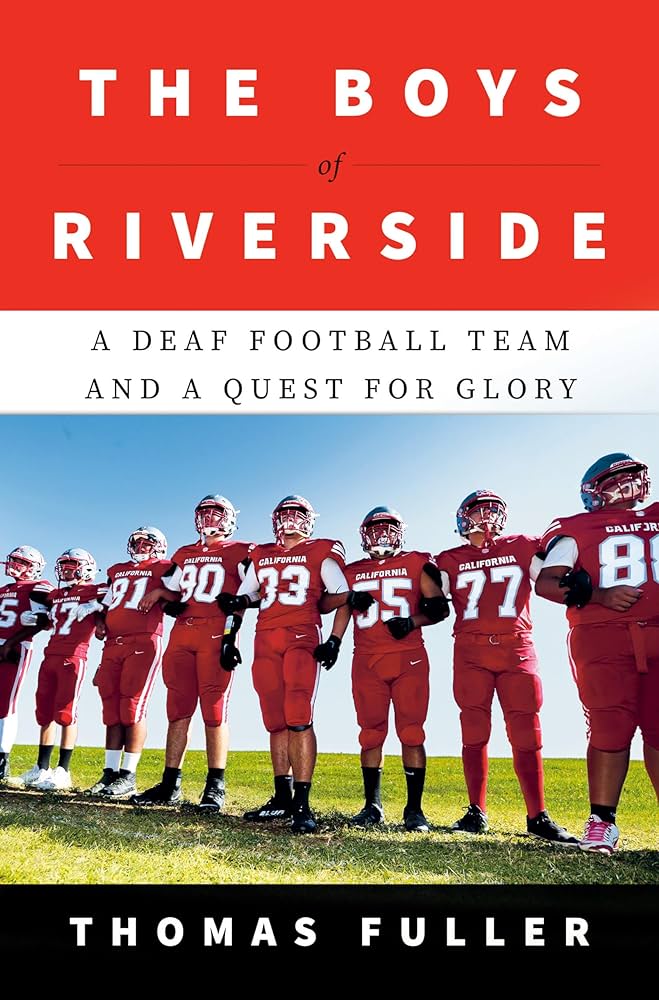
The Boys of Riverside is by journalist Thomas Fuller, a hearing man. Although I prefer to read books about Deaf people by Deaf people, this author admits that he was so fascinated by the Deaf football at the California School for the Deaf-Riverside team that he went on hiatus at work and learned all about them and their culture by following and interviewing the team. Therefore, he went in pretty ignorant like most hearing readers, making his book accessible in all the right ways. He predicts what it is that hearing people don’t know and shares it clearly, putting a Deaf football team today into a larger historical context.
While Fuller’s book is clearly written and engaging, I am not a football person at all. Therefore, I go into this review with full disclosure: I did not finish The Boys of Riverside. However, I read a good deal of the text and appreciated the way Fuller explained what he discovered after interviewing the team, its coaches, the graduates, and the coaches and teams made up of hearing people who played against the Deaf students at Riverside. Fuller makes it clear that being a Deaf athlete on a team sport can have an advantage: “In the article I wrote about the (CSDR) team, I quoted Aaron Williams, the head coach of Desert Christian, the hearing team the Cubs [Deaf school team name] had just defeated. He had a warning for future opponents of the Cubs. ‘I would say be careful in thinking that you have an advantage,’ Williams said. ‘They communicate better than any team I have ever coached against.’ The article, published in The New York Times on Monday after the game, went viral.”
Furthermore, Fuller acknowledges other benefits to being Deaf, such as communicating in challenging situations, like a loud bar, while scuba diving, or working in loud factory environments. Not knowing American Sign Language himself, Fuller asks, “On the campus of a deaf school, who is more disabled, the person who knows American Sign Language and can communicate effortlessly with students and staff? Or the person with perfect hearing who does not know ASL? Deafness, unlike a physical handicap, is essentially a language barrier in the hearing world.” Thankfully, Fuller never condescends the Deaf experience, though he is clear about the limitations. You may be thinking that a limitation is negative, though sometimes it breeds curiosity, such as when “…Keith (a deaf boy) was reading a book that mentioned the wind rustling through the trees. Rustling? What did that mean? He asked his mother. . . . Keith absorbed this knowledge and followed up with another question. ‘What sound does sunshine make?'”
The lack of typical sounds throws off the opposing team that comes to Riverside’s field: “. . . The national anthem was not part of the proceedings, and there was no announcer, nothing auditory except for the constant woosh of cars passing on the nearby freeway, the squealing wheels of the mile-long freight trains that frequently passed on the tracks next to the school, and the diesel generators for the lights.” In the US, it is common to play the national anthem before every sporting event, but why would you if the team cannot hear it? Although the song can be signed in ASL, the proceeding seems to lose its importance in the Deaf school at Riverside, which gives readers an interesting counter-perspective to what it means to be American.
I enjoyed the way Fuller discusses multiple cultures and how they interact among the people involved with this deaf football team. For instance, one deaf coach is from Iran, and he recalls growing up and meeting an American boy who brought an American football with him. “But it’s not round,” the coach recalls thinking, explaining that he and his Iranian friends proceeded to try and kick the American football like a soccer ball.
Had The Boys of Riverside been about a different sport, I likely would have finished it. However, I do encourage readers to check out Fuller’s work of journalism to get a perspective that may be friendlier to hearing folks who don’t know Deaf culture or ASL because Fuller himself is going in without any knowledge. Therefore, he knows what to cover for readers who also have no knowledge of Deaf people. Afterward, check out No Excuses: Growing Up Deaf and Achieving My Super Bowl Dreams by Derrick Coleman Jr., an NFL player.


I like NFL football (while acknowledging how problematic it often is) but probably wouldn’t have finished this one either. I had heard about it beforehand because I think it was selected as one of Amazons best books on the year it came out. Sometimes a book about sports can be a vehicle for something more meaningful , which I think this sounds like it is. I’m glad the author doesn’t condescend.
LikeLike
Oh wow, I hadn’t realized that this book was so popular out in the general public. I’m glad it was. He did mention something about writing an article that went viral, and that’s what led him to writing the book. I just missed all that news when it happened.
LikeLiked by 1 person
Mr Gums loves American football, more than any football here, which of course adds nothing to this conversation. I’m wondering why you didn’t finish it? Did it have too much boring detail about football? Or do you not approve of football so just aren’t interested? I’m trying to think if the context – like football – would stop me reading a book about something I’m really interested in, and can’t decide. I think it could stop me, but it would probably have to be a really problematical context or really poorly written.
I enjoyed your discussion of what the author achieved despite being a hearing writer, and am glad to hear that he did it sensitively. I loved that example of the Deaf boy and the “rustling of leaves” and the logical follow/up question.
Oh, and I also liked this because we knew Riverside County Well as where we lived in Ca, is northeast Orange County bordered Riverside County. We drove through it and went to events in it, often.
LikeLike
I have never been able to understand the rules to American football, so a lot of it doesn’t really create a picture for me. I’ve read nonfiction books about soccer and baseball and other sports. Football is just one that is never stuck. I am interested in why your spouse loves American football. It’s kind of surprising given that the rest of the world seems crazy about soccer. Although, I do know that you lived in the US. That might have influenced him. I’m not against football per se, but I am aware that it’s a rather dangerous sport and only recently have they started enacting rules to protect players.
LikeLike
I think you have better rules protecting players than most Australian football codes have. We have four: Australian Rules, Rugby Union, Rugby League, Soccer/Football. Yes, living there got him interested, and I think he likes something about how strategic the game is. For me it goes on forever.
LikeLiked by 1 person
I’m not really into football either and if we ever watch it here it’s always Canadian Football because that’s what Peter follows. So this book doesn’t have a huge appeal to me either but I do like the way it seems the author focuses on the advantages that this particular team would have. I like the idea of thinking of who is really disadvantaged on a campus full of Deaf people who can communicate with ASL.
LikeLike
I once heard it read that Deaf people have more in common with immigrants than disabled people, and your comment reminded me of that. There is no “disability” at the school for the deaf if you know ASL. It’s actually a difference of language, culture, and history (imagine an immigrant from Mexico, for example) compared to other people who are labeled disabled and don’t have a shared language, history, or culture.
LikeLike
I grew up sports mad, but I don’t think I’ve ever seen (on TV) a full game of American football, even now that Australian Rules footballers are getting games as punters. What I do wonder is if the opposing team has to hold back at all – how does a Deaf player, especially at the bottom of the pack, say ‘Stop that, you’re going to break something!’
LikeLike
I don’t know the rules of American football, but I do know it’s usually loud there. If someone were screaming and hollering, I’m not sure anyone would hear it. It’s a rather dangerous sport, especially in regards to traumatic brain injuries.
LikeLike
As a non-sports person, I can totally relate to this review haha I can’t see myself ever finishing a book about sports (although crazier things have happened!). I would appreciate the ‘hearing’ perspective though, that sounds very accessible
LikeLike
I’ve finished books by soccer giants like Abby Wambach, Carlie Lloyd, and Johnny Damon, but they’re all obviously written in collaboration with someone. The excitement is almost cringey! because! everything is! exciting!
However, Fuller is a professional journalist, and it shows.
LikeLiked by 1 person
Speaking of Abby Wambach, I listened to Glennon Doyle’s book and her story of them meeting and falling in love is LOVELY
LikeLike
I was on the fence about Doyle’s memoir that was EVERYWHERE when it was published because I was worried it would read too much like a bunch of cute positive affirmations. However, it sounds like it might be more than that.
LikeLiked by 1 person
Yah I don’t think it’s like that. It can veer into white women healing territory for sure, but the way her life sort of blew up and then came back together was fascinating!
LikeLike
Sweeeeet, I’ll audiobook it.
LikeLike