
Several years ago, I read Fantasticland by Mike Bockoven with a different horror book club, and we all loved it. The story is told via interviews with people who experienced what happened when a hurricane hit a theme park (definitely not Disneyland *wink*), and the different themed areas gathered their employees like rogue gangs and took action that led to mass chaos and murder. Sort of like a Lord of the Flies for theme parks, I suppose, all in interviews. You may have read one of the most popular fictional journalistic horror novels out there, World War Z by Max Brooks and enjoyed it. So, now you’re thinking, heck, why not Come Knocking by Bockoven?
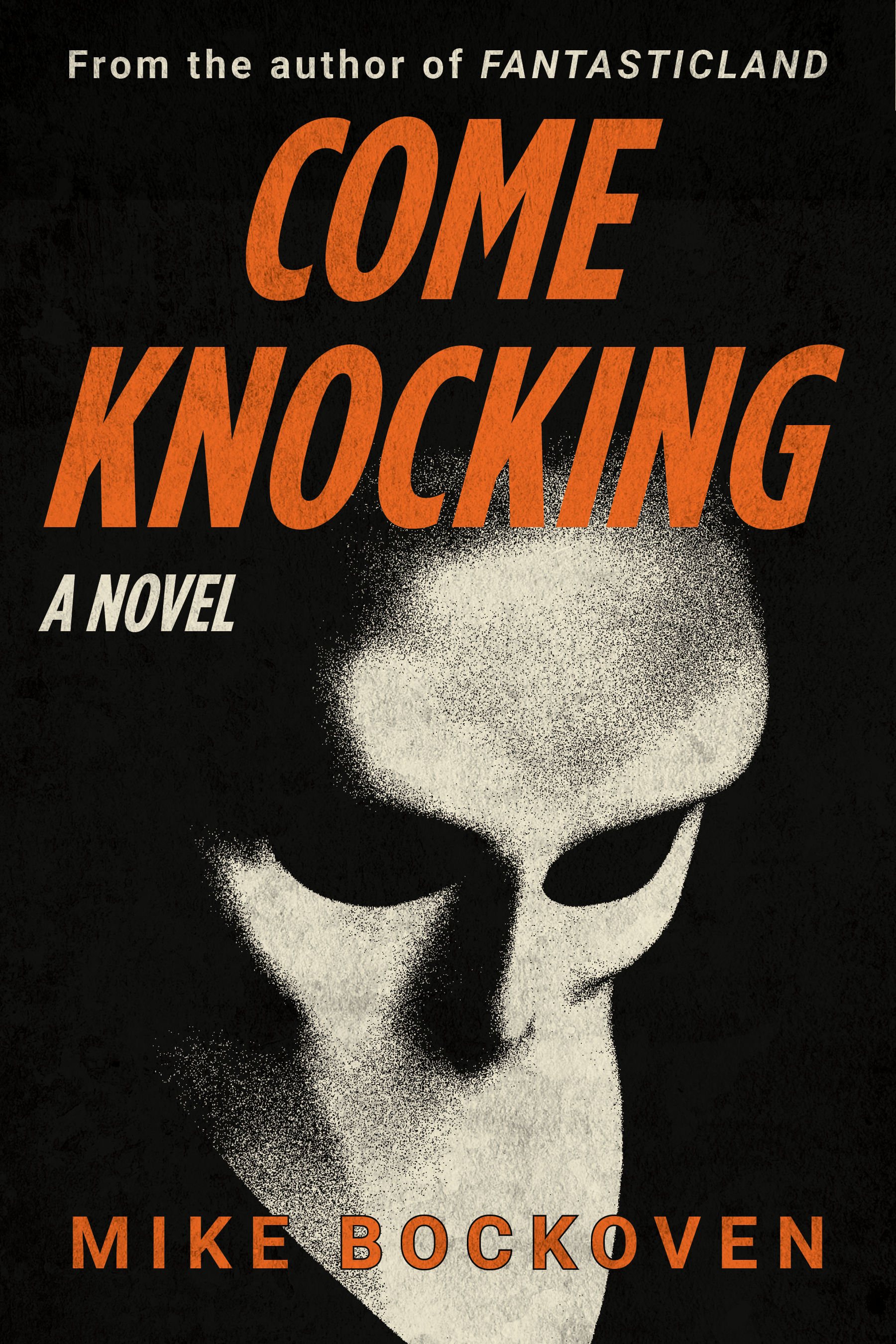
The same fictitious reporter from Fantasticland is back to interview people who were there on March 14th, THE night in Mike Bockoven’s latest novel, Come Knocking. I’m guessing it’s the same reporter so Bockoven can justify using the same format, but other than that, there is no connection. After a production company in New York City successfully rolled out an interactive theatrical performance called Come Knocking that had themes of death and for which every audience member wore the same mask (so you can’t tell who’s who when the killing starts, of course), they packed up and took the show to Los Angeles. This isn’t your typical stage show; Come Knocking is six floors through which ticketholders can travel around, are encouraged to split from other members of their group, follow character actors, watch dances, etc.
Our reporter describes the Come Knocking performance as “many things, all of them hard to describe. It’s an interactive theater experience, a massive creative and technological undertaking, a show with a powerful and vocal fan base…” However, brewing on the internet is a group called Who’s There? that hates Come Knocking for mostly unclear reasons. They’re on their own subReddit and have a Discord group. On the night of March 14th, this internet group infiltrates Come Knocking mid-performance, and rioting and carnage follow.
While the interview format worked successfully in Fantasticland, it hurts Bockoven’s newest novel. All the characters sound the same, regardless of age, gender, sexuality, or income. Two characters are notably different for the wrong reasons. One person’s first language is Spanish and calls March 14th “the bad night” instead of “March 14.” It felt… like Bockoven shouldn’t try to write characters from other countries. The other was British, and he sounded like all the other characters, too, with a random “mate” thrown in here and there. I can understand some readers may feel that having every audience member wear the same mask and making the point that people are anonymous online suggests we all sound the same due to hive mind, but I don’t agree. The point is the reporter is doing live interviews during which the interviewee cannot hide behind masks, the internet, etc.
Essentially, almost every characters sounds like an edgy early twenty-something in 2003 rather than young people today. There is little to no modern slang or phrasing, and we’re talking about young dancers and actors in a novel set today. It’s hard to tell in general who is older or younger, male or female, etc. Thus, Come Knocking as a novel lacks that feeling of authenticity in the interviews, which is further exacerbated when the reporter collecting all the information to turn into a book pulls information from Reddit posts as Bockoven imagines them. Those passages lack the traditional terminology from Reddit, such as OP for “original poster,” people ribbing each other for hilarious typos, and the edits at the end explaining any changes to the post, especially for added information.
What would have saved Bockoven’s novel? A limited number of narrators, fewer viewpoints that cover the same kinds of violence (several interviewees discuss the active shooter on one floor of the performance venue), and a forward momentum. Yes, we learn that Come Knocking was the hottest show in town, but I couldn’t fully picture why other than some of the dancers were topless or fully naked. When those same dancers go full-on Rambo on March 14th, I didn’t know enough about them to understand their quick pivot to violence. Partially, Bockoven relied on stereotypes to tell us what to think in shorthand. For example, one interviewee says, “My dad was a deadbeat asshole, and my mom had a revolving door of guys who would pump her and dump her.” Someone will have to convince me this is the language of an early-twenties woman and that I’m supposed to assume her ubiquitous childhood made her murderous.
Overall, a rather disappointing read.
 Grab the Lapels
I appreciate how you offer suggestions for what would have saved the novel. That’s constructive! You know me, this is not one I’d pick up, but I’m sorry for you that it was a disappointment.
LikeLike
I read a book just recently that reminded me of you! The review is coming out soon, but it’s called Here Beside The Rising Tide by Emily Jane. It’s a wild mix of things and it has a sea monster, but it’s not scary; it’s pretty cute and has a mom and her kids at a beachside town.
LikeLiked by 1 person
That sounds up my alley!
LikeLiked by 1 person
Oh how I hate it when a novel tries to tell me what to think!
LikeLike
I especially hate lazy stereotypes.
LikeLiked by 1 person
I’m sure I was never going to read Come Knocking, except maybe by accident. But I enjoy your analysis of why it doesn’t work. I guess writers of popular fiction are often under pressure to repeat their successes.
LikeLike
Perhaps, though I see he has multiple books. I’m wondering if he just wanted to bring this character back, the journalist writing the book. I really could have enjoyed the story from a third-person omniscient point of view, one that switches between characters within the same chapter, which would have given a similar effect to the interview style but allowed more space for describing the setting.
LikeLike
What Bill says … I can’t imagine this would come my way but I really enjoyed your analysis.
I also like your response to Bill re third person omniscient. I do like first person voices, and the interview format sounds like it could really work, but sometimes I yearn for good old third person omniscient, or even third person limited. It can be truly stylish but for some reason it seems like many see it as old hat and that cheeky (or whatever word you applying use) is the way to go.
LikeLike
I read an article probably 20 years ago that was talking about this major shift in publishing, transitioning from the third person narrator to the first person narrator, at least in US fiction. The article was titled “All About Moi?” The author’s point was that she felt there was a switch to so many Young writers not really knowing how to craft characters, so they basically inserted themselves as first-person narrators, and the result is that contemporary fiction at that time was starting to feel narcissistic.
LikeLike
Oh thanks Melanie … that sounds about right for here too, the shift not necessarily the cause which I don’t have a clear reason for. That reason sounds possible. I wonder too though whether it’s more due to a cultural shift from, for example, quite a “we” focus in the 60s and 70s (which continued a long cultural focus on community more than the individual) to a “me” focus which with growing neoliberalism from the 1980s?
LikeLike
Hmmm, I’m not sure.
LikeLike
I think the idea of the reportage format is a clever one, so it’s a shame that it doesn’t work here! The voices definitely need to sound different (and not in a stereotyped way). I think the (few) stories I’ve read in this format have been on the short story/novella side, and I wonder if it’s just difficult to sustain over novel length?
LikeLike
Fantasticland is novel length, and it worked well, so I’m not sure. I think the scope was too limited by interviews. I couldn’t picture the setting clearly, and I didn’t understand any of the characters well because they were retelling what they saw and not much else. What books have you read for which you enjoyed the interview style?
LikeLike
Sounds like he was trying to recreate what worked for him the first time and should have been trying something new instead!
LikeLike
The journalist is the same character, but that doesn’t matter at all because he’s just writing what the subjects are saying, so I didn’t really see a pointing carrying on with this same character.
LikeLiked by 1 person
Hmm disappointing for sure. it sounds like a cool concept, but difficult to pull off. I usually love the interviewer style, but the characters need to have their own distinct voices for this to work.
LikeLike
Have you read a lot of books that do the interview style? I haven’t, so I’m curious which ones you’ve enjoyed. When it works, I really dig it.
LikeLike