
I feel it bears repeating why I enjoy horror. I have a simile, though the simile falls apart. I don’t care. You know how in Jurassic Park the idea is that tourists can safely ride along in a car on a rail while they see real dinosaurs? Basically, engaging with what is dangerous in a safe way. That’s what horror is for me. We get to interact with that which scares us while safely remaining in the rail car. Now, we all know that in Jurassic Park the point is that the dinosaurs are unpredictable and none of it is safe, but I can’t think of another comparison. Maybe one of those boat tours with a glass bottom and you can see the sharks? That probably works better, but here we are.
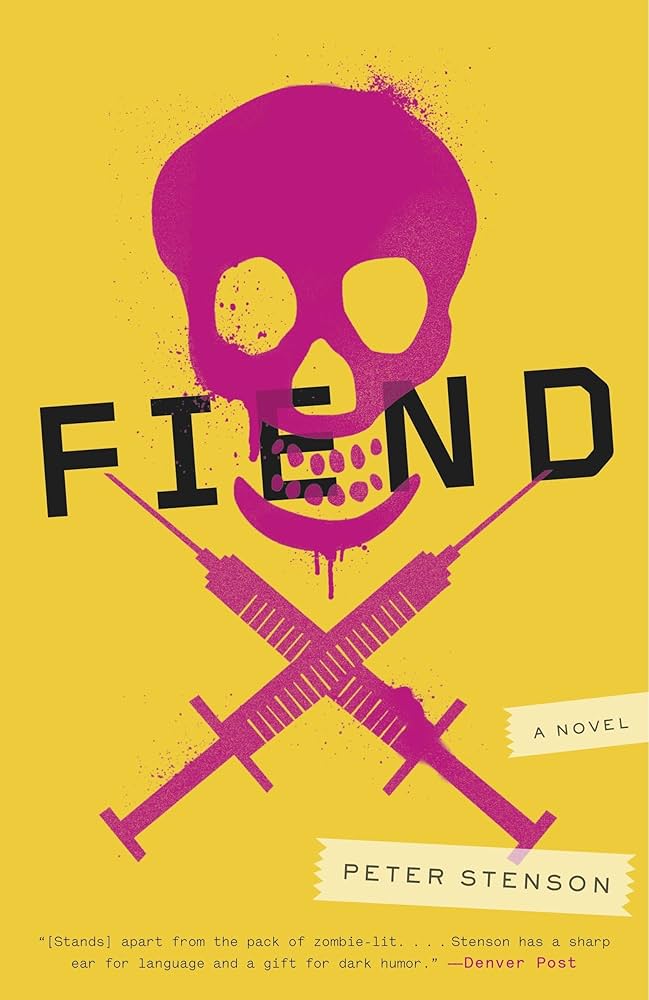
Anyway, for our zombie-theme month in the spooky book club I lead, we read Fiend by Peter Stenson. The title refers not only to the zombie-like creatures but also the main characters, all of whom are meth addicts fiending for drugs. In a twist on the genre, one night everyone came back as the living dead with the odd quick of giggling. Who ever heard of a giggling zombie? But thus they are.
Our main character, Chase, and his best friend, “Typewriter,” have been holed up for the past week getting high. When they see a little girl eating a rottweiler, they realize something is wrong, but not the full extent — a zombie apocalypse. In this novel, zombies are common knowledge. It’s a choice filmmakers and writers make to have zombies be “new” in their plots, but Stenson sets his characters in a world that has the same info as his readers. Chase realizes, “I’m thinking about every show I’ve ever seen, every film, about arms outstretched, moans, and decaying flesh, and ghouls and living dead.” The only people who didn’t “turn” that fateful night are meth addicts. To add an urgency, the only way to keep from turning is to continue using meth, a drug that requires chemistry and specific ingredients and someone who knows what they’re doing.
We have a huge problem with opioids in my state, and I cannot fathom spending more than a minute with someone high on meth. But I did read a whole book inside the head of a meth addict, his meth-head friend, and his meth-ed out girlfriend named, bizzarely, KK. Based on the table of contents, the story lasts one week. I enjoyed the time stamps, too, because these characters are tweaked out 24/7, and the time lets you know if it’s 2:00AM or 2:00PM. That made a difference to me. Rather than your typical survival novel in which you are rooting for the characters, in this case, they all suck so hard as humans. I wasn’t rooting for anyone, but I also wanted to know where the story would go, so I was hooked. I’d never read anything like Fiend, so even though the zombie sub-genre is tired, Fiend was not.
For example, in most zombie fiction, the characters keep moving to survive, searching for communities that have been established and feel like normal, pre-zombie times. It’s always a trap; someone in that commune is eating people or has sex slaves or something. But in Fiend, Chase, Typewriter, and KK have to find someone who can cook meth. We’re led to a cabin in the woods, a juvenile detention center, a Chinese neighborhood. I definitely felt like the tourist in the Jurassic Park car as people lied, stole, picked scabs, used a lot of slurs (which I accept because who has ever met a politically correct drug addict?), and were in general a sad mess. The body is king in this novel, and Stenson doesn’t hold back on his descriptions. The irony is the world has come to an end, and the people left to save it were known as “the walking dead” before the zombie apocalypse.
Stenson addresses many questions through Fiend without putting them right in your face. Chase and KK had been apart for the year before the apocalypse because she wanted to get clean and he did not. As a result, he stalks her that whole year, which we get in intrusive memories during the present chaos. He recalls, “She told me she couldn’t do it anymore. That she was leaving. Going back to treatment. I laughed. I told her she couldn’t quit.” When KK relapses, Chase is happy that they can be together again, even if he has to save in from the walking, giggling dead. We must ask ourselves the relationship between codependency and sobriety.
Also, when Chase and his crew go to a Chinese neighborhood, the meth cook there berates them “for “lowering” themselves to come to the Chinese ghetto “Because you figured us Hmong trash know what to do when the world ended,” whereas Chase was often bailed out of trouble by his “rich” white family. And lastly, if humanity’s only hope is to be high, does Stenson imply that life is so hard we must turn to chemical coping mechanisms? That the only way out is to blast off and ignore it? What would you do at end times?
I enjoyed Fiend and found myself laughing several times, but that sort of dark laughter that you know is wrong. After they reach a a guy living in the woods known as The Albion who cooks meth, they stay shacked up for days before realizing they all stink and are tweaking. Chase proposes they go skinny dipping in a nearby pond:
The Albino lets go of his dick and gives a few hip gyrations, sending it in a helicopter, and he says, Ready for takeoff, and then he laughs like this is the funniest thing ever and we do too and he sprints in his gimpy gait to the pond, jumping, his legs pulled to a cannonball. He lands in about a foot of water.


Is reading horror a morbid fascination, like looking at a spider? I find that some horror fans seem to get inured to the gore and then it takes more to satisfy them. This plot sounds a little like that–either you’re the living dead, or you’re actively on the way to killing yourself.
LikeLike
I just think it’s often relatable in unrelatable settings, humor frequently plays a role as the other side of a coin for horror, and we’re reminded of the frailty of life — how beautiful but short it is, how it can end senselessly or heroically. Horror also ejects you out of reality because whatever is happening is not normal.
LikeLiked by 1 person
Your simile works for me, except for me, horror invades my brain and gives me nightmares, so I guess the safe tour car isn’t so very safe for me after all. That quote at the end though is pretty funny. Ouch!
LikeLike
I do appreciate that some people have vivid nightmares and avoid the genre. I’m only trying to convince the folks who have an aversion because they assume horror is trash when it’s truly thoughtful and a great place to explore ideas. One book club member said she talked in therapy about this book and how it humanized drug addicts in real life for her.
That last quote lives in my head rent free. 😂 One foot of water plus the cannon ball maneuver.
LikeLiked by 1 person
You don’t have to convince me it’s not trash. You just have to convince me that reading about ideas via horror is more enjoyable than reading the same ideas through, say, historical fiction. I just don’t find zombies and vampires that interesting and I don’t want to want to have to understand what they are – you know, to know their culture – before I can get to the ideas. I am reading “our” book btw!
LikeLiked by 1 person
I typically don’t like historical fiction because it tends to romanticize everything, or make things work out in a way that is impractical just for the sake of having a clean ending. I do appreciate your comment that you don’t think the horror genre is trash. Basically, everybody has a genre that they love, and as long as they aren’t cruel towards others who have different preferences, I’m happy.
LikeLike
I know what you mean about historical fiction. I didn’t read it when my school friends were reading it for this very reason. Now I do read some, and I’m going to use that word you don’t like, which is “literary”! I am more likely to like “literary” historical fiction, because it doesn’t conform to that “clean ending” convention or formula. Perhaps instead of saying “literary” we could say “non-genre”. I understand why some people like genre historical fiction. They want to escape into an exciting past world where it all works out in the end. And that’s fair enough. People like to write it and people like to read it, but it’s not my preference, and we need to find ways of separating out the different types of historical fiction, so I can find what I like and others can find what they like. Same goes for most “genres” I think?
LikeLiked by 1 person
I have a similar experience sometimes with people when I tell them I enjoy reading science fiction and fantasy. They assume it’s all pulpy trash, though so these days with so many crossovers like Atwood, etc. But the stigma remains strong.
LikeLiked by 1 person
Your simile works for me, but the dinosaurs keep sticking their heads through the bars. That is, I don’t find horror to be ‘safe’. When I’m reading I identify with the protagonist and if bad things happen to them then I feel as though they are happening to me.
LikeLike
I can appreciate that. I also understand that some folks have horrible nightmares, so they process horror differently than I do. I often don’t relate to the protagonist because they’re so different from me. I may connect what’s happening to them with what’s happening to me, but typically I’m comparing differences rather than similarities.
LikeLike
What an interesting combo of topics! I’ve heard of drug addicts referred to as zombies but never would have thought to set them up against actual zombies. I’m not sure I want to spend any time with meth addicts but this does sound like a fascinating concept for a story.
LikeLike
I totally understand your simile re: horror, and I feel much the same way. I live a pretty quiet, safe life, so this is a way for me to feel like I’m getting some excitement even though I go to bed before 10pm every night hahah
LikeLiked by 1 person
Something I was thinking about the other day is how horror people are just thrill seekers of one kind. We don’t bungee jump, we don’t mountain climb, we don’t ride roller coasters, many of us are not into true crime because we find it too horrifying, but we do like play-pretend horror and find it thrilling, and often hilarious for reasons that I can’t even begin to explain.
LikeLiked by 1 person
I HATE roller coasters LOL
LikeLiked by 1 person