
*My copy of Landscape in Lavender by Brooks Kolb is an ARC that was sent to me by the publisher, Spark Press. This does not affect my review.
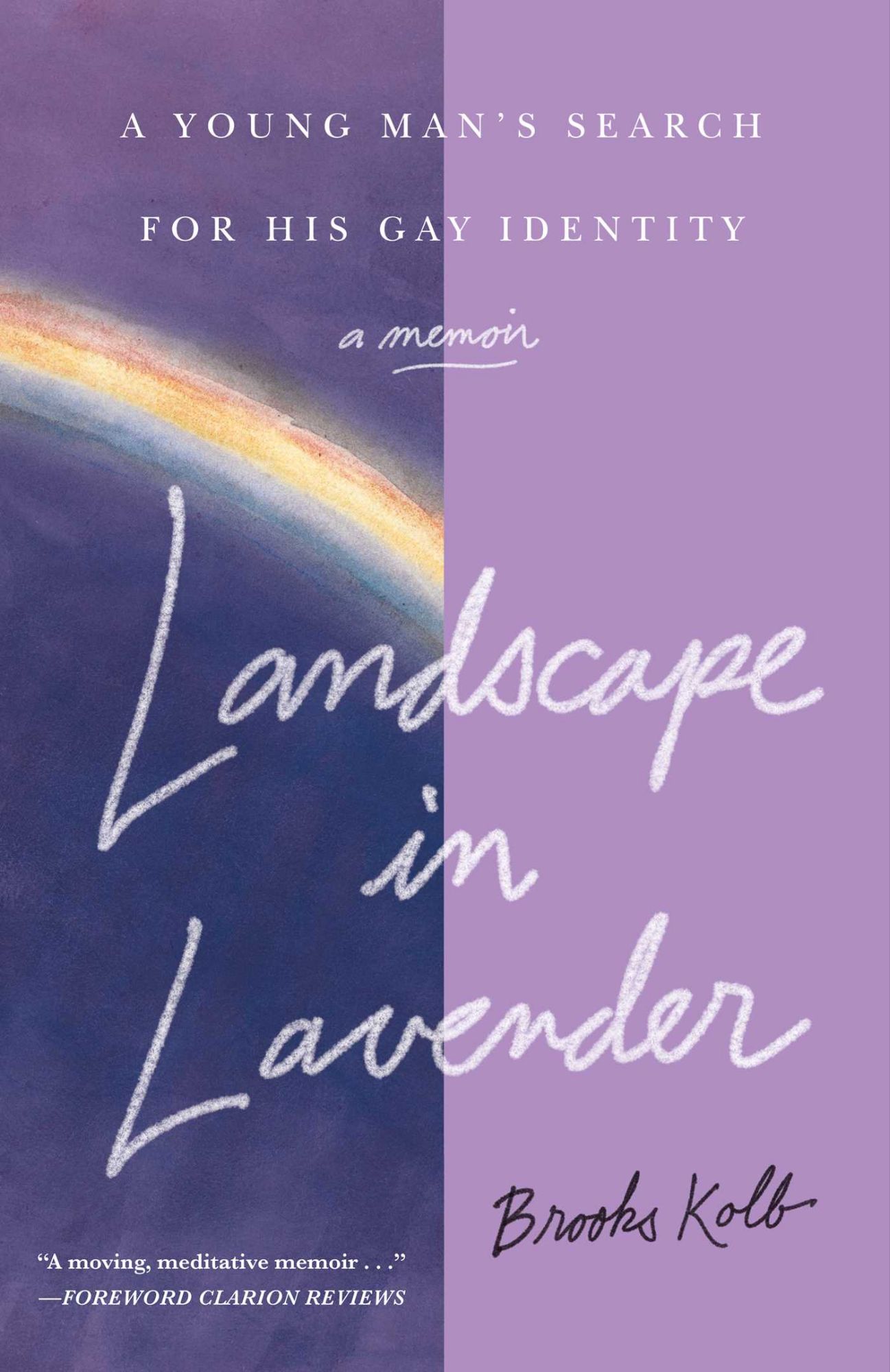
Landscape in Lavender: A Young Man’s Search for His Gay Identity by Brooks Kolb is a memoir that explores two halves. In one aspect of Kolb’s life, he’s a white landscape architect, the son of a famous building architect who was the professor of Kolb’s own mentors and professors. On the other side is a closeted young man uncertain if he is gay or just needs to find the right woman. Based on the timeline, I believe Kolb was born in the 1950s, so being gay was a problem for society and the AIDS crisis was lurking in the future.
An important aspect of memoir writing is using rhetorical tools to earn the reader’s trust. I found the opening of the memoir a bitter pill to swallow. Kolb and his friend have just shoved a sofa off the balcony of a fourth-floor apartment. It smashes on the ground. Kolb’s friend asks, “I don’t think we have to clean it up, do you?” to which he replies, “Of course not!” and then they high five. Kolb is moving to the big city! Right away, I thought about the people who now have to remove the furniture, that it’s blocking the sidewalk for anyone with a cane, walker, wheelchair, or stroller. For me, this introduction to the writer put me on edge for the next one hundred pages.
After I was put into a place of judging the author for being selfish, I noticed every little flaw. For instance, once he confirms to himself he is attracted to men, Kolb approaches them, saying, “I find you very attractive and I’d like to go to bed with you.” This happens more than once, and I found it terribly cringey, though, to be fair, I did get a sense of how awkward Kolb was when he came out. However, despite sleeping around in Philadelphia and after he makes the move to San Francisco, he judges other gay men for how many partners they have.
Everyone has their lived experiences, and we all look back and think how we could have done better. The issue is that Landscape in Lavender lacks deep reflection. The author frequently ends a challenging section by asking himself a bunch of questions, so instead of analyzing who he was as a young man, we’re left with “this happened and then this happened and I wondered X, Y, and Z.” But now that the author is over forty years past the events of his memoir, I expect evaluative self-awareness. As a result, the memoir reads like a diary.
The biggest question I had was why Kolb repeatedly lamented how he wanted romance and what basically amounts to a heteronormative relationship with a man but continues having one-night stands and finding sexual partners while clubbing. Kolb wonders, “Did begin gay always have to be about dancing and partying?” Even when his boyfriend is ill, Kolb misses clubbing. I’m not judging the choice; I’m noting the lack of analysis.
In the end, I didn’t get much from Landscape in Lavender except for a rub of discomfort — especially when he’s hiding from his white co-workers that he has a Black boyfriend, or questioning on the surface level his attraction to Black men (“Black guys,” he calls them, and I kept wondering how this phrase would come across if Kolb were a white woman). Oddly, I also felt like I didn’t know Kolb’s long-term boyfriend. Who was he as a person? I couldn’t piece together what they loved about each other because the fact-telling of events got in the way of what makes a person human. I think there is an interesting life here, but the book would have benefited from a co-author.
 Grab the Lapels
I can see why this narrator would rub one the wrong way!
LikeLiked by 1 person
I always find memoirs that lack that analytical/reflective edge a bit irritating – and that certainly sounds like an interesting choice of anecdote to open with! I would have been thinking about who would clear it up as well.
LikeLike
What is it that irritates you in particular? I come away with the impression that this person has lived an interesting life worth sharing but isn’t quite equipped to do so on their own. I think collaboration should be encouraged of writers. Instead, they tend to work alone, get feedback that is overwhelming/too much feedback, and things start to get muddled. After I finished my MFA program, one graduate has a book deal in which the editors just tore up her novel that we had been workshopping in our program the last two years. One of my favorite scenes was cut. They kept asking that she change the POV just to see what it would be like. That’s not the simple task of removing “me” and replacing it with “she,” of course. The author has to consider who can know what and why.
LikeLiked by 1 person
I think I spend so much time trying to get students to think critically (and especially to reflect on their own behaviour and attitudes, a huge part of nurse training), that when I come across a memoir where that hasn’t happened, it kicks my brain into teacher mode. I am not being paid to teach these random memoir writers how to think critically, and I can’t schedule them for a 1:1 to talk it through with them, so instead I just resent it 😉
Such a shame about your colleague’s book! I agree, changing POV is such a big deal because different people experience the same scene in massively different ways (even before you get to who knows what).
LikeLike
I always thought I was a good critical thinker until I became a sign language interpreter. I have to do it ALL THE TIME, almost automatically, and then I also have to do it while debriefing with myself later on. So much analyzing. I never thought about how nursing would need the same behavior, but it makes complete sense.
LikeLike
Too bad, this sounds like it had the potential to be an interesting memoir but needed some further thought. I wonder why he chose to start with the couch scene? That seems geared to show off selfishness and makes sense if we then watch him grow and become more aware of others but it doesn’t sound like that happens here.
LikeLike
I’m wondering if he truly thought drinking a couch of a balcony to shatter on the sidewalk was normal. His dad was an architect and professor, so maybe he’s privileged in a way that makes him oblivious to why this behavior is so cringey.
LikeLiked by 1 person
That seems so weird but then again I have come across people with that level of privilege and obliviousness in real life so maybe?
LikeLiked by 1 person
Hmm interesting points. It sounds like if not a co-author, at least an editor who pushed him more. They should be pointing out these issues at the very least.
LikeLike
Sometimes, an amazing life story is lived by a person who doesn’t quite have a way with words that we expect from a published author. A valid story indeed, but not conveyed in a way that connects.
LikeLiked by 1 person