
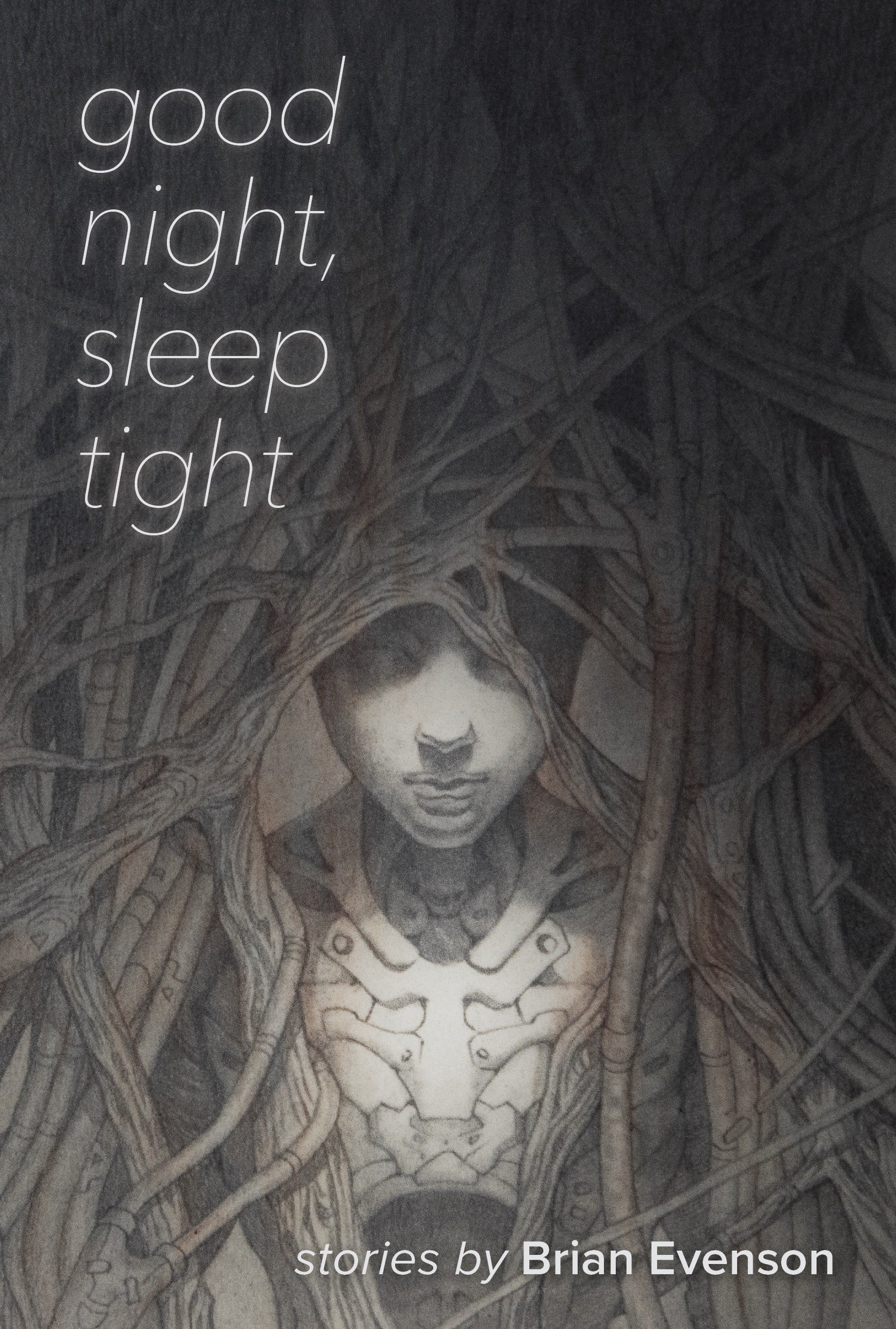
Brian Evenson is an utterly fascinating human and writer. He was raised in the Mormon faith, claiming during his visit to my MFA program that the family did not watch TV. They read constantly, and he commonly read a novel each day. In fact, when they went on family vacations, they all read wherever they were staying. Evenson is a kind, thoughtful speaker who explained that he was a prominent member in his Mormon community. In fact, he used to be a professor at Brigham Young. That is, until he published his first short story collection, Altmann’s Tongue, which I read in grad school. The stories were so violent that Evenson was fired. No sweat; he was hired by Brown University, which has an MFA program. I believe he is somewhere else, now. Over the years, Evenson’s books have toned down the violence (well, the one’s I’ve read), leaning toward dread over horror, science fiction concerns about humanity, and always a healthy dose of philosophy about what it means to perceive.
In Good Night, Sleep Tight, Evenson begins with two classic scary tales that place the main character in a situation from which they cannot escape. Dread overwhelms the character, and the ending is basically something to the effect of that character was tormented forever. Just your basic, fun, spooky sort of thing. But neither story is trope-laden. In fact, one is about a boy who rides on the shoulders of a man and doesn’t come down. I wondered if Evenson’s experiences with his own child were fodder for the tale.
Even the linguist (Evenson also translates French authors’ novels into English), his characters question the precise nature of language, especially when some characters aren’t even human. While the stories feel like they have no setting — what year is it? where are we aside from a generic woods? — it will dawn on you when you’re in the future because your narrator, who may seem like a thoughtful child, is perhaps an android. In a way, the androids reminded me of the communication breakdowns we all experience between neurotypical and neurodiverse individuals. If you say a word but mean something different, should you not acknowledge your inaccuracy? For instance, when a human woman who made an android in the likeness of her deceased son claims that it’s time for one of the children in her care to enter a cryogenic tube to be frozen for the remainder of the voyage, she uses a euphemism that the android “son” analyzes:
My mother referred to this as Finn’s ascension, though he did not in any manner of speaking ascend. . . . Metaphorically, my mother said, when I asked her about it. It is a figurative ascension. But when I questioned this, she admitted the comparison was inexact.
Many stories have characters pause to analyze the word someone uses, leveling up Evenson’s stories to something beyond a tale, something more like an opportunity to ask yourself about directness, accuracy, language, and meaning.
One of the best things about Evenson’s writing is you never get one thing. I pity the bookstore employee that must decide which on shelf his books best fit. Good Night, Sleep Tight has elements of fairy tales, science fiction, climate fiction, horror, and philosophy. Do the poor have more right to live than the wealthy? If you can only save nine out of forty-four people, who do you pick? When the world is uninhabitable, is it fair to go to another planet and mess with that one?
Evenson carefully acknowledges predecessors and makes something new, such as a story in which performing a specific ritual will call on the night archer, who will hunt for you. Although completely different, readers will notice a similarity to “The Monkey’s Paw” by W.W. Jacobs: “If you like, you may whisper what sort of creature you prefer him to hunt. Or what person. But, be warned: he will not always bring the prey you request.” Building off of one familiar moment, Evenson is able to get miles out of his ideas.
Evenson’s books make for excellent book club discussions if you’re into breaking down stories and hashing them out.


I agree that Evenson is difficult to categorize, and that is part of his appeal. The best writers often blur genre boundaries rather than staying comfortably within them.
LikeLike
Absolutely. I think that he knows genre conventions but doesn’t tie himself to them because he’s smart enough to borrow and create and play with expectations. I love how all the stories are removed from time, too. You never can tell WHEN you are.
LikeLike
I would not have picked up a book with this title, thinking it was horror. But I do love books that cross several genre lines!
LikeLike
Yeah, nothing in here is really horror. I think the title even implies that you should expect something that reads more like a fairy tale because of that emphasis on bed time stories and sleep that accompany the phrase “good night, sleep tight.”
LikeLiked by 1 person
The depiction of androids as thinking individuals seems to have slipped over from SF to the mainstream, reflecting probably no doubt our fears about the very near future. There seems to be some agreement, some conventions about how they will think and also some crossover with the way young men with high functioning autism are depicted.
I hope I live to see the first android autobiography. But then chat-bots are such perfect mimics already that it will probably say whatever we want it to say. (Or maybe it will just say, get out of the way cretins).
LikeLike
I’m not sure what you mean about androids and men with autism who are high functioning. Is this finding you’re seeing in fiction, or is this a reference to the tech bros like Musk, Zuckerberg, Altman, etc. that are involved in AI development?
I do think you would enjoy this collection.
LikeLike
All I meant was that in fiction they both seem to speak in the same exaggeratedly logical way. Though I wouldn’t argue if you referred to the tech bros as soulless robots.
LikeLike
I think they’re soulless due to their greed and narcissism, not their autism (and I’m not speculating; I’m referring to folks who have come out as being on the spectrum).
LikeLike
To be clear, so do I
LikeLiked by 1 person
This sounds like a collection I could probably read and enjoy, though like Jeanne I wouldn’t have gravitated to it from the title with that cover. It looks on the creepy side and I don’t gravitate to that.
I enjoyed your discussion with Bill about androids and young men on the spectrum. You asked the question I was wanting to ask and you two sorted it out without my having to engage. I have certainly been having some interesting conversations with AI apps/platforms/whatever in recent times. And, I’ve been getting the occasional AI-generated comment on my blog. The language is so good but you can tell it’s not quite right.
Oh, and I love that many of the stories hone in on language and different meanings. It’s a huge topic of conversation in my household, as Mr Gums the engineer tends to the denotative understanding of words – and too often the “comparison is inexact”. Still he can do cryptic crosswords in which the synonym you are looking for is invariably inexact!
LikeLike
One thing I find interesting is that the author has a young son, but most of the stories in which there is a parent, the author writes a mother. And the child is typically an Android that doesn’t know it’s an Android. It just knows that it’s different. So I can see the comparison that bill is making to autism and Androids — that feeling of I’m just like everybody else but I’m noticeably different in some way. It’s a highly engaging book, although the first couple of stories are a little on the spooky side. Nothing dramatic, more haunting. They actually read to me more like Victorian spooky stories as opposed to today’s gruesome horror. If you can get your hands on this book, it might be fun to read some of the stories aloud to your spouse. I’ll bet you guys would have lots to say!
LikeLike
Thanks Melanie .. it does appeal.
I don’t read much aloud to Mr Gums but would like that. I have been reading excerpts from my Irish novel to him lately because it’s just so delicious.
LikeLiked by 1 person
Oh these do sound good! I especially like this idea of analyzing language. It’s fodder for many a discussion, really the possibilities are endless. And you know I love a spooky story. And also, so good to hear that he was fired and rehired quickly, goes to show you just need to find the right place to recognize talent 🙂
LikeLike
Do you want me to send you my copy? You’ve been kind enough to send me a book in the past!
LikeLiked by 1 person
Normally I would say yes, but my shelves are EXPLODING at the moment. I’ve started loosening my rule of buying myself books and things are getting out of control here. But thank you for the offer! I’m sure you can give it to someone else closer by 🙂
LikeLike
Not a problem! I’m sure the local bookstore loves you right now.
LikeLiked by 1 person
I find myself interested – I like stories that are a little weird and multi-genre.
LikeLike
It throws you for a loop because the point of doing a genre is to use familiar tropes that readers like, but when an author like Evenson picks and chooses and makes it all new, you’re in uncanny valley territory. I love it.
LikeLiked by 1 person
Evenson is a very interesting person. I am happy to hear how kind he is. Does he still consider himself Mormon? I have read one of his collections, though I can’t remember the title. James was really surprised I was reading him because he had read his earlier really violent books. I liked some of the stories, but mostly was just meh about them and didn’t feel like I would like to read more. Probably because I much prefer novels over stories and no matter how much I try to change my preference on that, I have a hard time wanting to pick up any story collection, even by authors I love.
LikeLike
To my knowledge, he is not Mormon anymore. If you’re into philosophical science fiction, I highly recommend his novel Immobility. The audiobook is great and something you could listen to on your bike commute to work. I understand not enjoying short stories. Oftentimes, when I read them for a book club that I have to read, I start to feel like it’s a little bit of a slog, partially because I have to discuss all this stuff and how do we wrangle so much material into one good discussion. I’m a big fan of short story collections in which the stories are all connected, either by a topic or place.
LikeLike
I very much like philosophical scifi, so thanks for the rec!
LikeLiked by 1 person