
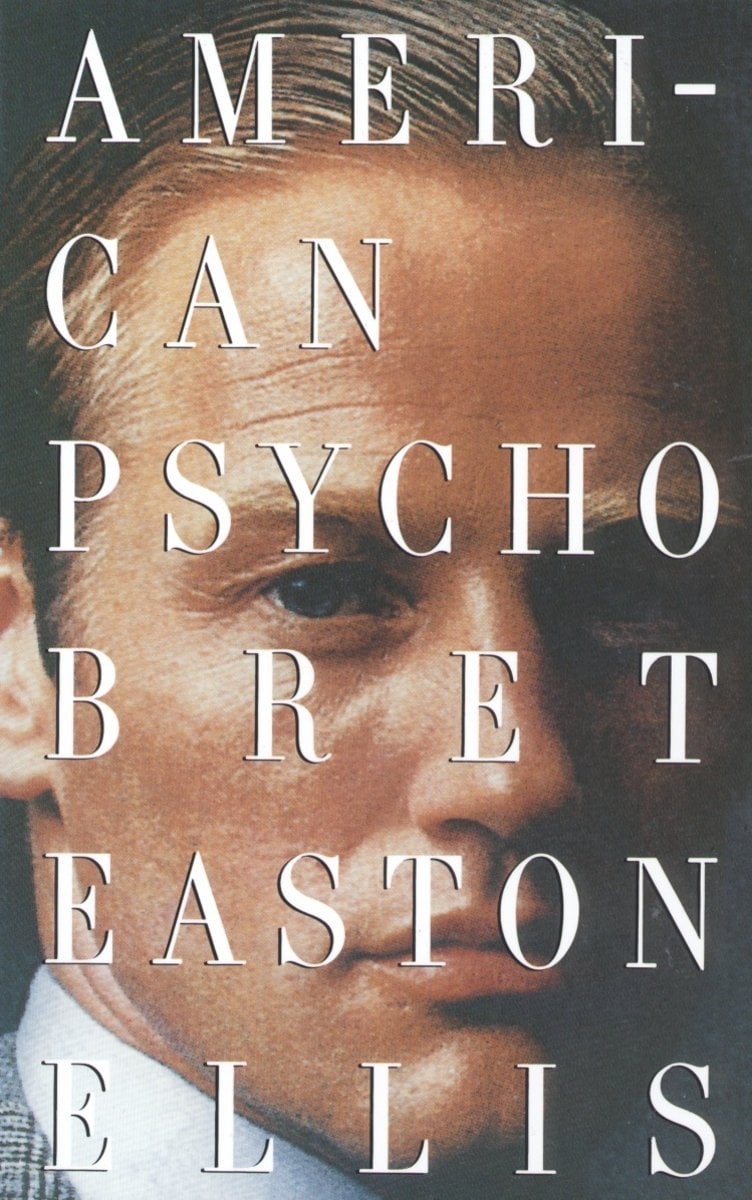
You’ve possibly seen the 2000 movie American Psycho starring Christian Bale, which was dubbed by critics misogynistic, to which fans retorted a woman directed it — Mary Harron.
However, it’s not often I’ve run across someone who has read the book by Bret Easton Ellis on which the movie was based. Reviews across Goodreads cite the absolute worst part each reader experienced, and they are varied. If a content warning exists for it, it’s in American Psycho. So, what makes Ellis’s novel so popular? And who should read it?
My concern is less about the kind of reader and more about reading in isolation. I think American Psycho is best read with a book club or in a college classroom, someplace people can discuss what’s on the page, their reactions, and what it means in the bigger picture, especially given the violent, graphic content.
Patrick Batemen is twenty-six and works on Wall Street in the 1980s during the height of the yuppies. We don’t know if he’s successful, per se, because he’s the narrator, and his focus is elsewhere. He’s white and able-bodied, obsessed with intense exercise and hygiene routines, he has nuanced knowledge of who designed clothing just by looking at it, and he’s going insane. We first meet Patrick with another white man (they literally all look alike, and that’s part of the point) as they discuss what’s “in” for this season’s fashion trends, where to eat fine dining, and where to score cocaine. It’s really, truly, very 1980s, which you never forget thanks to MTV, cocaine, Les Miserables on Broadway, Donald Trump, cocaine, misconceptions about AIDS, and cocaine.
Eventually, Patrick starts killing people between his two hours at the gym, watching The Patty Winters Show every morning, returning videotapes to the rental store, and eating at whatever Zagat says is hot this month. The murders grow more gruesome, and yes, they are written in detail. While readers may squirm at the horror, the shame comes from how often you laugh. Ellis has written in Patrick a character so unknowable — despite him being the narrator — that readers cannot agree if Patrick is actually killing people and blurting out violent fantasies or not.
“I’m into, oh, murders and executions mostly. It depends.” I shrug.
“Do you like it?” she asks, unfazed.
“Um . . . It depends. Why?” I take a bite of sorbet.
“Well, most guys I know who work in mergers and acquisitions don’t really like it,” she says.
Ellis’s novel speculates what 1980s yuppies thought through the sharp lens of Patrick Bateman. Yes, there are female characters, but they are largely zoned out from Xanax and the like, trying to snag the richest Wall Street bro they can, like some sort of warped Pride and Prejudice. Women are cycled among men like trading cards, but no worries, because straight white guys can’t get AIDS.
In reality, the yuppies are so inconsequential that nobody can tell one from the other. They’re always arguing over who’s actually sitting over at the next table, and Patrick gets confused for a different yuppie several times. His obsession with what people are wearing and the price of things is laughable when he encounters working class people who don’t think him consequential at all, like the video store clerk or the bartender. The yuppies play at being hyper-masculine, calling anyone they don’t like a slur for gay men, yet they’re constantly getting facials, manicures and pedicures, and are worried about how realistic their tans look. The point of reading this book is not to like the characters, but to get an in-depth look at the greed related to Wall Street and how destructive it was.
What intrigued me were the moments that snuck in, showing readers that Patrick is neither hyper-masculine nor confident. He gets anxious when things don’t go exactly how he “needs” them to go, such as peers who won’t make a reservation at a restaurant when he wants them to, causing him to fret over the prospect of waiting in line: “I’m on the verge of tears by the time we arrive at Pastels since I’m positive we won’t get seated but the table is good, and relief that is almost tidal in scope washes over me in an awesome wave.”
Despite having loads of money (one peer brags that he makes $190,000 a year, which made me laugh in 2026 dollars), Patrick is obsessed with returning videotapes through the entire novel: “And I’m thinking oh my god why didn’t you return those goddamn videos Bateman you dumb son-of-a-bitch.” In context, Patrick having these panicked moments are hilarious. Context is important; one chapter is just a three-way call in which people are trying to decide where to dine. It’s a riot, but when you read the premise, it sounds like a bit of nothing. That’s Ellis’s genius; you know these things are important to Patrick, and when they don’t play out as he wants them to, he’s like a living meme of dying on the inside. He laments, “…it has been a very unstable week for me — I found myself sobbing during an episode of Alf on Monday.”
I read American Psycho with a book club (a small group this meeting, including me, Nick, and two lovely mothers, one a librarian, one a church-going pharmacist) and I’m glad I did. We had a rich discussion, including, yes, which parts made us squirm the most, but also, we exchanged ideas about what kind of man Patrick is. Despite reservations, the three of us (sorry, Nick) finished the book. The pharmacist noted that had she read American Psycho for another local book club, one that has about 25 people each meeting, she would not have finished. The intimacy of a small group made space for a hearty discussion in a comfortable space. By the end of book club, I was 100% positive that Patrick wasn’t hyper-masculine at all, more of an awkward loser who fantasized about being so powerful that he could out-purchase anyone, have wild sex, kill and consume women, lord himself over the homeless — and convince readers it was all true.


I haven’t seen the movie so I had no preconceptions when I read it a couple of years ago. I like your analysis of Bateman’s insecurity, it adds a lot more depth to my understanding of the book. I wouldn’t have wanted to read it if I hadn’t thought the graphic rapes and deaths weren’t fantasies and a metaphor for how Wall St thinks of and treats the real world.
LikeLike
I only realized it as we talked at book club! The number of times he calls other men a homophobic slur was an early indicator, but as the book went on and we found out what happened between him and Evelyn, and no one knows who he is, well, it starts to get more obvious as you notice it. I actually kept the book so I can read it again at some point through this lens of Bateman being an utter drip.
LikeLike
Odd to say, but I adore this book. Patrick is the perfect unreliable narrator and I love how the reader has no idea what is real or what is in his head.
LikeLike
When I finished with it, I thought I would get rid of my copy because I wouldn’t read it again. And then I couldn’t…. It certainly grabs you in a weird way. I can see why some people are obsessed!
LikeLiked by 1 person
I’ve never read this or seen the movie but the premise does make more sense to me as a skewering of this type of culture rather than Bateman being some kind of hero. It sounds funnier than I would have expected though, with him worrying about video rentals and restaurant reservations.
LikeLiked by 1 person
Given the context, it’s seriously dark humor. You laugh, you feel bad you laughed, but there it is, funny and absurd. I think the movie lets Bateman off the hook a bit, suggesting he truly is a psychopath. It’s not as ambiguous, which the author states emphatically was intended, as the movie in which Bateman continues and heavily suggests he got away with everything and will continue killing. I love the idea much more of this being an obsessive loser imagining what it means to be a powerful man. It weirdly fits in with what I read now of these “incel” type of guys. Maybe Bateman was the first incel.
LikeLiked by 2 people
That’s so different from how I’ve always imagined the story to be. I still don’t think I’d read this but that at least sounds more interesting than “deeply unpleasant man goes around murdering people” which has always been my impression of American Psycho.
LikeLike
I love that my review has everyone writing something similar. I’m rather proud of myself 😁
LikeLiked by 1 person
I really enjoyed your review of this! And yes, the quote you included did make me laugh and then feel guilty at laughing. This sounds like a really interesting book – have you seen the film? I haven’t read or seen it, but your comment about people calling it misogynistic makes me wonder if the film just did a very straight rendering of the action without tapping into that insecurity you identify.
LikeLiked by 1 person
I saw the movie years ago, so I watched it again after writing my review. It’s much more clear cut that Bateman really is some kind of violent psychopath who got away with everything, which the author hated. The book is so “on the one hand/on the other” when you discuss if it’s all in his head or really happening, and that’s the joy of it. You start mining for quotes and moments to prove your theories. When I watched the movies this time, I noticed all the sexual content is explicit, but the violence is all off screen, and I have to assume the director did that intentionally. Perhaps to keep the movie at an R for cinemas, but also I think the violence is not the point. It’s more the idea of what Bateman thinks violence means about the violent person, that they are powerful.
LikeLiked by 2 people
Huh. I can see why this book made such a splash, and I could never understand that before. Maybe hindsight helps, and I think enjoying horror must help.
LikeLiked by 1 person
Well, that’s a wonderful compliment that I’ve brought a new perspective to the book. Thanks, Jeanne!
LikeLiked by 2 people
I’m glad I read this review – I feel like I get why people might like this book. I still don’t really want to read it, but it brough understanding! Also, he sounds like he would fit right in with today’s manosphere bros.
LikeLiked by 1 person
It also reminded me of older men, too. For instance, there is an old video of Sean Connery in which he says sometimes you have to slap a woman, so she doesn’t become hysterical. He means this seriously based on his facial expressions. It’s not quite the same as labeling women “hardbodies” (good) or bitches (bad), but the vibe is still there.
LikeLiked by 2 people
I do remember reading this book a very very long time ago. I don’t think I’ve ever watched the movie though. I read other Brett Easton Ellis and it was super weird, he released a book in the 2010s that I didn’t really like. Sigh, yah, this would just be a tiresome book to read in this day and age I think, the obvious misogyny, etc. And I think we’re much better at spotting mental illness and calling it what it is nowadays.
LikeLike
I think the book suggests he has a mental illness, but today, in 2026, it reads more like he’s an incel than someone with true psychopathic disorder. In fact, it almost reads like a giant red flag for what to pay attention to, which, perhaps, is what interested the director — a woman — in taking on the project. I’ve heard his other books are kind of weird and that some read like a play on American Psycho. The 80s certainly affected Ellis and what he was interested in.
LikeLiked by 1 person
Haven’t heard much from Ellis lately too, I wonder if he’s continuing to write to just retired now
LikeLiked by 1 person
I have not seen nor read this book. I think it sort of passed me by at a time in my life where I was focused on other things, and then the violence hype I heard about it later didn’t enthuse me to read it later. But you have made me more interested than I have been in recent years.
I must say that I still can’t understand what happened in the 80s. As a baby-boomer who grew up in the 60s and 70s, the switch from peace and love (to be corny) in our time, something we thought was moving us all in the right direction, to the conspicuous consumption and wealth (with the cocaine-fuelled lives etc) of the 80s came as such a shock. From where?
LikeLike
I noticed there is a new book about the rise of yuppies and where they came from, and I plan to read it. The synopsis mentioned the rise of the stock market as a place to make good money and how white men from elite colleges being funneled into these jobs.
LikeLike