
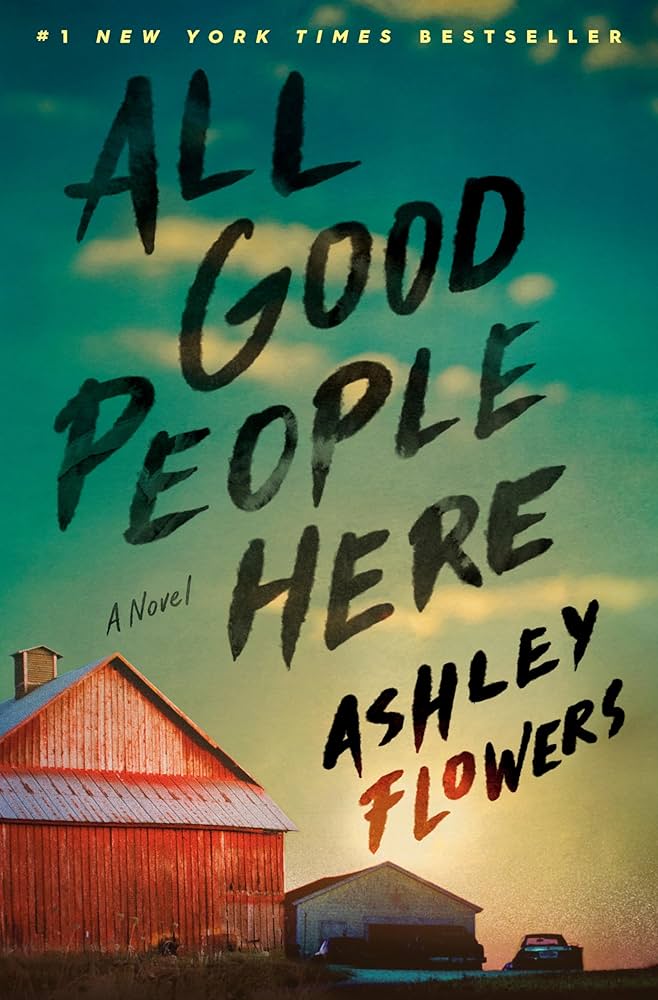
I’m truly surprised I read All Good People Here by Ashley Flowers because it breaks my #1 bookish rule: I don’t read books in which the synopsis is mainly about a missing person and seeeecrets. I’ll be so happy when this trend is over. Anyway, Ashley Flowers is from the area where I live, and my mom’s library book club was going to read All Good People Here, so we added it to our mini book club, and here we are. Set in Wakarusa, Indiana, Flowers’s novel is located in a place I’ve been many times. In fact, they’re famous for their jumbo-sized jelly beans.
All Good People Here basically means that small town people would never do anything bad. In fact, one character says, “Seems like a nice Christian family to me…” which is Midwestern code for straight, white, married, has children, churchgoing. The novel is told from two points of view: Krissy starting in 1994 and Margot in 2019. Krissy married Billy and had twins, aged six, a boy and a girl. One night, the girl, January, is missing and some graffiti is painted on the wall, words that never added up to anything for me. She’s found dead. As the novel unfurls, Flowers will point to the twin brother, the mother, anyone who has attended a dance recital, and a stranger, among others, as the killer. Because you know. Everyone has secrets.
Margot is twenty-five and has just moved from Indianapolis to Wakarusa to care for her uncle, aged fifty, who has dementia. His wife died the year before, and now that he’s alone, everything is worse. Margot, a reporter, convinces her boss at the paper (or is it website? do people still get papers?) to let her work remotely (how would that work?? If you’re reporting, what are you going to report on from Wakarusa, home of the giant jelly beans???). Anyway, a girl in the nearby super-Amish town of Nappanee is killed, and Margot can’t let it go that the death of January in 1994 is just like the death of this girl, even though the situations have nothing in common other than both girls were six. The local bartender agrees with Margot for a very good reason: “We’re only big enough for one childnapper round these parts.”
Margot’s editor demands she stop pushing an agenda (this is not the first time Margot claimed a a little girl’s death is just like January’s), but Margot fails to listen and loses her job. She proceeds to spend the rest of the novel trying to prove January’s death and the new murder are linked, constantly leaving her uncle at home despite him having a tendency to wander off and point his shotgun at people. Meanwhile, Margot’s meager savings drains away for take-out meals and traveling to hours away without a lead to go on. At one point, she’s in Chicago where she pays for a hotel and starts Googling the person she wants to interview. It’s Chicago. Would you drive to Sydney or Vancouver or London and then Google someone in the hopes of finding their address?
I want to say this was the point during which the novel stumbled and fell down, but that would be suggesting it didn’t have two left feet to begin with. Nothing adds up or makes sense. We get ominous lines that make your head say Dun dun DUUUUN!!! like, “Krissy couldn’t have known then everything that kiss would lead to. If she had, she never would have done it. If she had, she would have run fast in the opposite direction.” By the end of the novel, we learn pretty much everyone had their fingies on the crime scene the night January was killed because Flowers wants to keep you guessing, but boy does she work hard to make everything as dramatic as possible. At one point, I had an important relationship figured out and then thought I was wrong all because one character had the X, but they used to call that person Y back in high school. It’s not even a good nickname. It’s two different Midwestern white people names. That’s not how nicknames work.
As we discussed All Good People Here in my mini book club, which now includes Biscuit and my cousin Jordy(!), we lamented the overdramatic one liners there simply to seem ominous. It doesn’t work. It comes off as cheesy. One line actually reminded me of little Gage at the end of Pet Sematary. And he’s possessed! These are supposed to be real, alive children, for corn’s sakes.
 Grab the Lapels
Pretty sure I wouldn’t enjoy reading this book but I didn’t enjoy the tone of your review!
LikeLike
“did”! I meant did!
LikeLike