Scroll down for the text review.
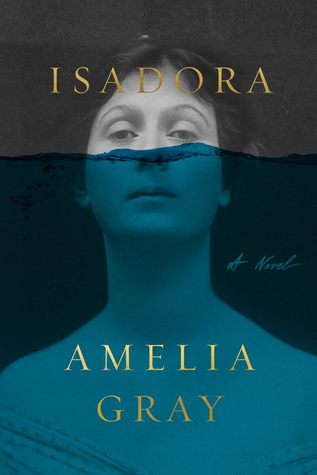
Amelia Gray’s novel Isadora is about the real-life “pioneer of modern contemporary dance,” Isadora Duncan, whose life was changed forever after her children died in an auto accident. The novel begins with their death and proceeds with the funeral, the year following during which Isadora travels and unravels, and her decision to conceive again. All told, Isadora is 400 pages long.
I’m familiar with Amelia Gray’s short story collections and her first novel, Threats, and I believe her voice shines in shorter works. Threats felt discombobulating in a frustrating way, never allowing me to find my feet. But in short stories, Gray’s personality comes through. I say this as someone who met Gray at a conference; she arrived late, claiming, “I’m like a ball of chickens taped together today!” Those Amelia Gray one-liners just kill me in the best way. Isadora is full of them but hang on a tragic cast of characters.
My main concern with Isadora is how long it took me to figure out how to read the novel. I was far into the book before I realized there were four voices: Isadora, Elizabeth (Isadora’s sister), Paris (the father of Isadora’s second child), and Max (Elizabeth’s sort-of lover who runs Elizabeth’s dance school modeled after Isadora’s theories). The chapters don’t always announce clearly whose thoughts we are in. For instance, all the chapters that were letters written to an Italian named Romano were by Elizabeth — and I thought they were all by Isadora until the last 100 pages. Sometimes the chapters do let readers know whose mind we’re in, such as Paris walks the grounds at Oldway, which is permanently under the kind of endless renovation that can be endured only by the wealthy.
Each chapter is short, maybe 3-5 pages, which I liked. You can read the chapters like little stories, which is where Gray shines, but they all go together, so you can’t check out. When I felt lost because my brain did occasionally check out, it was the one-liners that kept me going. Gray is just too interesting to quit, even when the characters are at their darkest. After the children have died, Isadora says, “A straightjacket could barely keep me together.”
Each of the four characters imbue Gray’s voice, and their function is to show you Isadora’s world. Paris, who fathered Isadora’s second child, takes up flying. He is the heir of the Singer sewing machine empire. At one point, “Paris had gotten wrapped up in the excitement of an exhibition and accidentally funded a new wing at the Louvre.” He’s stupid rich, but Gray’s description of his wealth are funny.
Isadora is overly-dramatic. Readers learn she “once demanded that a sofa be brought to her in a restaurant and, when her request was refused, ruined the entire meal trying to properly pose in a straight-back chair…” Even when Isadora seems overly-dramatic, you cannot deny that she is a powerhouse. The novel is set in 1913, and you could almost forget for how brazen Isadora is. Her dismissal of an employee is on par with Zora Neale Hurston’s insults:
Watching your piggy lips sputter has been reward enough for months, but now I want you gone. You think I could not see you scheming? How dare you. Take your place in the anal tendon of artistic merit, you disease. You don’t have a bit of philosophy you didn’t scrape off the shoes of greater men, and there is no greater man than me. I am your very own father and mother both, and I am putting you out on your ass.
That is chilling, and I am so impressed with how Gray represents a historic female powerhouse.
Sister Elizabeth highlights the ways in which Isadora controls everything around her. She runs the Elizabeth Duncan school of dance, which teachers Isadora’s methods, meaning wealthy mothers will do anything to get their daughters in. It’s hard to remember that Elizabeth is not just an employee; she has her own school. But she’s always in the shadow of Isadora. Bother girls were taught ballet by their mother; however, something happened to disable Elizabeth’s leg, and so she’s always longing from the wings.
Max is Elizabeth’s lover, but he’s a useless lump. He tries to take over her dance school, feeding the students tons of processed meat and protein despite Isadora’s instructions that they all eat vegetarian to stay light in body. He also has the girls lifting weights for strength training, against the wishes of Elizabeth, who seems unable to run her own school in Max’s presence. Max laments not having slept with Isadora, and his eyes are on the school’s piano player despite Elizabeth being right there.
Interestingly, the novel doesn’t follow or promote social norms like marriage. Paris has a wife and children but courts Isadora and fathered one of her children. Isadora does not marry and purposefully has three different men father her children. Elizabeth is partnered with Max but writes letters to an Italian man. Relationships are fluid.
If you know who Duncan is as a historical figure, you’ll know how the novel ends. I don’t think it’s about spoilers; Amelia Gray takes us into a year of recovery and healing with four unusual (and real!) people and filtered through Amelia Grays unique, unmistakable voice. Highly recommended, but also cautioning you that you’ll feel on the back foot when you start.