
Scroll down for text review.
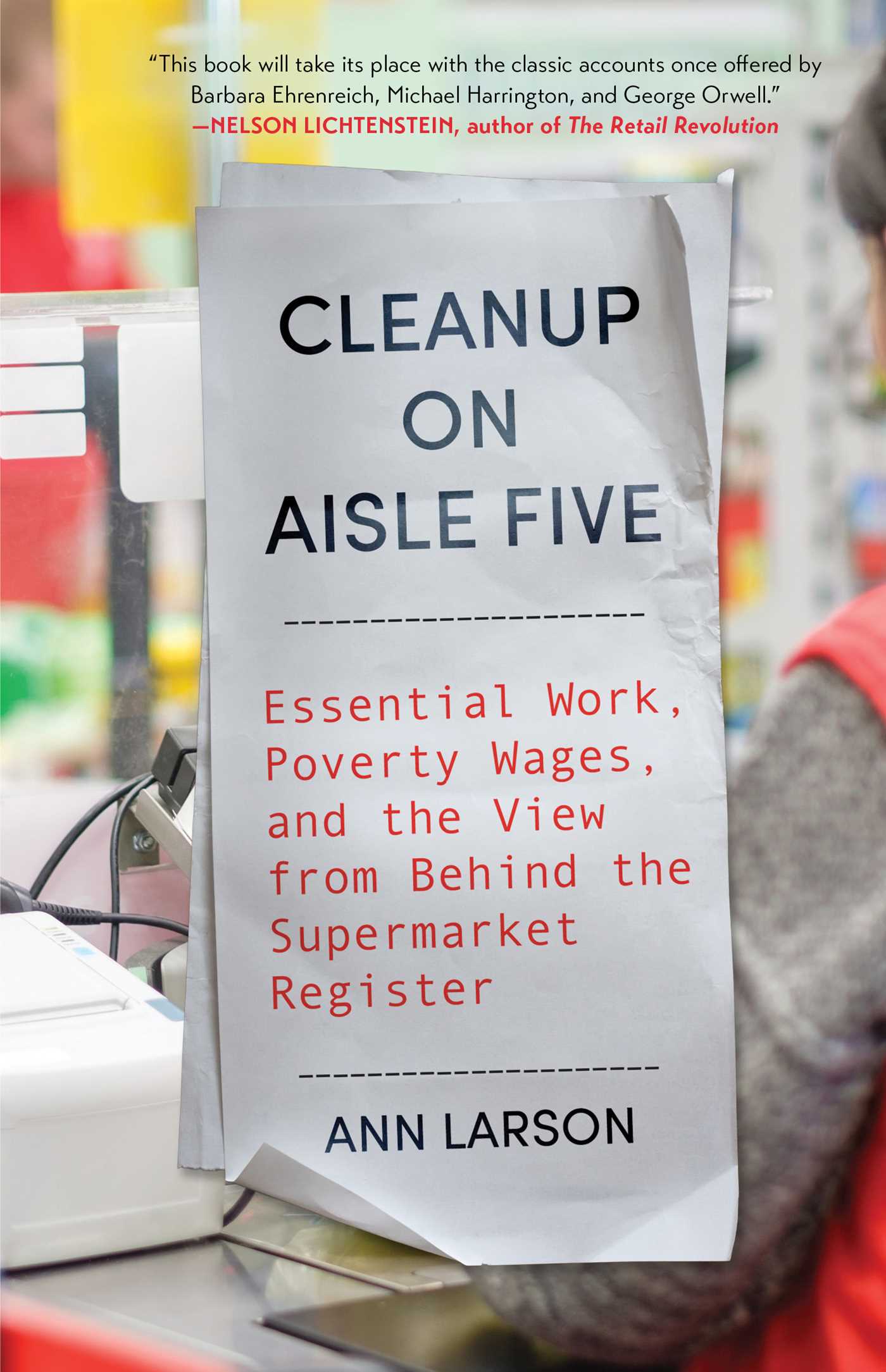
Today I am reviewing Cleanup on Aisle Five: Essential Work, Poverty Wages, and The View from Behind the Supermarket Register by Anne Larson. you. t’s a relatively recent book and one that I picked up because for one summer when I was sixteen, and I learned a lot and forgot little despite, twenty-five years passing. Ann Larson worked for a bit longer — one year — in a grocery store she calls TGS (The Grocery Store). Larson has a master’s degree, but adjuncting wore her out and in 2020, she applied for and got a job as a supervisor at TGS. While she didn’t plan to write about her time at TGS, one incident made her realize perhaps she should: a customer shit on the floor. Larson acknowledges, “The shitting incident forced me to reconsider. Maybe this story was bigger than just the pandemic. I was perplexed by my colleagues’ reactions. Why had some denounced the man, while others had been sympathetic?”
Whether a person responds sympathetically while in TGS is a big theme of Cleanup On Aisle Five. The longer Larson works for TGS as a supervisor, the less sympathetic she is as her colleagues call out sick, are no call-no show, leave early, or abandon their cash registers because she has to manage the front end team. When she is stranded, Larson has to juggle the fallout of angry managers and customers. Sometimes, Larson is Team Customers, striving to make things flow smoothly. Other times, she is Team Co-Workers, such as feeling sympathy when a man who stole from TGS was caught: “We tased a guy over doughnuts and milk last night,” one co-worker lamented. Should TGS employees report food theft during the pandemic when the economy tanked? Or uphold the law and store policy?
However, Cleanup On Aisle Five is not testimony only; Larson relays how her coworkers are just as poor as the customers who steal. Some don’t have food for lunch. Another had to leave work because her period started and couldn’t afford sanitary napkins. They all lack access to medical care or time off to recover from the backbreaking labor of moving thousands of items per hour while standing on a cement floor.
Because “broken” workers prove to be unreliable, rather than paying them a fair wage and health care, TGS, like many of its brethren, install self-checkout lanes. Interestingly, Larson notes that when a machine breaks, the cashier overseeing the many machines is expected to fix it without technical knowledge. Typically, technicians must be brought in, delaying customers more. Larson explains that a “2022 study showed that theft is rampant at self-checkout, with companies attributing as much as 23 percent of losses to the technology. Stores, including Target, Walmart, and Dollar General, have all cited theft as a reason they are limiting or replacing cashierless checkout.” Therefore, as I read Cleanup On Aisle Five, I was learning about the business of grocery stores in addition to Laron’s and her coworkers’ anecdotes, which sadly matched my own memorable summer as a cart pusher.
Much of working in a grocery store sounds awful, but on top of that is the indignity of having no control over your life, and Larson emphasizes that indignity clearly. She points out how employees are scheduled only when the store needs them, including weekends, evenings, and holidays, and the schedule is sometimes only posted a week in advance, meaning you cannot plan a vacation, even something simple like a beach day, because you don’t know if you’ll be scheduled, and you are so broke you can’t afford to lose your terrible job. To really churn the orphans in the orphan churning machine, so to speak, Larson writes, “A person may even be assigned a split shift: working during a busy period, clocking out during a slowdown, and then returning later when business picks up again.” As a capitalism tool, the grocery store is a microcosm of what is wrong with unfettered greed, snatching rights from workers.
While we may gnash our teeth are large grocery stores, I did learn they have a positive aspect to them. Larson learned that when “mom and pop” grocery stores were the norm, in the American south, Black customers not only were served last at the kinds of places where the clerk hands you grocery items from behind a shelf, but they were charged more, too. After chain stores with cashiers were built, the unequal costs went away.
Cleanup On Aisle Five is highly readable not only for the anecdotes but for historical lessons and added data about how stores function to show that TGS is not one grocery store, it’s all of them.


Just your review is an explanation of why unions are so important. It is unconscionable that it is decades since the US minimum wage was raised, and that companies owned by billionaires can rely on the US government to supplement their workers’ wages.
Of course neo-liberalism is everywhere and Australian businesses do their best to ignore and/or co-opt tame cat unions (the ‘Shoppies’ are notoriously right wing) but still we maintain a (barely) liveable minimum wage.
I have never worked in any kind of shop thank goodness, and the trucking industry is relatively well paid (if you can handle being away from home all the time).
Never go through a self-serve checkout is my motto, though of course we lost that battle with fuel sales a long time ago.
LikeLiked by 1 person
People in the US have been convinced that by paying union dues, they are getting screwed over. A lot of money is put into propaganda, and companies that are located in states that are union friendly typically leave and move to the more “wild west” states (yes, Texas). I can’t believe how much money a company will put into preventing unions rather than working with employee demands. Now, I will say there are some companies that actually listen to their employees because they NEED those employees, who are not easily replaceable. If the company has a conscience, the union as a middle “man” isn’t necessary. That, sadly, is uncommon. Right now, the minimum wage in Indiana is $7.25.
I hate to sound dense, but why do you never use a self-checkout? Is it because you hate the machines or to intentionally interact with a human, or…?
LikeLike
Every self checkout is an unemployed worker.
Every time you use a self checkout you are one step closer to a life spent interacting only with machines.
LikeLike
I mean…. someone probably said that about cars.
LikeLike
Its terrible that staff can get treated in some of the ways that you’ve described here in this day and age. I didn’t realise that in some places shop workers recieved so little notice of their schedules. I cant imagine how much worse things must have became during the pandemic too. Sounds like an informative read which highlights a lot of troubling issues.
LikeLike
I was surprised what with computers and AI that the store in the book couldn’t schedule better. Back when I worked at a store in 2001, it was paper tacked up on a board. You actually had to randomly drive in to see the schedule because it wasn’t always up predictably. There is talk of AI helping with scheduling at places that use KPIs. I’m excited about that, to be honest. So much human math-ing that could be energy spent elsewhere.
LikeLiked by 1 person
I wouldn’t be surprised if part of it is the fact that the people making the schedules aren’t actually affected by them so its not themselves getting inconvenienced by it all.
LikeLike
I wonder if they want to keep making the schedule because that’s all there is to their jobs….
LikeLiked by 1 person
This sounds really interesting! I’ve never worked at a grocery store but I do work with customers and so I feel like I would find things to relate to! We try as much as possible to shop at a locally-owned grocery store in our town because they seem to treat their employees well. They have several employees who have been with them for decades.
LikeLike
When Nick and I worked in a grocery store, it felt like the corporation treated employees as if they would just be turned over, so the employees turned over easily. If you don’t treat people like they’re going to be there for decades, they’re not going to act like they’re going to be there for decades. I’m glad you have a shop like that! I hope the employees get chairs.
LikeLiked by 1 person
No chairs, unfortunately. I’ve never seen a grocery store worker sitting down in Canada!
LikeLiked by 1 person
As someone who has suffered from IBS, I almost felt bad for the person who did shit on the floor .However, as much as I struggled I couldn’t see myself ever doing that in the middle of a store. Just shit your pants! Ammiright?
Anyway, aside from that, I really hope wages have improved since the pandemic when people realized how essential grocery stores were…sigh. I’ve heard that Costco though, is a really good place to work. Very good wages, great staff discounts, it’s apparently the top tier grocery place. I don’t have a membership personally, but I’ve considered getting one, and knowing they are so good to their employees really makes it worthwhile
LikeLike
I know Samantha Irby has shit herself in public many times. I love all of her books, though the first two are my favorite. I felt bad for the person because even if they did shit on the floor intentionally, you know that has to be something related to a mental break with reality, even if temporary, or a mental health issue.
To my knowledge, wages have not changed much. In fact, this book was written post-COVID about her time in the grocery store during COVID.
I do like Costco because I buy my hearing aids and Nick’s beer there.
LikeLiked by 1 person
Costco has some really good gluten-free stuff I can eat there. Like gluten-free ramen noodles, which are very hard to find!
LikeLiked by 1 person