
For the text review, scroll down.
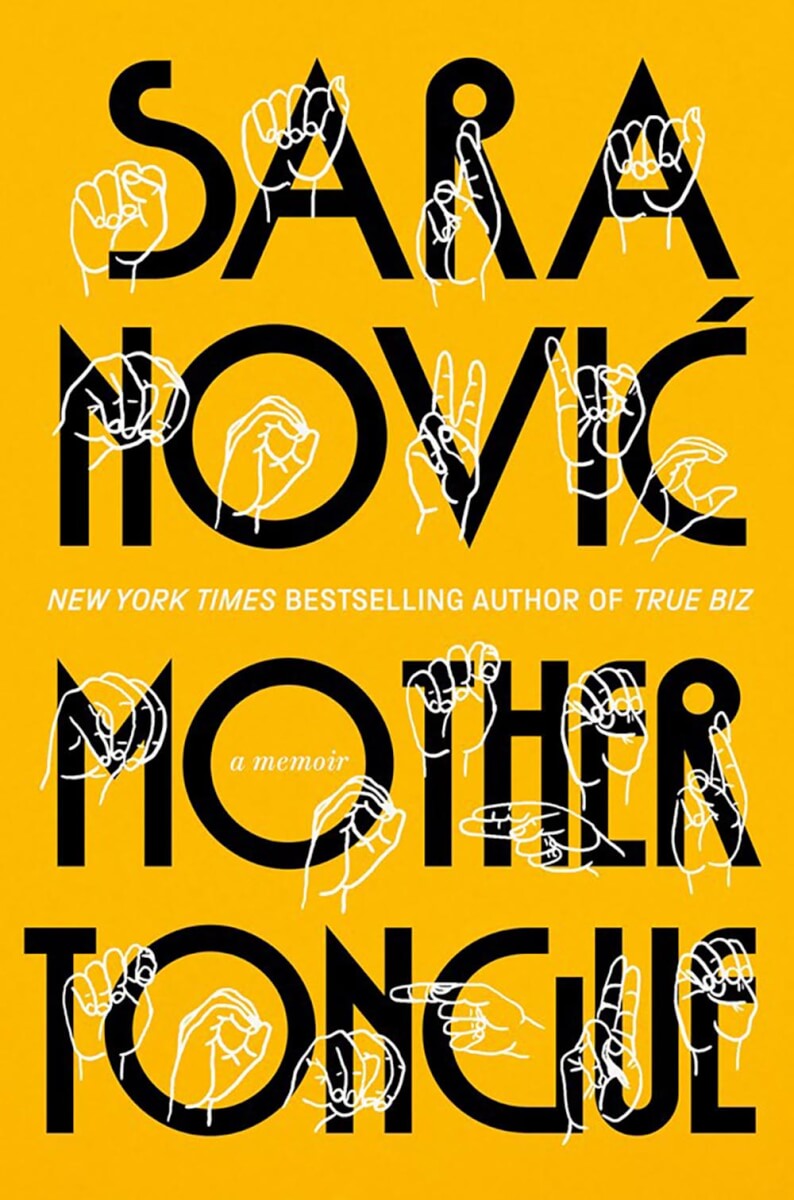
Mother Tongue by Sara Novic is a memoir about navigating deafness, disability rights, eugenics, adoption, motherhood, and, of course, language. Novic’s hearing diminished when she was school-aged, something she tried to hide. However, an unusual heartbeat that led to fainting was less easy to shrug off, causing her body and its “lack” to make her noticeable. As a high school student, Novic found a deaf community and learned to sign, meaning her first language is English.
Novic’s memoir isn’t about her development in the deaf community but more a question of language access. After giving birth to a hearing son, Novic and her partner decide they want to adopt a child, which was always the partner’s wish—he himself was adopted and had a great experience. What follows is the process of international adoption during the COVID-19 pandemic and the hardship and race against time Novic’s family faced. Because the little boy they wanted to adopt from Thailand was also deaf but didn’t have access to sign language, his window for language learning that we all have was rapidly closing.
While it’s not uncommon for memoirs by deaf authors to include some history and culture of the deaf community, Novic shared information I had not encountered elsewhere. For example, Martha’s Vineyard is famously known as a place where everyone used to sign, whether hearing or deaf, because so many islanders were genetically deaf. It just made sense for everyone to communicate. However, it wasn’t quite the utopia people who know about Martha’s Vineyard sign language, according to Novic, but there were communities in which both hearing and deaf people signed in cooperation, including nearby Elkhart, IN, a place I’ve been to many times (and I do know deaf people who live there).
Most importantly, Mother Tongue is relevant NOW. She explains the potential effects of the second Trump administration on poor, disabled, and minority communities. Imagine if the Department of Education is dissolved as Trump wishes. What happens then to children like her adopted son who has an IEP (individual education plan) and his rights to a free public education in the least restrictive environment. On the other hand, the least restrictive environment for deaf children is not in public schools with everyone else, but in deaf schools with their language peers. Other benefits, including the Affordable Care Act and SNAP (Supplemental Nutrition Assistance Program).
Really, at the heart of Mother Tongue is the importance of communication needs and what barriers are in the way of growing one’s sense of self through language. Those barriers may be medical, governmental, or educational.


This is the same Sara Novic who wrote Girl at War, a profoundly moving novel about a Croatian girl who becomes a child soldier in the Yugoslavian civil war of the early 1990s. I reviewed it a few years back and I recall googling her to find out more about her. She was apparently writing this memoir at the time so I’m delighted to see your review. I’ve added it to my Wishlist.
LikeLike
She also wrote the novel True Biz, which is amazing and I cannot recommend highly enough. It looks at the lives of deaf people and those around them (hearing family members, school admin, interpreters, etc.).
LikeLike
Sounds like an interesting memoir with a lot of food for thought. Its interesting to hear that some historical information is included too. Definitely troubling to learn how her son could be affected due to governmental changes though.
LikeLike
I’m not sure what it’s like now, but it felt like about twenty years ago, I knew of several white families adopting children from China. I wonder if it had to do with the One Child Policy or something. Novic’s son isn’t from China, but I did think about her comments on international adopting being a type of trauma because not only is a child removed from the birth parents but the culture into which they were born, too.
LikeLiked by 1 person
I hadnt thought about that before but I imagine it must have had some kind of impact. Although I know in Call The Midwife they were helping overseas even before that policy came into place. Although I’m really not aware enough of all the ins and outs in comment on it. I do agree that it must be especially hard to be pulled away from your culture like that, especially when language barriers are involved. I’d hope the systems in place generally always only do so if its for the best. Although I imagine like anything there are some cases were corruption sadly plays a role.
LikeLike
Interesting! I didn’t know that fact about Martha’s Vineyard Sign Language.
LikeLike
Yes, I’d never heard that about Martha’s Vineyard, either.
LikeLiked by 1 person
I shared a video to Edward, but here is another about Martha’s Vineyard sign language past and present: https://www.youtube.com/watch?v=ltR21R0sl0o
LikeLiked by 1 person
I really like this video that shows comparisons of different signs for English words. The signer on the left uses MVSL and the signer on the right uses ASL. https://www.youtube.com/watch?v=EzZsZrtdIlA
LikeLiked by 1 person
Wow, interesting! They’re so different. I think ASL is more expressive, but MVSL is probably easier to learn.
LikeLike