
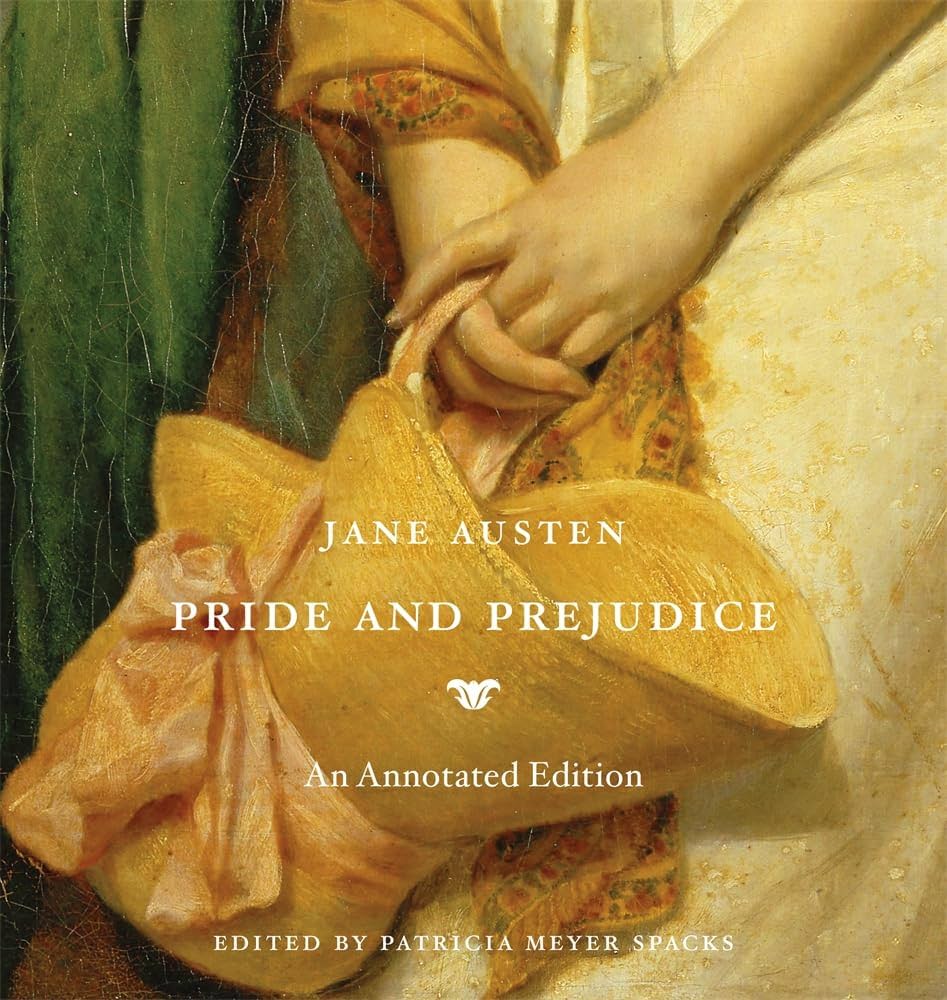
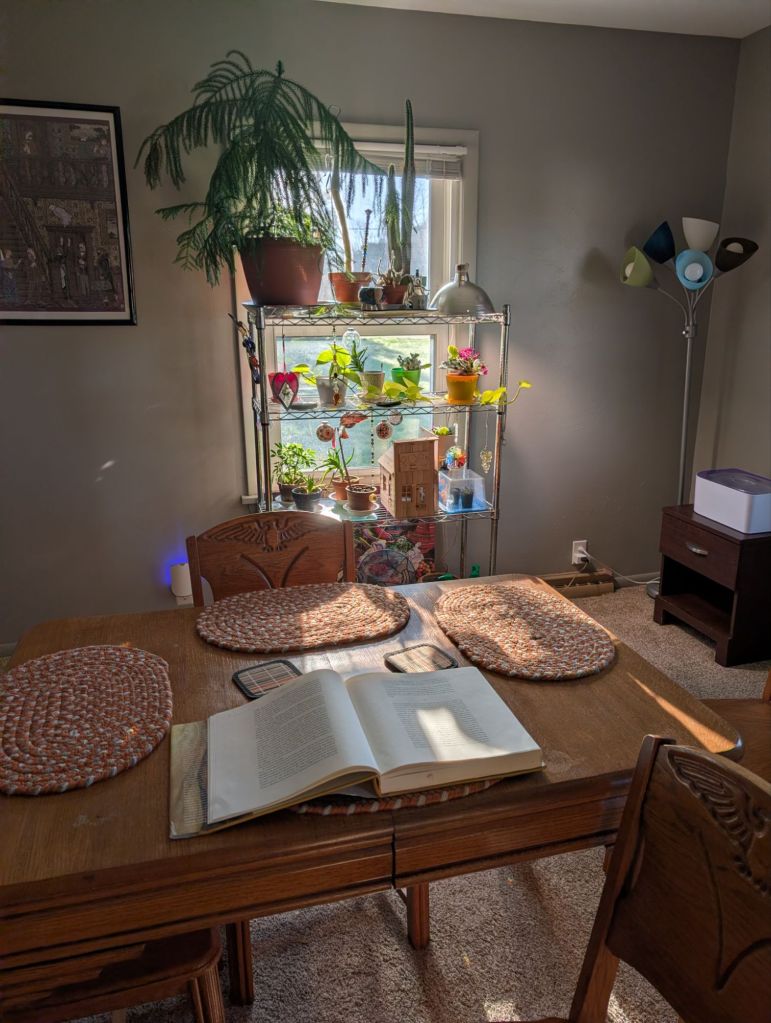
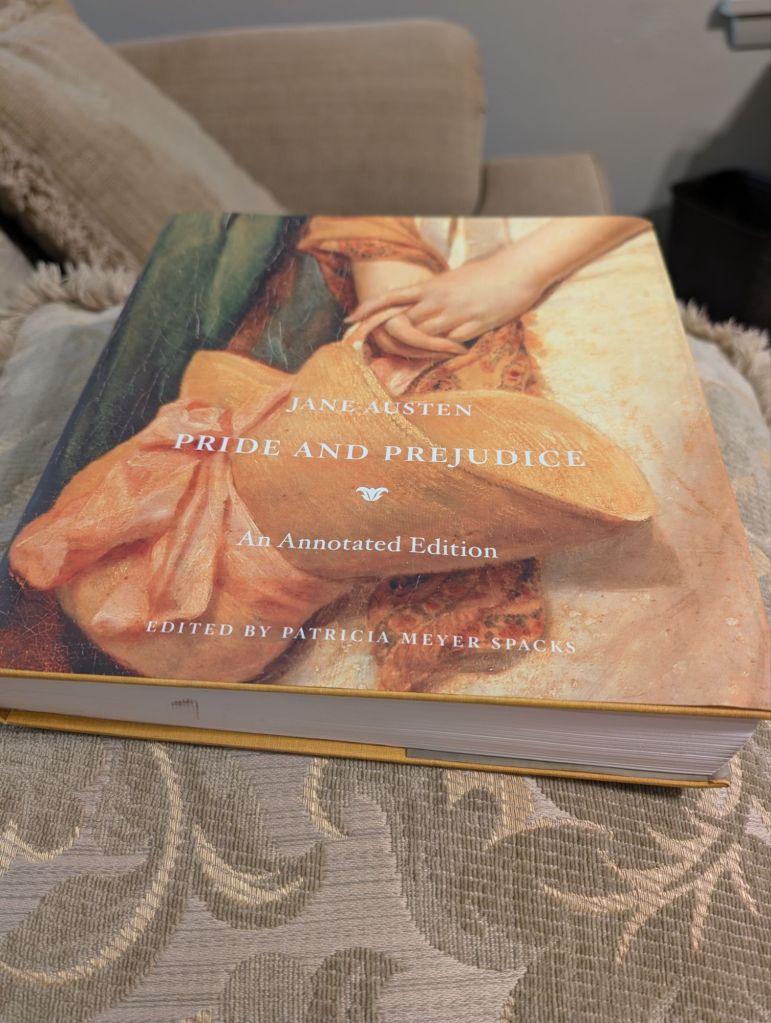
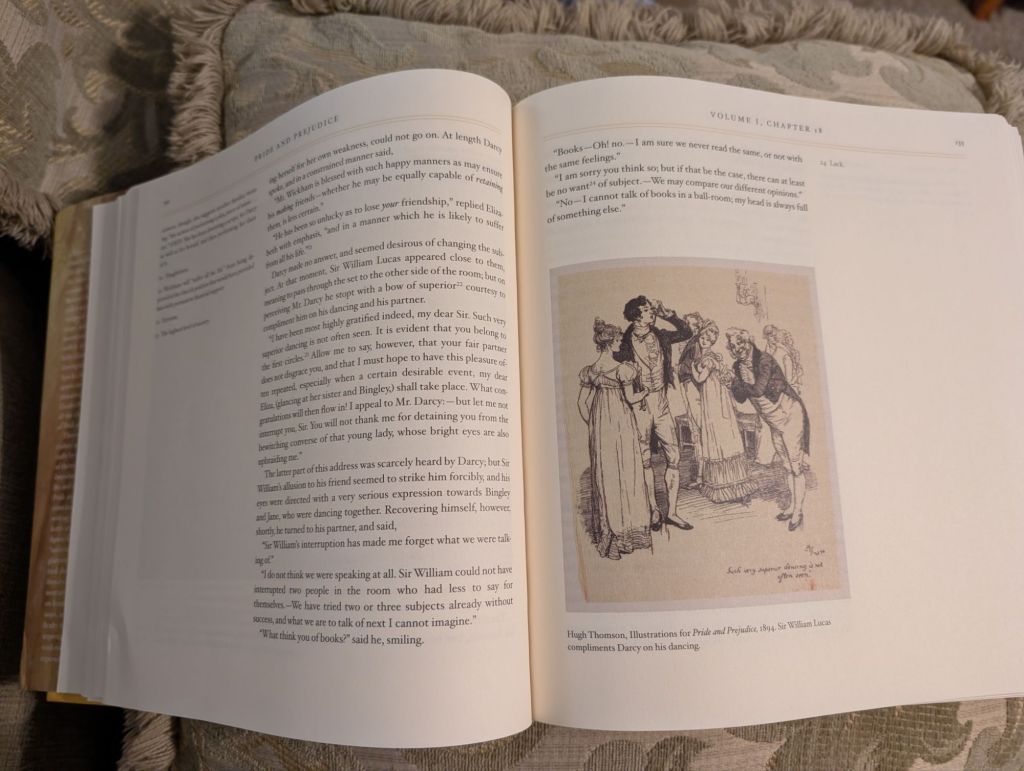
I read this entire novel and all the side notes (for they are on the side, not the end or foot) aloud to my spouse starting March 24, 2026. We finished June 24, 2026. If you’ve been here before, likely you know I’ve never read Pride and Prejudice. The following notes were written as they came to me, meaning they are in order with the chronology of the novel.
- When exactly do we learn there are five Bennett daughters? Is this just already known thanks to the book’s notoriety? I already knew which ones I was supposed to hate…
- The number of times I’ve said, “What a shithead!” aloud.
- Why is Mr. Bingley so nice, and why can’t he be Elizabeth’s love interest? I mean, Jane could have conveniently died from that cold…
- I literally just said “what a little shithead” again.
- It’s impressive that anyone knows who’s talking in this book, because the lack of dialogue tags is astounding.
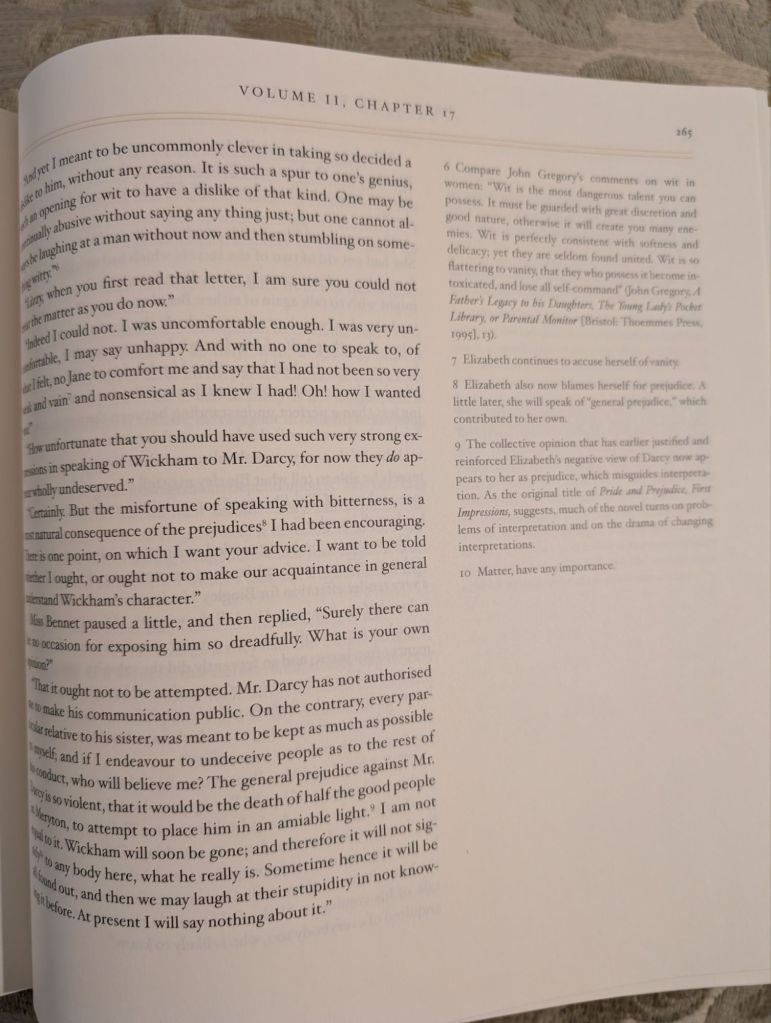
- The notes about the flogged soldier are interesting. Not only do Kitty and Lydia not think about why soldiers are there, but the context of why certain soldiers were flogged and how common the practice was.
- The note about how the word “nice” has changed meaning. According to the editor, it used to mean “foolish, silly, ignorant.” However, before Austen’s time, “nice” had these various meanings: “wanton or lascivious, showy, effeminine, fastidious, refined, shy, pampered, trivial, risky, and dainty.”
- I was really surprised by the chapter in which Elizabeth and Mr Wickham shit-talk all kinds of people. It seems really malicious and gossipy, uncharacteristic of what I’ve been told about Elizabeth.
- I feel like Mary gets a bad rap. Everyone seems so upset with her for having thoughts that aren’t nuanced, but she’s a freaking teenager. Also, the scene during which she starts singing, and Elizabeth is just horribly embarrassed. In the text, it doesn’t say that Mary’s a bad or boastful singer; she was just eager to sing. Poor Mary!
- I’m truly confused as to what Darcy was thinking when he told Elizabeth that he was proposing to her, and that he had saved his friend, Mr Bingley, from the same fate by putting Jane in an ill light. What did he think the outcome would be?? Even if Elizabeth was a gold digger, what kind of life was he expecting to have with her?
- Note from the editor: “Because of Darcy’s higher social status, it would not be proper for Elizabeth to introduce her aunt and uncle unless he requested the introduction.” Me: “What a dumbass society.”
- Darcy asks if he can introduce Elizabeth to his sister. Me and Nick: “Awwwww!”
- From the text: “…Mr. and Mrs. Gardiner were half a quarter of a mile behind.” Me: “Soooo, 1/8 of a mile?” Nick: “They hadn’t invented the number 8 yet.”
- When Elizabeth asks when Mr. Darcy knew he loved her, she tells him herself the reason is because she is #NotLikeOtherGirls
 Grab the Lapels
Mrs Bennet says “When a woman has five grown-up daughters” near the beginning of the first chapter. That’s when you learn there are five sisters.
Did you enjoy it? From your notes it seems like you hated it. 🙂
LikeLike
I didn’t hate it; these are just moments that got a reaction out of me. Some of them are positive reactions. I think I went into it with the impression that Elizabeth Bennett is one of literature’s greatest heroines, but she was just as flawed as everyone she was judging, and she wasn’t above gossiping about other people, too. I thank some of my favorite moments were when she had to tell her family that she was engaged to Mr Darcy, and they were all so surprised. She basically had an, “Oops, my bad” moment with every family member. Can you imagine if one of your siblings talked about how much they hated somebody for over a year, and then said to you “surprise, I’m getting married to them”? It’s actually quite funny.
LikeLiked by 1 person
I think my favourite part was the letters they write to each other. And I think Mr Bennet is funny. It is all funny, really, it’s laughing at the rudeness of polite society, and all the confusion that it causes. 🙂
LikeLike
Did you notice how at the end Mr. Bennett is left looking foolish, too? It used to be he and Elizabeth were a team that made fun of others, but at the end she felt differently about it.
LikeLike
I think it was all friendly really, he was a very sarcastic person, and Elizabeth had changed her understanding of Mr Darcy’s character since she last had seen him, so she had to get him up to speed so that they were on the same page again. But after she explained how nice Mr Darcy is, Mr Bennet is happy for her. And in the final chapter it says he visits Elizabeth all the time, so they must have stayed close.
LikeLike
He did change; you are right. I assumed he learned a little that his behavior isn’t always appropriate. The narrator explains how Elizabeth was embarrassed of her family, even her father, for being uninvolved and undisciplined. If he were a good father, the situation with Lydia wouldn’t have happened, according to the book. Thus, Kitty is basically punished in advance for the actions of Lydia.
LikeLiked by 1 person
Upon reflection, I think my favorite character is actually Kitty. She parties hard, doesn’t apologize for anything, dodges consequences, and ends up living true to her heart. A total shithead to be sure, but what dedication to the craft.
LikeLike
🤣🤣🤣 Oh, sweetie. I like the uncle who saw Elizabeth and Mr Darcy as an advantageous match because he could go fishing whenever he wanted. Same energy as Kitty, lol.
LikeLike
I think it’s about first impressions of people, and how wrong they can be. When Elizabeth first talks to Mr Wickam she thinks that he is the only nice person around. He’s sweet on the outside but mean on the inside. Mr Darcy is rough around the edges but kind hearted once you get to know him.
LikeLike
I don’t even know that Mr Wickham is sweet on the outside as much as he is charismatic. Boy, have I met people like him. They tend to be in grad school.
LikeLiked by 1 person
It is a very observant book, people obviously haven’t changed over the years. You can never really tell what’s really going on in someone’s mind.
LikeLiked by 1 person
I’ve always read Mary as the kind of character who misses social cues and insists on singing (or whatever) when it’s not time for that yet. It’s embarrassing to be associated with someone who–for instance–butts up in line in front of someone else and starts talking about what they want to a clerk when other people have been patiently waiting their turn to do the same.
LikeLike
I don’t like to diagnose fictional characters, but Nick and I did talk about how the way Mary is written reminds me of neurodivergent people. And if that’s the case, I don’t think she should be shamed for who she is. I mean, they weren’t diagnosing people as neurodivergent back then, but of course they existed, and I’m sure Jane Austen encountered such people.
LikeLike
I was thinking of a friend of mine who is not neurodivergent but is rude sometimes, without really noticing it. She grew up privileged, like Mary, and just sort of expects other people to hop to it when she wants something.
LikeLike
That’s a good point and part of why I’m hesitant to make silly attempts at diagnosing others. If someone is rude, it’s not fair to say, “Oh, they must be disabled.”
LikeLiked by 1 person
Also, I am autistic and I still had to learn to be polite to people! It’s not a carte blanche to behave however you want, and it’s a bit patronising when people treat it as such. I just had to learn differently. My parents were capable of recognising that and helping me to do so, long before we knew about the autism. If Mary had half-decent parents they would have done the same thing! (I do feel a bit sorry for her whenever I reread. While I have no intention of watching it I’m glad The Other Bennet Sister is giving her a different story. I like to think she would have got there eventually, just like I did :-))
LikeLike
I’m so glad you chimed in here, Lou. My impression of autism is often colored by an individual I used to word with who had absolutely LOVELY parents but this person was still dramatic and could come across as rude. I chalked it up to impulse control issues, but I’m starting to see that this person was making choices in spite of what they knew was right. In fact, most of their sentences started with, “No offense, but…” I think it would be good for me to get some books by folks with autism to get different perspectives and get this one person out of my mind as a prime example of autism. Even worse, perhaps, I am a bit of a jerk in my head when I think, “I know Lou has autism, but you could never tell!” I absolutely have some work and learning to do.
LikeLiked by 1 person
We have only interacted in comments and video calls when we are doing something we both enjoy, i.e. talking about books! If you had met me at a party full of strangers and bad noises and weird lighting, you would definitely have been able to tell 🙂 But I hope I would still have been polite!
Re: your “no offence” acquaintance, that sounds to me like someone who has learnt one single script for conversation and just uses it for everything without thinking about context/the other people’s feelings. I have had to learn lots of scripts and deliberately identify the different contexts when they apply. I get it wrong much less often now, but I still do. (And some scripts that neurotypical people use without thinking seem so untrue to me that I just can’t use them and have had to find alternatives). This is what I mean about my parents, and other adults like my teachers and youth leaders, helping me to figure it out.
LikeLike
I love that. It seems like the takeaway is about guiding each other through the craziness that is society.
LikeLiked by 1 person
You know, I read it last year and I didn’t like it that much. I want to read more classics, but I lost motivation after reading this one.
LikeLike
Having an excellent editor with accessible side notes makes a world of difference. Like I mentioned, this was my first time actually finishing this book (I only made it through the first chapter or two last time). Most editors give too much information, so you get distanced from the plot because you’re lost in the historical context. I also like that this editor uses side notes because you’re not constantly flipping back and forth or looking down. It’s just a slight eye shuffle over, and there the notes are. I also read Sense and Sensibility edited by this same person and got through the whole book and liked it. Getting through motivated me to check out more classics. Now we’re on Dr. Jekyll and Mr. Hyde.
LikeLiked by 1 person
Cool! I want to return to the classics one day, but I have to look for the right ones for me.
LikeLiked by 1 person
Regarding Wickham’s gossipy conversation with Elizabeth, I think that’s there to put the reader on alert that he might not be what he seems. Elizabeth is the main character of the book and we haven’t really seen her behave like that before, so she’s sinking to his level – like in Emma, when we see Emma and Frank Churchill behaving so badly together. I think Austen is challenging the reader to wonder if someone who brings out the worst in her character is really a suitable partner for her.
LikeLike
I have noticed that I tend to match the people I’m around. I have always assumed I’m easy to influence in social situations.
LikeLiked by 1 person