
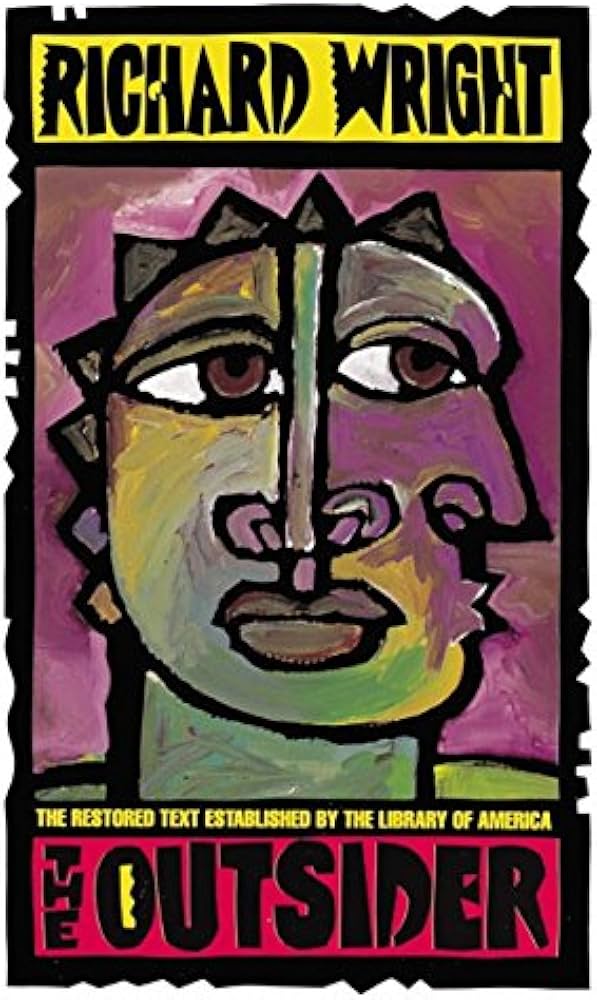
Richard Wright was a contemporary of Zora Neale Hurston, a Black man who criticized Hurston, an unapologetically Black women, for catering to white readers. While Hurston’s novels dig deep into the feeling lives of Black Americans through everyday encounters, Wright wrote The Outsider, a behemoth of a novel about the thoughts of one Black American named Cross Damon in exceptional circumstances. I struggled to read the text and switched to audio.
Two things stand out to me about The Outsider: it is emotionally neutered and the timeline is messy. Cross Damon is twenty-six years old, living on the south side of Chicago in 1950, and just learned that his teenaged girlfriend is pregnant. He also has a wife and three children with her. Wright establishes that Cross feels shame around lust because his mother didn’t have her son the Christian way either, so she projects her shame onto him. His friends give him a hard time for sliding into alcoholism. Okay, the story is off and running, but we know little of how Cross feels about all of this. His emotions toward his wife are rather clinical, especially when he recalls how nervous she was around white people: “He understood now; it was the helplessness of dependence that made her fret so. Men made themselves and women were made only through men.”
A train accident changes everything, and Cross moves to New York City where he assumes a new identity and is taken in by Communists. Like you do. The Outsider reminds me a little bit of reading Lolita because we are in Cross’s head, and it’s a cold, destructive place that wants to convince you nothing bad is happening. And yet we still know nothing of Cross’s emotional state. He rationalizes, “His life had become a vast system of pretense; one act of bad faith necessitated another, and in order to prove the sincerity of a new lie he had to fall back upon lying still further.” Although Richard Wright wanted to write intellectual novels about Black Americans, and he felt his contemporaries had a duty to do so as well, he often removes the emotional response, something I found perplexing.
The other issue I took with The Outsider is the timeline. Within twenty-four hours, he’s taken in by the Communist party and claiming he knew certain members well. One communist’s wife says she’ll kill herself if Cross leaves her. Really?? There is also a lot of female “whimpering” in Wright’s novel, to the point where the word enraged me. I wasn’t convinced Wright knows how to write female characters, as they are smitten with Cross in mere minutes, letting him, a stranger, make long-term financial decisions for them, sleeping with him, threatening to kill themselves, etc. When Cross decides he loves the wife of a communist, he thinks, “…he wanted that sensitive heart of hers to be his monitor, to check him from sinking into brutality, from succumbing to cruelty, and she wanted to love him for his being black because she thought he was an innocent victim.” By this point, the guilt from his mother’s projections and his alcoholism have disappeared, oddly.
Lastly, because the novel only takes place over a few days, you’d wonder why it’s 672 pages. After a pivotal scene that is described in detail, the communists ask Cross what happened, hypothesizing the narrative. In detail. And then the police do the same. And then the district attorney. Etc. We keep going over the same plot point again and again. Well, except those twenty-seven pages during which Cross is spouting all his theories on Communism. He says things like, “Now, during the past thirty-five years, under the ideological banner of Dialectical Materialism, a small group of ruthless men in Russia seized political power and the entire state apparatus and established dictatorship.” Meanwhile, the other characters just stand there and listen, as if Wright had paper dolls in his hands and forgot to animate some of them. Readers are not provided convincing evidence that Cross is an intellectual, so he sounds like someone who thinks he has it all figured out, and you’re the dummy for not being on the same page — except he has no clue what he’s talking about. Honestly, it felt like Wright wanted to shares his political thoughts and did so in fiction through Cross, but he should have written a non-fiction collection of essays and used Cross as a hypothetical person in a situation. Truly, I was glad when The Outsider was over.


I like the idea of a Black, Communist, contemporary of ZNH, but I’m not sure you’ve convinced me to read his novel. I certainly agree from what you’ve quoted that he seems unable to write believable women…
I went off and read the Wikipedia entry. Firstly, he was by the time he wrote this, an ex-Communist. And. There is an earlier novel with the same protagonist! (I didn’t see how many pages).
I’m on my second Communist account of the Depression (in my reading this year), and they do seem to take people in (ie. help them). Though I agree that doesn’t make the people helped instant Communists.
LikeLike
I’m not surprised Wright was no longer Communist; they sounded crazy in the novel… inflexible, like humans are just cogs in a Communist machine. I did read that this book is part of a series, but I don’t think they really are? It was unclear to me. You’d be better off reading his novel Native Son.
LikeLike
Ok. I now have Native Son on Audible
LikeLike
Excellent, looking forward to your thoughts. I haven’t read it in over 20 years, but I remember it being very tense.
LikeLike
The only thing I knew about The Outsiders before reading your review is that it was Wright’s first novel to receive mostly negative reviews; sounds like they’re deserved!
LikeLike
I actually didn’t look up any professional reviews (compared to community reviews on Goodreads) after I finished because I was capital D done. I wonder if being in Percocet made the book tolerable or worse, but it certainly didn’t motivate me to read more about the novel after I finished.
LikeLiked by 1 person
For a second, I thought this was the one by Stephen King. 672 pages to cover the events of a handful of days, yeah, that’s too long. Thank you for the review.
LikeLike
I don’t think I’ll be rushing to pick this one up! 672 pages is an awful lot of pages to cover a few days. You can get a century-long family saga into that page count!
LikeLike
So true! I will add that even though the book was like the size of a brick if we’re thinking about length, it’s also a mass market paperback. I guess, that means it really was the size of a brick!
LikeLiked by 1 person
Well, I feel comfortable leaving this off my TBR!
LikeLike
It’s a classic, and sometimes classics don’t need to be read. Someone else in the comments noted that this was his worst reviewed novel. I didn’t know that when I bought it. I will say that my brain is starting to consider reading other classics because I’m currently reading Pride and Prejudice aloud to Nick. I’m looking at the Picture of Dorian Gray, Dr Jekyll and Mr Hyde, maybe even Moby Dick. I read a new memoir that had a big quote from Moby Dick, and the writing was truly beautiful. I was turned off by the novella Billy Budd, so I never picked up Moby Dick.
LikeLiked by 1 person
Whoa, why does it feel so freeing to allow that classics don’t all need to be read?
Dorian Gray and Jekyll & Hyde are both books I remember being quite short and entertaining. Moby Dick has some stunning sections and some more difficult to get through sections.
LikeLike
I’m worried about Moby Dick, but we’ll see. I’m glad to hear those other works were a hit with you, though! I feel bad confessing I’m not a fan of Frankenstein. I thought perhaps I felt that way because it’s old, but I love Dracula.
LikeLiked by 1 person
I would say Frankenstein is a lot denser than any of those others. Stevenson really writes adventure novels and focuses on the thrills. Both he and Wilde are more concerned with entertaining the reader, I think, than Mary Shelley was.
LikeLike
I can’t complain; I like being entertained, and Shelley, I have since learned, is beloved by moody teenagers because the book was written by (we assume) a moody teenager.
LikeLiked by 1 person
Do you think there is a gender aspect here? That ZNH is more about emotions and Wright is more, hmmm, objective/analytical. Some men – male writers – don’t understand the significance of feeling (or emotion, or the domestic) in stories that have socio-political drivers. Does this make sense?
LikeLike
I don’t think it has to do with gender and more that Wright felt the pressure to write for and about his race, to uplift the race while saying something academic about it. Hurston felt no need to represent a race in her writing and was criticized harshly for refusing to do so.
LikeLike
Ah thanks Melanie. It’s a bit like those (mostly men I think) who criticise Austen because she didn’t write about the Napoleonic Wars that were raging as she wrote. Why can’t people write what they want and we critique on the basis of how well they wrote that not on the basis of some idea about what they should write!
LikeLike
Yes! I think that’s a good comparison.
LikeLiked by 1 person
Yikes, reading this novel would annoy me. and over 600 pages! That’s a hard no. And the fact that he criticized Zora? Another hard no. Good for you for picking it up though.
LikeLike
Okay, I love you for defending Zora like that. 🤣
LikeLiked by 1 person