
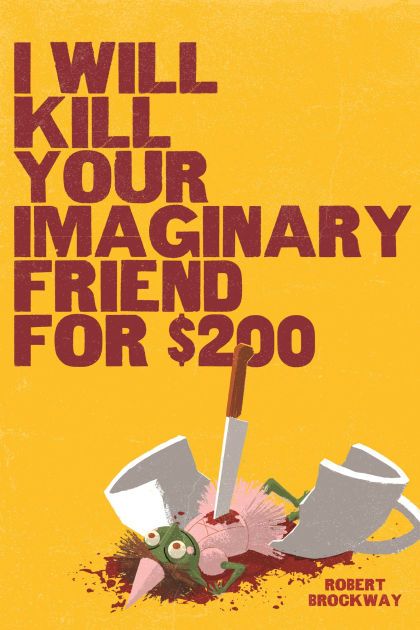
What an extraordinary novel. I thought it would be flippant, given the title. However, it is not. Instead, Robert Brockway lets his imagination loose in I Will Kill Your Imaginary Friend for $200 to examine the lives of children who lack attention for different reasons. The novel is dedicated to single parents, and our main child protagonist is a little girl named Kay whose mother loves her dearly, but is a single parent who must work constantly to maintain their small house. Thus, Kay is home alone when she’s not at school. Her loneliness and dread of quiet leads her to create an imaginary friend named Eddie Video, a character based on a YouTube channel she enjoys.
Other children develop the imaginary friends they need, and not all children come from lower income home. Some are children of parents who have elite job titles, thus making them too “important” to pay attention to their children. Brockway demonstrates that loneliness is loneliness, regardless of the money situation, but that poor children imagine monsters and wealthy children imagine friends. Kay is our main focus, the heart of the plot, and we see her at school, saying and doing everything wrong despite her best efforts: “Even when Kay was right, she was ridiculous. She struck out like a crooked nail, while everyone else was so happy being flush with the wood.” Kay is bright, imaginative, thoughtful. But not befriended.
Instead, she convinces her teacher that she’s required to check in with her mom at specific times, so Kay is allowed to have her tablet during recess. Sitting alone, Kay watches Eddie Video on YouTube, spaces out, and, from the outside, practically looks catatonic. What’s happening is she’s imagining interactions with Eddie Video, whose favorite thing is “pranks!” Eventually, he persuades Kay to do “pranks,” too, which leads her to hurt another child. After Kay is suspended, she spends even more time at home alone, and Eddie Video is there….talking to her directly. Ultimately, the prank at school was the catalyst to get Kay alone with Eddie Video, and the reader gets the jist that Eddie Video is neither as playful nor harmless as other children’s imaginary friends.
While Kay is the heart of the novel, Ivan is the “hero.” Yes, hero in quotes because he’s a worn down, poor, struggling, lonely man — I believe in his 30s? — who helps adults kill their imaginary friends that never left and are incongruous with adult life. It’s hard to hold a job or develop relationships if you have a tiny, obscene fairy saying naughty things and farting incessantly (see the fairy on the cover). Our poor “hero” is such a “nobody” that he doesn’t even go by his own name anymore. Maksim Ivanov is from Ukraine and moved to the U.S. when he was a child. His accent and cultural differences singled him out as a “weirdo,” and the other children dubbed him Ivan, assuming he was a Russian boy, someone not to be trusted.
The layers in I Will Kill Your Imaginary Friend for $200 are breathtaking. There is so much heart and sadness, joy and love, darkness and fear. Brockway’s novel is imaginative yet comments on the real issue of social classes, too. When Ivan (he goes by Ivan in the novel because he surrendered his own identity years ago) delivers food as a member of the gig economy, he’s amazed at how rich people look homeless as a trend, that the most expensive restaurant can exist next door to the poorest parts of a town.
One massive issue Ivan faces, the reason he can kill imaginary friends for weary adults, is that he can see all the imaginary friends. Typically, only the person who created the imaginary friend can see it, but Ivan is the exception — which is dangerous, because they do not like Ivan for one important reason revealed later in the novel. As a person who struggles every day seeing dangerous things that others don’t, Ivan realizes he’s terrified: “With focused effort and a lot of expensive professional therapy, one day Ivan might finally beat this phobia. But he couldn’t afford that, so he watched YouTube therapy videos by attractive people with exposed cleavage, and settled for living with it.” Isn’t that just so American?
I Will Kill Your Imaginary Friend for $200 is an immersive, original plot that both holds up a mirror and is kind to parents who can’t afford to be with their kids all the time. Brockway’s acknowledgements note that he was raised by a single father, and I can tell this is a personal story with a huge dose of imagination. I was kept guessing until the end about what would happen, and I was wrong in so many ways.


This book sounds like a lot – but also sounds really well done. I’ll mention it to my horror-loving coworker.
LikeLike
I suspect she would love it based on what you’ve said about her before. It’s truly inventive.
LikeLiked by 1 person
I had an imaginary friend when I was a nipper apparently. My parents were not wealthy however and my friend was not a monster. Nor was I left alone at home or neglected by my parents. I know this is a data point of one but there seems a big flaw in the premise of making imaginary “friends’ a question of social class and upbringing.
There, I shall get off my soap box now 🙂
LikeLike
I think the point about poor children’s imaginary friends being “monsters” is the idea that the imaginary friend is a way of externalizing being left along frequently, that desperate need to be cared for and attended to. Some of the imaginary friends looked like tantrums, in a way. Just an utter chaos of emotions.
LikeLike
I’m also dubious about the idea of imaginary friends vs monsters being in some way predicted by social class and/or parental involvement. I didn’t have an imaginary friend, despite the fact that I was a lonely child (not because my parents were neglectful, just because I couldn’t make friends). I did spend a lot of time imagining myself participating in the books I read or pretending I was in various adventure stories, but no single identifiable “friend”. I have worked with and looked after children who did have imaginary friends, though, and I don’t really think they had any single unifying factor around parental neglect or lack of money. Some of them were from very happy homes!
LikeLike
The author dedicated the book to single parents, and in the acknowledgments he talks about how he was raised by a single father and often left home alone. I’m guessing this is a deeply personal book despite it being quite fantastical. I’ve personally never met someone who had an imaginary friend, so I kind of wondered if they were just a figment of fiction. I wondered what your perspective would be on this, given that you are a pediatric nurse.
LikeLike
This sounds like such an interesting premise. I had an imaginary friend, two actually. It sounds like the creepiness here is also coming from the actual content this kid is consuming. Are the videos themselves supposed to be bad or is it only from her imaginary friend? I think there’s definitely some horror to be explored in the idea of some random YouTuber controlling a small child in any way – maybe because that feels way too possible in the real world!
LikeLike
Basically, my understanding is that the child creates an imaginary friend using whatever is around them. So, originally, this little girl is just watching a YouTube channel, and she creates an imaginary friend out of one of the characters. Then, we later learned that this character has a history that exists before her imagining him, which is why he’s so scary.
LikeLike
I’ve called people I know only through book blogging my “imaginary friends” since 2008! This book sounds interesting.
LikeLike
It was fascinating how creative the lore was around why this one man can see imaginary friends, what the imaginary friends mean to the children, and this one main imaginary friend that has gone rogue.
LikeLiked by 1 person
Ohhh this does sound good! I love how many layers it has, there’s so many ways to think about it. Very quirky. I never had an imaginary friend, I’m the LEAST imaginative person I know.
LikeLike
I’ve never even met someone who has an imaginary friend. This book was awesome; one of the most memorable of the year so far.
LikeLiked by 1 person
Oh now that’s high praise!
LikeLiked by 1 person
My son had an imaginary friend for a while, 2 or 3 years probably. I only knew because he talked about his ‘friend’ to his sisters. Was he lonely? Maybe. Milly was mostly stay at home, and I was home when she worked evenings, but we had moved around a bit. At about that time we settled and he has had the same (real) best friend ever since.
The novel sounds like an interesting way to discuss class, even if we are not sure here that imaginary friends are class based.
LikeLiked by 1 person
The comments do seem pretty divided if not squarely against Brockway’s feelings about money, attention to children, and imaginary friends being related.
LikeLike
I didn’t read your post as suggesting that ALL imaginary friends are created in this way for this reason – just that this is one type of imaginary friend situation. I love your post on this, and I particularly love that the story is both holds a mirror to and is kind to parents who can’t afford to be with their kids all the time. So much of the decisions we make in life have two sides, and this is particularly so for people pushed into corners over which they have little control. Damned-if-you-do-and-damned-if-you-don’t situations are not rare. It sounds like Brockway has explored this one with warmth and empathy.
LikeLike
I agree, I thought he was truly empathetic to parents who couldn’t be with their children all the time, and I also did not read his characterization as some prescription of how imaginary friends are created. More so, I think that loneliness leads to longing to belong.
LikeLike
Thanks Melanie … I think loneliness is an issue that not enough attention is paid to. Not just by governments and health authorities but by individuals.
Here’s my soapbox: I think people who claim they are going to leave their homes in a box have not thought about how isolated and lonely you can become in old age, particularly once you lose mobility (can’t drive, can’t walk much, can’t easily get on buses). If you have kids they cannot be there for you all the time. They will have work, their own kids etc. And your friends who are still alive are going to be in the same situation as you. I just don’t think people get it. Loneliness is an awful thing.
LikeLiked by 1 person
I love that your reply made me wonder about seniors and imaginary friends. My Uncle Ralph saw Amish kids before he was moved into a safe place. He lived alone.
LikeLiked by 1 person
That’s interesting Melanie!! I love that my reply did too.
LikeLike