
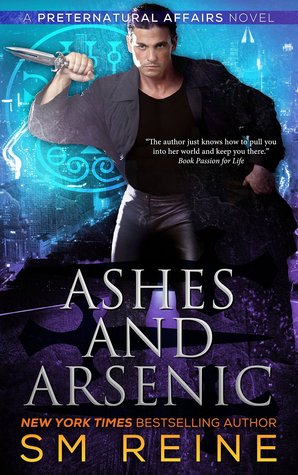
Because his boss is out of town, Cèsar is in charge, so instead of being assigned the complicated cases (see all the reviews above), he chooses a bank robbery that has evidence of witchcraft. Cèsar is a witch, so he thinks this will be easy. That is, until he sees the security footage reveals his brother as the culprit. In a novel about who you can trust, which includes believing his brother just because he’s family, Cèsar must decide if he’ll risk his job (and a memory wipe if he gets fired) just to stay loyal to his only brother, who, in the past, has used blood spells and actually robbed banks.
S.M. Reine never writes characters separated from reality. What I mean is all the bodily stuff Hollywood likes to skip for fear of viewers learning Jennifer Lawrence has hemorrhoids, or something like that, Reine includes. Here’s a funny example:
A woman shrieked as she leaped off of the toilet, jerking one of my Star Wars bath towels in front of her body.
“Oh, Jesus, I’m sorry!” I shielded my eyes, trying not to see the lady who’d been using my bathroom. . . . I backed out halfway before realizing that there shouldn’t have been any women using my toilet at all. . . . It was Aisha, the witch who’d held me at gunpoint in the warehouse. And I’d caught her taking a dump in my bathroom.
I appreciate seeing characters in their bodies because it makes them more real to me, even if they are witches who work for a secret agency that keeps the peace among demons, angels, and humans. I understand the writing is a little vulgar, but it also reminds me that a hot witch in leather pants also needs to poo. I don’t like characters whose bodies are like photographs because it makes me feel bad that mine is like a flesh factory of organic processes.
There’s also something endearing about Cèsar being a so-so witch. He pulls through when it comes down to business, but the guy is allergic to magic, going into full-body sneezes whenever magic is cast or even leaves a residue. Furthermore, he seems to bumble his judgements of everyone, from the women he’s sexually interested in and his work partner, to his brother and other suspects. Take Aisha, for instance: “She beckoned me over, a finger to her lips. I lowered my gun, then lifted it again. I had no idea how I was supposed to treat her now. Good guy? Bad guy? Chaotic neutral, likes she was fucking Catwoman?”
For the next book: In this installment we learn more about Cèsar’s family lineage, which describes witches from way back, including his grandfather, who appears in this novel a frail old man who will destroy anyone with magic. I’d like a story about the Hawke family, maybe even shows Cèsar learning magic from his relatives. A sort of prequel, if you will.


Man, I am enjoying these recaps! We’re all getting to know César. It’s like how my coworker tells me about the books she reads that I’m probably never going to read but I still enjoy hearing about them. And I do the same for her. It really widens our knowledge of books.
LikeLike
Hahaha, I’m so glad! I scheduled these for you guys so you wouldn’t miss me while I was gone. I love that you do the same thing with your coworker (I’m assuming it’s the one who loves horror). I was AMAZED when I worked at a library how many librarians don’t read at all.
LikeLiked by 1 person
I totally agree with your thoughts on the bodily functions. It makes me feel so much better about my life in general, but it also connects me to the story more. I just appreciate it! And it’s so rare!
LikeLike
Absolutely. I’m reading a book now in which a character, totally zen, has money, good looking, pulls up, jumps out of his Jeep, and says, “I have to take a shit.” I just could not stop laughing.
LikeLiked by 1 person
we need more of that!!!
LikeLiked by 1 person
I feel like I’m getting such a good sense of this series from these daily recaps! I don’t love descriptions of bodily functions but I do like it when it’s clear that characters have real bodies. Because you’re right, my body functions and has these features and I want to read about characters who have bodies like that too!
LikeLike
You can read a whole novel in which no one eats, and I find that uncanny.
LikeLiked by 1 person
Ok, so I’m reading a very long novel right now and my primary complaint is that there is too much description of everyday ordinary action! I really want to know what’s going to happen but there is so much time devoted to the characters washing their bodies, getting dressed, washing the dishes, hanging the laundry. Like, get on with it! I know they do these things, I watched them do these things yesterday! Years ago, I read some Q&A with someone from Star Trek answering the question “Where are the bathrooms on the Enterprise?” and the answer was basically, of course the Enterprise has toilets but why would you devote time to showing them? So I guess I won’t acknowledgement of the characters’ bodily needs but there is a limit, for me.
LikeLike
I oddly get bothered when characters have a quick meal break and eat it in a cafe or on a park bench and the author describes the person as “munching” or “nibbling” their food. I’m triggered just writing this, lol.
LikeLiked by 1 person
I’ve never given it much thought but I do hate “munching” or “nibbling”. Those are things cartoon characters do, not real people!
LikeLiked by 1 person
Again, I am liking our so-so witch, but this interested me most:
“I appreciate seeing characters in their bodies because it makes them more real to me … I understand the writing is a little vulgar, but it also reminds me that a hot witch in leather pants also needs to poo. I don’t like characters whose bodies are like photographs because it makes me feel bad that mine is like a flesh factory of organic processes.” I didn’t think the writing was vulgar, but I’m not sure I need to see (read) bodily functions for characters to feel real. I think anything we hear about a character needs to serve the purpose of the novel. If we need description of bodily functions simply to make a character feel real, I’m not sure I would think that’s good writing? But, if seeing the bodily function tells us something about them (or the person who sees them, in a case like this) then I don’t mind if it’s vulgar or not.
LikeLike
I was writing to Karissa that I find it odd that I can read an entire novel in which no one eats. Things like that which connect humans to one another. I recently heard that the great unifier of the world, from the Queen of England (this interview was a few years old) to the homeless person in a tent in LA has to poo the same way–same body position, same thoughts, same everything.
LikeLike
Haha Melanie, I love hearing about food and dining, not so much about pooing! But I don’t need to hear about them unless they are relevant. It is interesting though that one of the criticisms of women’s writing for so long was their interest in the domestic, and yet as a woman I love reading about the domestic, including the meals and the cleaning, but again as long as it serves the purpose of the novel. And of course the critics felt that domestic themes were not meaningful. Fortunately the world has moved on. Have I added anything to our conversation probably not!
LikeLiked by 1 person
I wonder if you wouldn’t love the novel What Diantha Did by Charlotte Perkins Gilman. Domestic, feminist, a great read. The audiobook is particularly good.
LikeLike