
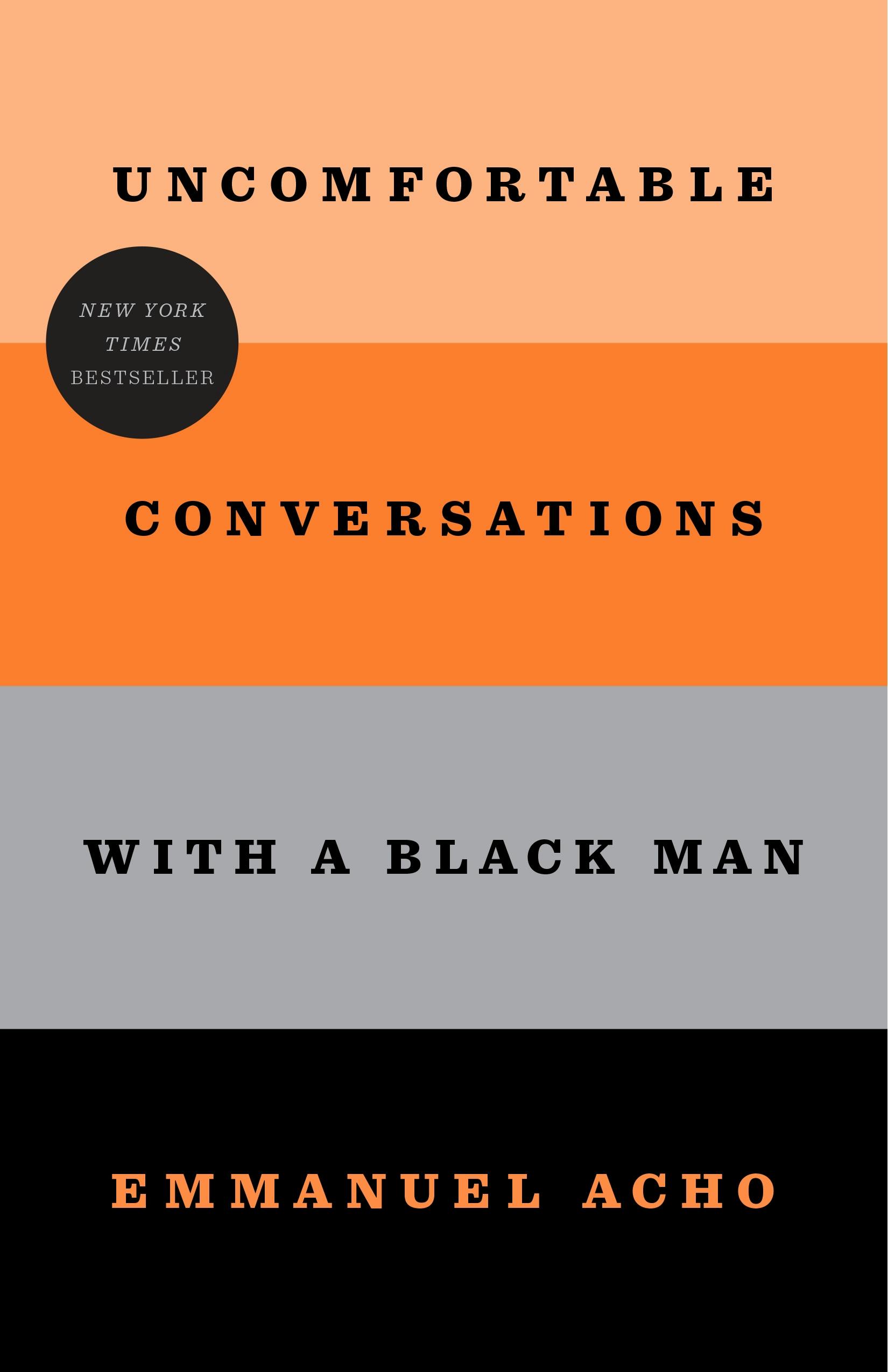
Written when he was 29 years old, Emmanuel Acho is behind first the podcast and then the book Uncomfortable Conversations with a Black Man. Acho explains that he was born and raised in Texas to Nigerian immigrants. He attended a private school with mostly white students and acknowledges that for all the reasons I just listed, his experience as Black man in America is different from many others. However, when he was drafted in the NFL and attended college, he felt “at home” with other Black people.
This book was chosen by my workplace as our first quarter book club, which earns us continuing education credits. The facilitator asks six questions to which we must reply. I realized something silly; I found Acho’s book be neither uncomfortable nor challenging, and the reason is I have a lot of background in Black history and culture. I’ve taken a graduate class on the history of Black people in Detroit. A Civil Rights class. A Black lit class. I’ve taught Black lit classes at the college level. I don’t know how many times I’ve read The Autobiography of Malcolm X because I used to teach that, too. The books and movies he recommends, I’ve seen and watched. Therefore, the audience for Uncomfortable Conversations with a Black Man is likely a white person who feels confused about what seems illogical or like contradictions. For instance, Acho discusses why white people can’t say the N-word but Black people can, what is appropriation vs. appreciation, what is white privilege, does reverse racism exist, etc. The questions he addresses were all submitted by white people.
I do appreciate Acho’s kind tone, historical examples that lead to present day realities, and his sports analogies. Usually, too much sports drives me insane, but his examples from the NFL are clear and helpful, such as when he discusses a huddle. Below, I’ve copied and pasted my answers that I shared with the company book club, as I don’t have much to add for a review and thought you might enjoy this different approach.
Choose one historical example of oppression experienced black people and describe the long-term impact.
Around 2005, I took a graduate-level course called Black Detroit. There, I learned what “white flight” is and how it negatively impacts Black communities. Detroit used to be a flourishing city thanks to several auto industries. Southern Black Americans left the south, which many felt was a dangerous place to live, and moved to northing cities like Cleveland, Chicago, and Detroit. Thanks to the auto industry, these Black migrants got a foothold in upward mobility. Yes, the work was grueling long days and riding the bus home, but for the first time, many bought homes and joined churches and clubs designed to uplift the Black community, especially newly-arrived migrants.
However, as people left blue-collar work and moved into professional careers, they also bought homes in nicer neighborhoods, typically populated by white families. As a result, the white families started leaving inner city Detroit and moved to the suburbs to avoid having Black neighbors. This is known as “white flight.” The long-term result, one that still affects Detroit today, is that the city is too big (in square miles) with too few people (mostly Black families) and has little industry to support workers (after the auto plants because automated). In many places, there is no trash pickup. Police and ambulance services take an unacceptable amount of time to reach emergencies because there isn’t enough tax revenue to support more staff. Banks will not loan someone money to buy or renovate homes in inner city Detroit, even places that used to be considered high-end, luxury houses in the heyday of Detroit. The latest issue is gentrification. White families are now moving into the city and buying homes using personal loans. Therefore, Black families are being priced out of their own neighborhoods as white communities build up the area, buying homes, starting businesses, etc.
I know the author gives plenty of other examples, and this one is not in the book, but it’s a memorable example that helps us understand neighborhoods across the US affected by intentional oppression.
Role-play responding to a person who makes a comment based on their implicit bias. What would you say?
The police in my city update their Facebook page with local incidents, and it often feels like most incidents are shootings. Whenever the police describe a shooting, and I mean they are not including any information about the victim or perpetrator. Without fail, there are dozens of comments that all make the same remark: “The usual suspects.” Again, no information has been given about the shooter, and yet people in my community have decided someone Black was the shooter. How do I reply to this?
I don’t have the same knowledge that Acho does of the history of gun violence in the Black community, though he did describe the relationship between being poor and violence. My response would be just that—the relationship between desperate poverty and violence. If you’re looking for a movie recommendation, try Spike Lee’s Do the Right Thing. I would also reply that when the perpetrator turns out to be white, no one says, “The usual suspects.” In my city, there are poor Black communities, and in the neighboring county, there are many poor white communities. Both are on the news for drug charges, murder, and gun possession. Therefore, people assume Black communities are more violent or tend be behind shootings when it’s fairly equal, even in the news. People see what they want to see, confirming their own biases. I would also ask, “What response do you have immediately when you see white people charged with a shooting on TV?”
Compare and contrast: Cultural Appropriation vs. Paying homage to another culture. What is the difference?
Cultural appropriation is taking without giving credit or giving credit to the wrong person because you haven’t actually learned about the thing you are appropriating. Acho gives the example of a Kardashian crediting her braids to a white woman she saw wearing the braids. Ms. Kardashian is taking something from another culture, without, it seems, even being aware that it’s from another culture. Paying homage means showing respect for the creative labor of another culture. It wasn’t clear to me if Acho felt that white people can participate in another culture, so long as they give credit. I mean, he says yes, but the “yes” lacks conviction to me.
Here’s an example: I remember a group of high school girls in my grade spent every spring bring in the Caribbean (oh, to have Caribbean money…) and would always coming back tanned, with braids, and henna. And yet, they never seemed to talk about who did the braids and henna, did the artist talk about their culture, did they research the history of the brains and henna, or was it just a cute thing they could do before they came home to show off in the hallways of the high school what a great spring break they had? Recently, my husband’s workplace hosted a “Share Your Culture” potluck, for which everyone could bring a dish that represented their culture. This is a good way to try new foods, ask the chef about them, and see if you can learn the history or importance of that food in the person’s culture.
Describe your understanding of “Reverse Racism.”
Reverse racism seems to have two definitions. One is when a non-white person says or does discriminatory things about a white person. Or so I thought. Dr. Kendi is quoted stating that there are Black folks who do not resist racism, and there are Black folks who uphold racist institutions and policies. Ben Carson comes to mind. Basically, someone who isn’t anti-racist is racist. The other is when something, such as Affirmative Action, supports the advancement non-white people. The common misunderstanding about affirmative action is that it benefits unqualified candidates who are not white. In reality, any number of candidates could be qualified, but the hiring entity may choose a non-white individual to help the black community “catch up” after history has put them behind. In general, having white skin will never be a disadvantage, even if a white individual is poor, uneducated, or feels left out during Black History month. It’s about Black people needing to remind folks that their lives matter, just for white people to reply all lives matter, as if all lives are equally in jeopardy. In conclusion, reverse racism doesn’t exist because there is so large body of Black people in power over white people.
Give an example of how you can be an ally.
When an organization operated by a minority group asks for a specific kind of help, I’ll do it if possible. For example, I saw a special on CBS about a marine biologist who studies sharks and was kicked out of academia, who went in to start her own organization: MISS (Minorities In Shark Science). This Black woman faced discrimination and plagiarism from her white peers, so she wrote a book about it (called Sharks Don’t Sink by Jasmin Graham), and I read it. Afterwards, I sent MISS money to support the scholarships for young Black and brown aspiring shark scientists, which was specifically how Graham asked folks to be an ally.
Books of winter ❄️⛄🎄
- Savage Inequalities: Children in America’s Schools by Jonathan Kozol
- Monster: A Fan’s Dilemma by Claire Deder (DNF)
- This is Not a Book about Benedict Cumberbatch by Tabitha Carvan
- Crafting for Sinners by Jenny Kiefer
- Uncomfortable Conversations with a Black Man by Emmanuel Acho
- The Lost Girls by Allison Brennan (#11)
- Deliverance by James Dickey
- Devil’s Call by J. Danielle Dorn
- Dream Count by Chimamanda Ngozi Adichie
- Jaws by Peter Benchley
- The New York trilogy by Paul Auster
- The Man Who Shot Out My Eye is Dead by Chanelle Benz
- All of Me by Venise Berry
- At Wit’s End by Erma Bombeck
- Minding the Store: Great Literature About Business from Tolstoy to Now edited by Robert Coles and Albert LaFarge
- Touched by Kim Kelly
- Awakened by Laura Elliott
- The Road to Helltown by S.M. Reine (Preternatural Affairs series #9)
- After Life by Andrew Neiderman
- Paradise Rot by Jenny Hval
- How to Save a Misfit by Ellen Cassidy
- Suggs Black Backtracks by Martha Ann Spencer
 Grab the Lapels
This book sounds like it could be a great starting point for someone less familiar with racism and Black experience in America. I enjoyed reading your answers to the questions.
LikeLike
Thanks, Karissa.
LikeLiked by 1 person
Yes, I’m with Karissa re reading your answers to the questions. It sounds like a good book for someone starting out learning about these issues. I particularly like your response to the “implicit bias” question, because this can be the trickiest area. People can just not see their bias (and I include myself in this possibility though I do hope I am conscious of most things I say or think.)
I’d love to know how the discussion went. Did everyone agree? Did anyone say something that surprised (in a good or bad way) or inspire you?
LikeLike
To be honest, a lot of the other responses were fairly short. I might just be long-winded, or it might be the academic in me, but I tend to write a mini essay.
LikeLike
I can relate to that – as I’m sure you can guess!
LikeLike
I love this format! Very interesting stuff, and also cool that this book was chosen as the book club pick.
Re: the question about how to be an ally. What I always like to point out to people is that being an ally is never a mystery, as groups are always very explicit about how to be an ally – their communication is clear, and easy to understand. Often, they will say ‘this is how you can help’ at the end of their message. So when people claim they have no way to help, it’s just a poor excuse. I know you know that, but it always surprises me when other people don’t!
LikeLike
I like how you think about what an ally is. And if the group isn’t clear about what they need, it can be challenging to ask them. That’s something that I learned after my grandfather died. It’s like The grieving people need help, but they don’t know what kind of help. So if you want to be an ally, and the group isn’t clear about what they want, come up with a few options and let them choose. I know with what is going on in Minnesota, I can’t fly there and be part of the protests. That’s just not reasonable or logical. But I have a blog friend who lives there, and she’s rather distressed. So I asked her about where I could send some money to support organizations that are doing good work to help people. That way, she didn’t have to come up with something for me. I hope you’re having a great day, Anne!
LikeLiked by 1 person
Hmmm yah good point re: grieving folks. When people are grieving, asking how you can help is apparently not helpful – just stepping in and trying to take stuff off their plate is supposed to be the best. But, when groups of people need support, they are usually quite good at explaining how you can help. Maybe that’s the distinction?
My day is starting off great, because I’m writing to my blog friends and chatting books 🙂
LikeLiked by 1 person
Love it! 🩷🩷🩷
LikeLiked by 1 person
This sounds like a good book especially for someone new to the concept of anti-racism. I think it’s great your workplace has a book group and that you get CLE credits. Do you know what the next book is?
LikeLike
I don’t know what the next book is yet. They do the group quarterly, and I read this book right away, meaning I have 3 months to wait. I guess that means around the 1st of April we should have a new book?
LikeLiked by 1 person