
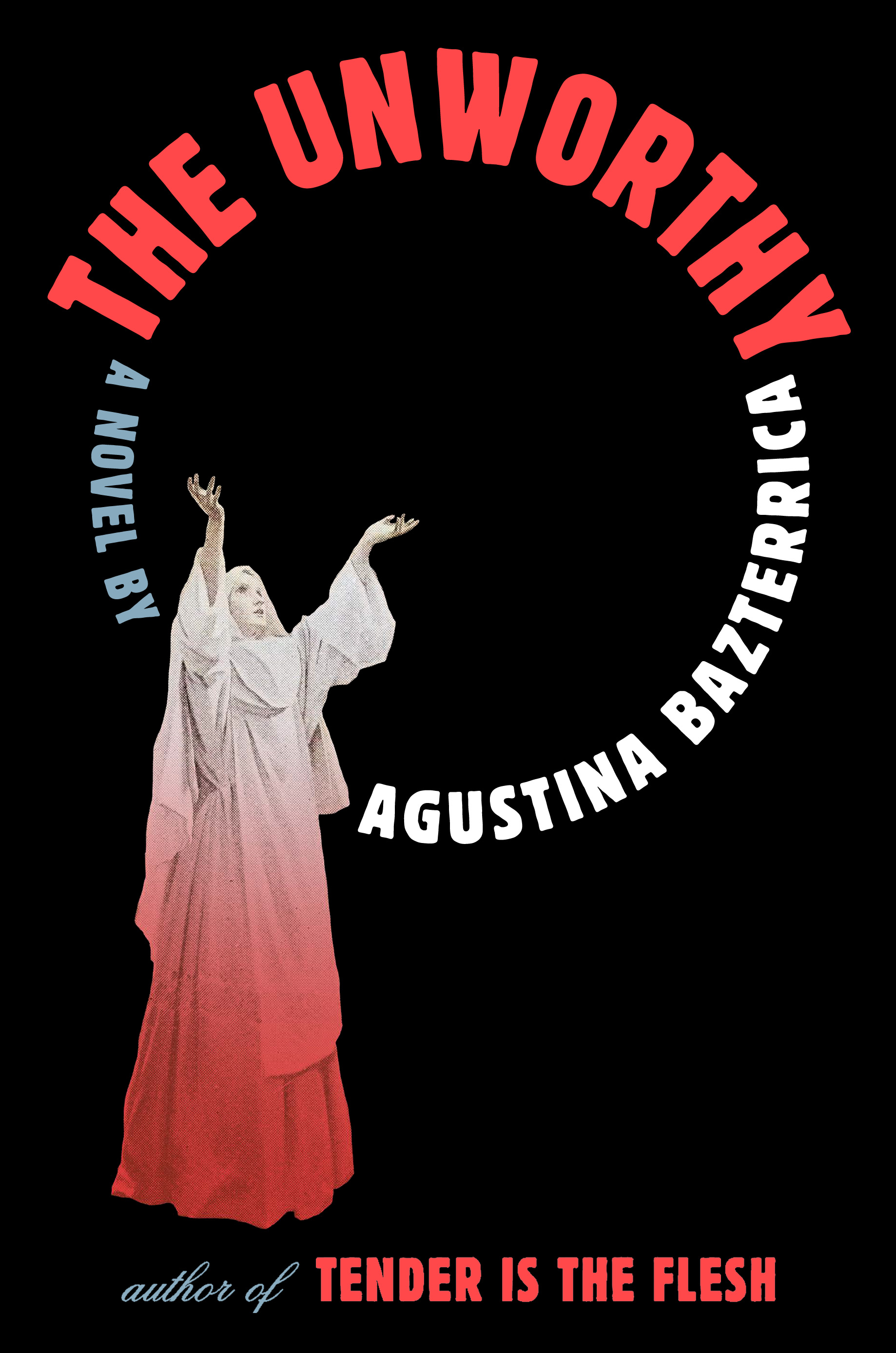
The Unworthy by Agustina Bazterrica, translated by Sarah Moses, comes in at under 200 pages, but still manages to feel long. Readers are thrown into a bizarre world that feels both medieval-monks-flagellating-themselves and post-apocalyptic-futuristic. Just how futuristic? We learn at one point that cell phones were already useless by the time our narrator was a little girl. Rich people were having metal trees installed near their homes to increase oxygen production. This isn’t our current society collapsed; it was a society after that that fell apart into a wasteland caused by climate change. No clean water, no trees, no signs of insects, and unpredictable weather.
Unfortunately, The Unworthy had a lot I didn’t care for. Firstly, the current timeline takes place in a sort of monastery for women who are part of a religion (not Christianity with its false God) in which they physically harm themselves to show their devotion. Again, I’m picturing the monks flagellating themselves, but this has to be a modern brick sort of building — maybe even a dorm or abandoned office suite, or a jail? The narrator mentions cells with no windows or lights.
Bazterrica never explains why women would abuse themselves in the name of religion, and considering these women come from “outside” where it is hard to survive, I can’t imagine they are immediately brainwashed into thinking sewing their eyes shut is better than being hungry. I mean, they’re only eating things made from crickets (so there are insects, but only crickets . . .). How much better is that? The Mother Superior offers little to no spiritual instruction that would persuade someone to subject themselves to torture. Behind a curtain a man none of the “unworthy” like the narrator have seen sits. Who is he? What does he do? I get the connection to women as subservient and men as rulers with privilege, but it’s not explored decently.
I can’t remember the characters’ names except the few bullies, including the Mother Superior, who stomps around in combat boots, dolling out punishment. In an effort to get her story out, our narrator writes what happens to her, and the book readers hold is supposed to be what the narrator left behind (except she hides it in a wet tree . . .and it’s written in her blood . . . despite the fact that they’re all starving and don’t have strength to spare). This poor young woman (age completely unguessable) clings to any woman she meets in her cult who shows the tiniest bit of difference compared to other “unworthy.” Because her lovers seemed interchangeable as characters, I wasn’t rooting for any particular relationship.
When she’s outside the building, the narrator takes note of small things about her environment, hinting to readers that outside the cult walls, things have improved. Should the narrator and other “unworthy” flee? Is the planet healing itself? Bazterrica never takes us down that road. It’s not all religious cult and self-harm, though. In her papers, the narrator writes a bit about her mother and what happened after her mother died: the gang of children she took up with, a cat she adopted, struggling to survive on her own. I found her past most interesting and wanted loads more about these metal trees and a post-cell phone world pre-collapse, and how some countries turned off their electric grids to stop the AI from taking over humanity. Yes, that is throw in the plot casually, as if I wouldn’t be extremely interested in 2025: The Year of Our Lord ChatGPT & Can I Trust This Video.
Bazterrica didn’t hit the right notes with me, and her rushed ending full of plot holes left me feeling like a polluted river you can’t swim in. On the other hand, if you check this book out on Goodreads, there are pages of 5-star reviews written in Spanish, so I wonder if something is lost in translation or that the narrative speaks more intimately to Bazterrica’s Argentinian readers.
Books of Fall 🍂🍵🎃
- Feeding Ghosts by Tessa Hulls
- Rebecca by Daphne du Maurier
- Just Desserts by G.A. McKevett
- Slewfoot by Brom
- She Throws Herself Forward to Stop the Fall by Dave Newman
- Submerged by Hillel Levin
- The Unmothers by Leslie J. Anderson
- Homing by Sherrie Flick (DNF)
- The Bloody Chamber and Other Stories by Angela Carter (DNF)
- Ask Elizabeth: Real Answers to Everything You Secretly Wanted to Ask about Love, Friends, Your Body — and Life in General by Elizabeth Berkley (DNF)
- No Good Deed by Allison Brennan (#10)
- Fat!So? by Marilyn Wann
- The West Passage by Jared Pechaček (DNF)
- Quest for the Unknown: Bizarre Phenomena by Reader’s Digest (DNF)
- Icebreaker by Hannah Grace (DNF)
- Notes on an Execution by Danya Kukafka
- Queer Little Nightmares, edited by David Ly and Daniel Zomparelli
- Player Piano by Kurt Vonnegut, Jr.
- Compassion, Michigan by Raymond Luczak
- Bitter Thirst by S.M. Reine (Preternatural Affairs #8) (forthcoming review)
- The Unworthy by Agustina Bazterrica (trans. by Sarah Moses)
- Syd Arthur by Ellen Frankel
- A Life in Letters by Zora Neale Hurston
 Grab the Lapels
I can’t remember – have you read Tender is the Flesh? I’d be interested in seeing how they compare.
LikeLike
I have not read Tender is the Flesh because all anyone talked about was the body horror aspect, and that doesn’t interest me. There has to be a reason for the body horror. It’s in this novel too, without much convincing reason unfortunately.
LikeLike
That one was recommended to me because of the body horror and I uh. Yeah. Was underwhelmed by the book overall.
LikeLike
I did notice that almost all of the 5-star reviews on Goodreads were in Spanish, making me think either there is something lost in transition or the Bazerrica’s work speaks more to her South American (I’m assuming mostly folks in Argentina) audience.
LikeLike
I get where you’re coming from, and I’m genuinely glad you laid it out this clearly. “Under 200 pages but still manages to feel long” is such a specific kind of reader pain, like getting trapped in an elevator that plays only one song.
That said, I think The Unworthy is aiming for exactly that claustrophobic, slow-grind feeling. It’s not trying to be a neat, explain-everything post-apocalypse with a clean timeline and a lore bible. It’s more like a damaged document smuggled out of a system that survives by keeping people confused, hungry, and afraid.
On the “why would anyone do this” point: I don’t read it as “these women heard a persuasive sermon and said, sure, let’s go full medieval.” I read it as coercion dressed up as faith. The whole setup works the way real-world control systems work: cut off choices, restrict information, punish dissent, repeat the same ideas until they feel like reality, and offer one thing people will do almost anything for… a version of safety. If the outside world is brutal and the inside world promises refuge (even a miserable refuge), people will rationalize a lot. Not because it makes sense in a calm, well-fed brain, but because survival turns your brain into a desperate accountant.
And yeah, the book definitely withholds. The man behind the curtain, the hierarchy, the logic of the place: it’s frustrating if you want answers. But I think the absence is part of the point. The narrator doesn’t have a full map, so we don’t either. That missing context becomes part of the horror.
I’ll also admit: I wanted more of the world outside, too. The metal trees! The post-cell phone weirdness! The “countries shutting down grids to stop AI” throwaway line! Those crumbs are so tasty. But Bazterrica keeps snapping the camera back to the cell, because the story isn’t “how the world ended,” it’s “what people do to each other inside a machine that feeds on belief and deprivation.”
So I don’t think you’re “reading it wrong.” I think you bumped up against what the book is built to do: make you uncomfortable, deny you satisfying explanations, and leave you with that grimy feeling of being trapped with someone else’s fear and half-memory. If that’s not what you want from a read, totally fair. There are plenty of dystopias that hand you a flashlight and a map. This one hands you a scratched-up confession and says, “good luck.”
Also, for what it’s worth, your metaphor about the polluted river you can’t swim in is gross and perfect. I’m stealing it (with respect).
LikeLike
I love this comment. I actually had my spooky book club meeting about this book last night, and one woman said she wanted a prequel that was just about the world collapsing. We typically go from a world we know to utter desolation, but the way Bazerrica has this timeline in which the narrator was born after cell phones don’t work and AI is going to kill us all, and this is BEFORE the big collapse, is something I’ve never encountered before. We also discussed how the book would read differently if it were in chronological order. Get that outside world first so the inside world see safe. I think what you write about taking away choices, repetition, and coercion makes a ton of sense. In fact, I can’t believe I missed the fact that this book is almost like a giant metaphor for domestic violence in the early stages when the abusing partner starts cutting off people, resources, and autonomy in the abused person’s life. Honestly, I think what would have totally changed everything for me and made this a much more appealing work is if we didn’t have the epistolary angle. Why not be in third person so we can see more and experience more, but still from the narrator’s point of view. I have seen reviews that say this book is about the power of words, but no one in my book club felt like that was true.
LikeLike
We’ve spoken before about the crossover from horror to SF, and specifically to dystopian near futures. My impression from your review is that this novel describes a horrible future rather than being traditional suspenseful horror. In any case I’ll see. I’ve bought it and I’ll read it soon.
LikeLike
In this novella, we’ve gone past the deterioration of society, in which people were fighting the AI take over of humans and an unliveable planet and go beyond even that. I’ve never encountered that middle space before where society has collapsed but not yet the liveable world, which then moves readers into the unliveable world.
LikeLike
Bummer this didn’t jive with you, it’s gotten such great reviews and I have a copy in a pile somewhere. I had hoped to get to this past spooky season but didn’t manage to. Maybe next year.
LikeLike
We have such different perspectives, Stefanie, that I think you will enjoy this one. I wanted more on the horror end from it, but I’m guessing it’s a kissing cousin to Handmaid’s Tale.
LikeLiked by 1 person
Hmmm yes perhaps something was lost in translation? let’s give it the benefit of the doubt. Also, I don’t think I will ever get the cringey image of someone sewing their eyelids shut out of my mind (shudder)
LikeLiked by 1 person