
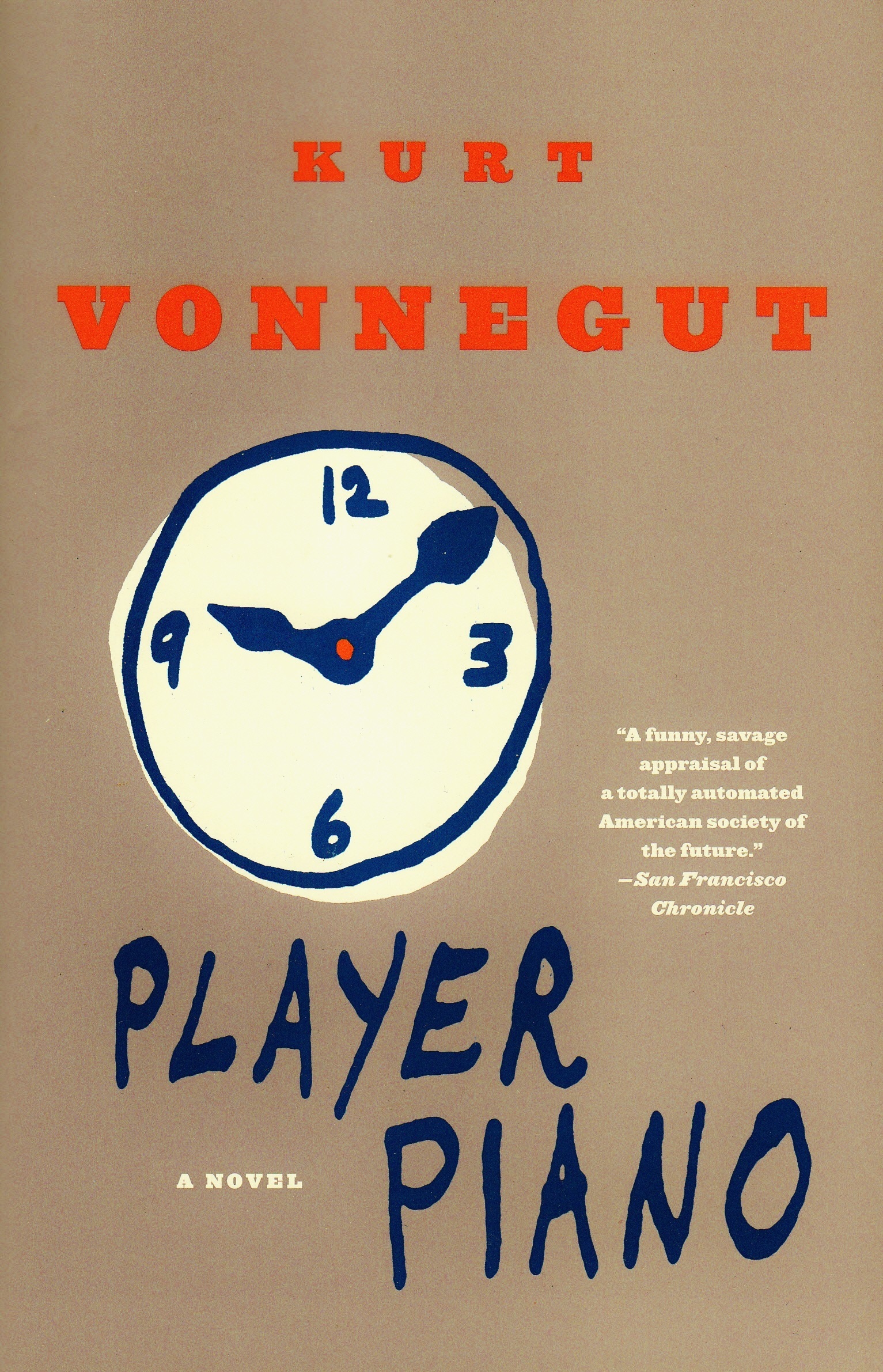
Kurt Vonnegut, Jr.’s first novel, Player Piano, is about Dr. Paul Proteus, a manager in a futuristic American society. Everything is so advanced technologically-wise that there are two groups of people: those who have a doctorate in something (engineering, real estate, secretary, etc.) and those who don’t have a high IQ according to the machines; therefore, there is nothing for them to do, not even physical labor. The machines do it all, meaning the “have nots” live on a stipend, have excellent medical care, housing, modern appliance (dinner is done in 28 seconds), etc. Their thinking is done for them: “His standard of living is constantly rising, and he and the country at large are protected from the old economic ups and downs by the orderly, predictable consumer habits the payroll machine gives him. Used to be he’d buy an impulse, illogically, and industry would go nutty trying to figure out what he was going to buy next.” However, humans cannot live with no stimulation, no purpose. You may be asking, “Why don’t they become artists!?” Well, art is carefully monitored, meaning no book is published, no art is produced that doesn’t already have a clear number on how many would sell, and at what profit.
Dr. Paul likes to sneak across the bridge to hang out in a bar with the purposeless folks. What he doesn’t realize that on his side of the bridge, people like him are always being watched, which puts him in hot water. There are strict anti-saboteur laws to prevent dissatisfaction in the lower class (though Vonnegut does not use that word that I remember, as it would probably create dissatisfaction). Dr. Paul starts having ideas about buying a farm to get escape some of the pressure of being busy doing nothing (really, the machines can run everything) and his high-pressure wife, who constantly wants Paul to climb the social ladder. Of course, he hasn’t asked his wife if she wants to move to a farm, let alone be a farmer. Paul’s desire to do physical labor in a skilled profession, about which he has no knowledge. On the farm, which has been on the market for over a decade, lives an actual farmer who doesn’t own the land, but whose family has cared for it for generations. Here, we get that clash between the “intelligent” and the “wise.” I thought Paul’s dreams were hilarious because they are so on point for today’s “trad wife” fad. “I just wanna hold my baaaabies barefoot in a dress and gather chicken eggs!” LOL, lady, that’s not farming.
The second storyline is about Shah of Bratpuhr, who is visiting the US to see what it’s like. He’s brought his nephew to translate, which is funny to me because in our industry, we consider interpreting for family members to be unethical. Family members are happy to “clean up” what the person says, or leave information out. Anyway, the Shah serves as an outsider who clearly notes that the people without jobs are basically slaves. The envoy leading the Shah around the US is appalled to find out that the translation for the jobless Americans is the word “slaves.” I think Vonnegut is trying here to make the point that America thinks of itself as first and best. Meanwhile, this Shah is supposedly from some underdeveloped country. This absolutely reminds me of the current American president and how he proclaims all Americans are doing awesome (the current narrative is that we are not struggling with cost of living), and other countries are [insert something derogatory].
Player Piano tended to feel all over the place because Vonnegut info dumped in the first chapter, had Dr. Paul bumming around for a while because he doesn’t actually have anything to do, though he does get into some shenanigans with an old friend who shows up to town, a character known mostly in my mind for his Irish last name and failure to shower. Like, ever. Then, we start hearing about The Meadows. Oh, lordy, The Meadows is coming! It sounds oddly like field day at summer camp, but the attendees are all people with PhDs. I had no clue how to feel about The Meadows because I couldn’t discern what the point was.
It finally became apparent when Paul gets to The Meadows and a loudspeaker repeatedly shouts at attendees to sit next to someone they don’t know so they can learn about each other:
“The more contacts you make here at the Meadows,” said the loudspeaker, “the more smoothly industry will function, co-operationwise.” It’s a networking event!
Except they are always 5-8 minutes behind schedule, so no one ever actually networks. Do they even need to if all these people don’t really work? Early on, Paul’s secretary is threatened by a radical thinker who shows up at Paul’s work — radical in that he’s depressed because he invented a machine that put him out of a job. He tells the secretary she’s easily replaceable (this reminds me so much of America’s 2008 economic recession), to which she balks, “There are all sorts of special decisions I have to make . . . I mean, all sorts of things come up that require more than routine thought — more than any old machine could do.”
And here’s the sticking point for me. If the people who are assessed as “dumb” don’t work, and the people with PhDs go to work but can be replaced by machines, and everyone is provided for…. is this a class novel? Is it about boredom and having a purpose? I found the conclusion of the novel rather hilarious because people are so damn predictable. On the other hand, the novel didn’t distribute information clearly, leaving me wondering where I was going and what I was doing. Not only did my spouse, a reader of deep thinky books, struggle to get into Player Piano (he didn’t finish), most of my book club didn’t finish either. People really struggled to get into it, even after switching from text to audio, and vice versa. Overall, it’s a worthy read, but you have to want it.
Books of Fall 🎃🍵🍂
- Feeding Ghosts by Tessa Hulls
- Rebecca by Daphne du Maurier
- Just Desserts by G.A. McKevett
- Slewfoot by Brom
- She Throws Herself Forward to Stop the Fall by Dave Newman
- Submerged by Hillel Levin
- The Unmothers by Leslie J. Anderson
- Homing by Sherrie Flick (DNF)
- The Bloody Chamber and Other Stories by Angela Carter (DNF)
- Ask Elizabeth: Real Answers to Everything You Secretly Wanted to Ask about Love, Friends, Your Body — and Life in General by Elizabeth Berkley (DNF)
- No Good Deed by Allison Brennan (#10)
- Fat!So? by Marilyn Wann
- The West Passage by Jared Pechaček (DNF)
- Quest for the Unknown: Bizarre Phenomena by Reader’s Digest (DNF)
- Icebreaker by Hannah Grace (DNF)
- Notes on an Execution by Danya Kukafka
- Queer Little Nightmares, edited by David Ly and Daniel Zomparelli
- Player Piano by Kurt Vonnegut, Jr.
- A Life in Letters by Zora Neale Hurston
- Bitter Thirst by S.M. Reine (Preternatural Affairs #8)
- Deaf Eyes on Interpreting, edited by Thomas H. Holcomb and David H. Smith
- Compassion, Michigan by Raymond Luczak
- Syd Arthur by Ellen Frankel
 Grab the Lapels
I enjoyed Player Piano when I read it nearly a decade ago, but I have been reading 1950s SF most of my life. I wrote in my review that it was bursting with ideas – which you put less generously as “all over the place”.
In passing, I have a daughter with a PhD who lives on a bush block on the coast and is perfectly described by “I just wanna hold my baaaabies barefoot in a dress and gather chicken eggs!” (except she mostly wears overalls).
Vonnegut writes satirically, but I think this is a serious attempt to imagine in fiction the effect automation might have on a modern economy. By the time you’re 60 you might see just how much he got right.
LikeLike
To be fair, you are accurate that it is bursting with ideas, but the lead-in to the ideas isn’t there, hence my feeling that is all over the place. I think I enjoy the novel now, but not while I was reading it, which is a strange feeling!
I hope you don’t think I shit on your kids with my comment. The kind of person I’m describing is a big fan of pushing their trad-wife life without doing much work of any kind and taking cute photos in dresses while telling others they should live the same way. That’s definitely but the same as organic/small farmers who are actually it there doing the work, just on a small scale.
LikeLike
I’m sure my daughter would agree with your description. She’s living her perfect life – five kids, 90 acres of forest, 5 chooks, 2 goats. And a well paid three day a week job to keep it all ticking over
LikeLike
I felt like this book was like the strange child of a Flintstones vitamin and a Charleston Chew candy bar. Based on the packaging and prior experience, I knew the contents were going to be good and good for me, but it was taking a lot of chewing to get through the first bite. Then I looked at the rest of that thing and set it down, thinking I’ll come back to it later. Maybe. There are plenty of candy bars that aren’t quite as hard to eat, yet would still pair well with chewable vitamins.
LikeLike
Naturally. I don’t remember if you’ve read Breakfast Of Champions before. If you haven’t, maybe I should read that one to you. 🙂
LikeLike
I’ve read a few Vonneguts but not this one. It sounds interesting though if for no other reason than it seems kind of obvious that the seeds of his later writing are on display here.
LikeLike
Because I read Breakfast of Champions first, I assumed all of his writing was really kooky, but since then I’ve read three more novels, and if anything they’re fairly dark and despairing with a small grin. Someone is irrevocably changed.
LikeLiked by 1 person
I had a Vonnegut phase when I was in my early 20’s – didn’t read this one, though. Nick’s description hasn’t made me want to pick this up, LOL.
LikeLike
He’s such an amazing, intelligent reader that when a book is challenging to him, I’m suspicious. However, I finished it for book club and thought the ending was so, “Ugh, humans!” in a funny way.
LikeLiked by 1 person
This is the first Vonnegut I read, way back in the summer of 2004. I remember a lot of what you’re describing but not a lot about what I felt about it. I’ve definitely felt more engaged by other books from him.
LikeLike
I’m always amazed that he’s known for being so funny and cheeky, but almost every book of his that I’ve read has just left me devastated.
LikeLiked by 1 person
Vonnegut is funny but it’s such dark humour. Like when someone jokes about the death of a parent or something and it’s genuinely funny but also their way of coping with grief. His characters are absurd but their absurdity is also truly tragic. You might laugh when reading Vonnegut but you don’t read him to laugh, you know?
LikeLike
Mostly, I remember how he writes worldwide, and sometimes universal, destruction of human beings. Much like the lesson to be learned from the sci-fi film Terminator 2, humans are going to destroy themselves. Vonnegut seems pretty adamant about that, yet there is something to smile about….?
LikeLike
Ok so I’m going to sound very ignorant here but – there is a Kurt Vonnegat jr? I’ve never even read a Kurt Vonnegat book, and now i’m behind a whole generation of writers LOL
This book does sound a bit muddled. Like, I appreciate the exploration its suggesting, these are all worthy topics and questions, but it does sound like you need to do quite a bit of ‘wading’ in it.
LikeLike
🤣 Kurt Vonnegut, Jr is the author Kurt Vonnegut. Some people just leave off the junior part. His dad was the senior, who worked as an architect and professor. You’re not generations behind. 😂
LikeLiked by 1 person
Oh jeeezzzzzz
LikeLiked by 1 person