
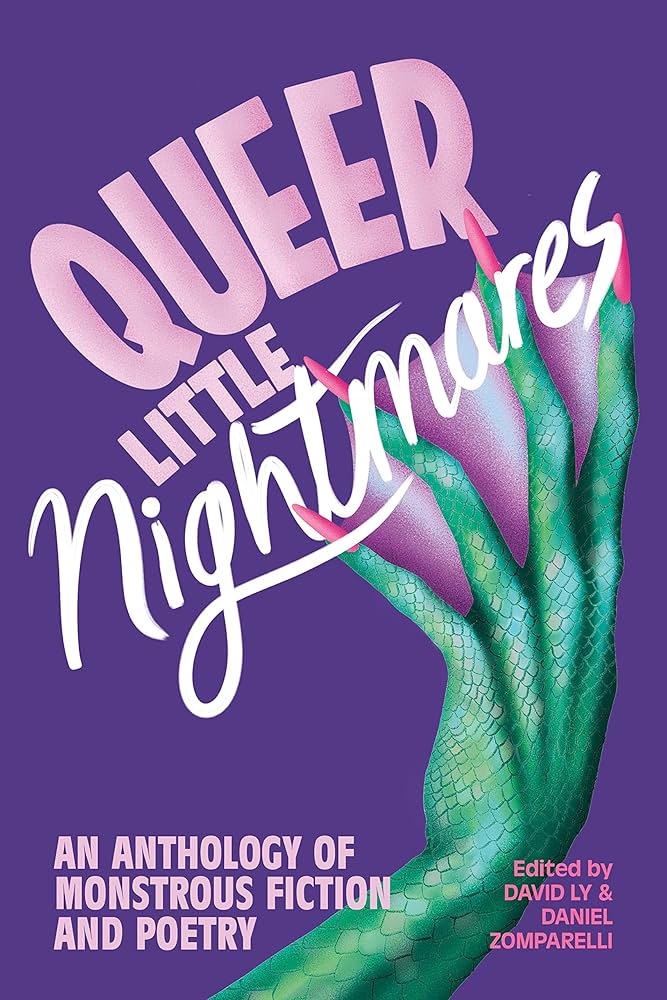
Queer Little Nightmares: An Anthology of Monstrous Fiction and Poetry is edited by David Ly & Daniel Zomparelli. I picked this one up because I needed a book starting with Q for a reading challenge I’m doing, and if you look at my fall reading goals below, you’ll see I’m DNF-ing books left and right. I don’t always love horror anthologies because the quality is SO varied. I mean, I know we all say that about every collection we read, but horror can be ridiculously varied, as in people writing the most predictable, bland, tropey stories to tales that make you feel weird that YOU have a body with sensory input because what you’re reading is so riveting. Queer Little Nightmares tends to fall in the latter category because the editors selected tales that read more Lovecraftian that spooky. Tentacles, babies crafted from human detritus, lagoon creatures, etc. The publisher didn’t really need to tell readers that a Queer anthology with monsters exists because “…monsters have appeared in popular culture as stand-ins for the non-conforming…” Honestly, marginalized populations writing horror craft some of the best stories because such groups are outside of “normal” culture, the stuff that makes us blend in and behave homogenously.
My favorite story was actually about menstrual blood called “And the Moon Spun Round Like a Top” by Hiromi Goto, a Japanese-born woman who now lives in Canada. A buttoned-up employee, who feels threatened by a younger male coworker, is humiliated at work when he cautiously tells her she needs to head to the lady’s room, as he has seen period blood on her pants. This alone would upset most readers, but as the woman learns, it’s not just period blot, but clots — which happen. Except the clots become sentient and won’t stop coming, ever increasing in size and aggressiveness.
I’m not sure that Goto’s story mentioned a Queer identity. In fact, I don’t recall any of the stories in which a character announces via their narrator role what their gender and sexuality are, which I appreciate. The characters just ARE, and they exist in some bizarre worlds all gloriously created in fairly short narratives. The only downside to the collection were the poems. After each story comes a poem, and they were so vague in their intention, that I did not enjoy any poem. I am pretty clear that I like poems that convey an emotion or imagery because for me, a bunch of words that don’t go together do not convey anything.
Overall, a worthy, creature-filled science fiction/creepy collection!
Books of Fall 🍂🎃🍵
- Feeding Ghosts by Tessa Hulls
- Rebecca by Daphne du Maurier
- Just Desserts by G.A. McKevett
- Slewfoot by Brom
- She Throws Herself Forward to Stop the Fall by Dave Newman
- Submerged by Hillel Levin
- The Unmothers by Leslie J. Anderson
- Homing by Sherrie Flick (DNF)
- The Bloody Chamber and Other Stories by Angela Carter (DNF)
- Ask Elizabeth: Real Answers to Everything You Secretly Wanted to Ask about Love, Friends, Your Body — and Life in General by Elizabeth Berkley (DNF)
- No Good Deed by Allison Brennan (#10)
- Fat!So? by Marilyn Wann
- The West Passage by Jared Pechaček (DNF)
- Quest for the Unknown: Bizarre Phenomena by Reader’s Digest (DNF)
- Icebreaker by Hannah Grace (DNF)
- Notes on an Execution by Danya Kukafka
- Queer Little Nightmares, edited by David Ly & Daniel Zomparelli
- Player Piano by Kurt Vonnegut, Jr.
- A Life in Letters by Zora Neale Hurston
- Bitter Thirst by S.M. Reine (Preternatural Affairs #8)
- Deaf Eyes on Interpreting, edited by Thomas H. Holcomb and David H. Smith
- Compassion, Michigan by Raymond Luczak
- Syd Arthur by Ellen Frankel
 Grab the Lapels
Sentient menstrual blood – that’s definitely more horror than I could handle.
Running down your list, you must have read Rebecca a few times now.
I read Player Piano a few years a go, and loved it. I really wish I had read everything that Vonnegut wrote, but I can’t imagine I will now – too many new fields to explore.
LikeLike
I’ve read Rebecca, I believe, three times? There’s always something new to explore in that novel.
My review of Player Piano is coming next week, I believe. The first Vonnegut novel I ever read was Breakfast of Champions, which has a totally different vibe. His other novels I’ve read are closer to Player Piano.
LikeLike
Glad this turned out to be a good collection, though too bad you didn’t like any of the poetry.
You DNF Angela Carter? Did I miss the why on that one? I’m surprised because I find her to be generally pretty awesome. 🙂
LikeLike
I have a post coming up explaining why I did not finish so many books. Each one just had a little something about why I decided to stop. To be honest, this is the only book that I’ve ever read by Angela Carter. I did finish it way back in college because it was assigned for a class (I didn’t like it then), but recently, someone from the book club chose it. Which of her books would you recommend?
LikeLiked by 1 person
Bloody Chamber but clearly that one didn’t land 😉 I’ve not read her in some time and there’s lots of her stuff I haven’t read but I do recall enjoying Wise Children. And I think I read Wayward Girls and Wicked Women, but I’m not 100% on that because it would have been a very long time ago.
LikeLike
I’m bummed that I used to really enjoy Joyce Carol Oates, whom I believe is one of Angela Carter’s contemporaries, but Oates started getting weird at some point on Twitter, like JK Rowling. Huge sigh to that!
LikeLiked by 1 person
“In fact, I don’t recall any of the stories in which a character announces via their narrator role what their gender and sexuality are, which I appreciate. The characters just ARE”. I like this too. We don’t need to know sexuality unless it’s critical to the story. And sometimes it’s just part of the background – maybe a two-mother family – so we might discover that as the narrative continues but it is not relevant to the plot or themes. This is how it should be, along with novels where it is front and centre because that is what they are about.
Oh my I’ve said a lot to just agree with you haven’t I? That’s partly because I haven’t got much else to say but I’m glad you found a book you could finish and get some enjoyment from!
LikeLike
I always love how thoughtful your comments are. I would even extend what you’ve said to things like is the character single, employed, live in an apartment, the location, etc. Basically, my issue is an info dump of any kind, especially of labels.
LikeLike
Ditto to you too Melanie, re comments.
And, yep, agree. I dislike labelling, in particular. I can live with some info dump friending on how it is done but labelling? Nope!
LikeLike
I don’t know that it’s the info dumping itself as a practice that bothers me, just that I personally can’t remember everything that they said. Then I spend most of the book in the dark because I’ve forgotten much of what was foundational.
LikeLike
Fair enough but info dumping is hard to do well I think … and the fact that you (readers) struggle to remember the info is not necessarily your fault?
LikeLiked by 1 person
Not one for my TBR but I am glad you found a winner amongst the DNFs!
LikeLike
It was a process to get here.
LikeLike
This sounds like fun! And I actually met Hiromi Goto a few years ago, and read her book Half World, which I (think?) was a graphic novel. She’s a highly regarded queer writer here, so glad she’s making herself known down south too 🙂
LikeLike
Heck yes! Now I’m going to check out if any of these authors are at my library. I haven’t read a graphic novel in a while, and the last one was about Ed Gein. 🤮
LikeLiked by 1 person
definitely check out more of Hiromi’s stuff if you can find it, she’s awesome
LikeLiked by 1 person
Oh, I’ve met Hiromi Goto! She came to my town when her graphic novel was released and did an event. The graphic novel was weird but fascinating. The poems sound like a strange addition here. Are they supposed to be connected to the stories or are they just there?
LikeLike
I think the editors just wanted a variety of stuff for the theme. I believe one of the editors is a poet.
LikeLike