
We can never have too many reminders that anyone who lives long enough can expect disability eventually; disability is a very normal and predictable part of the human experience.
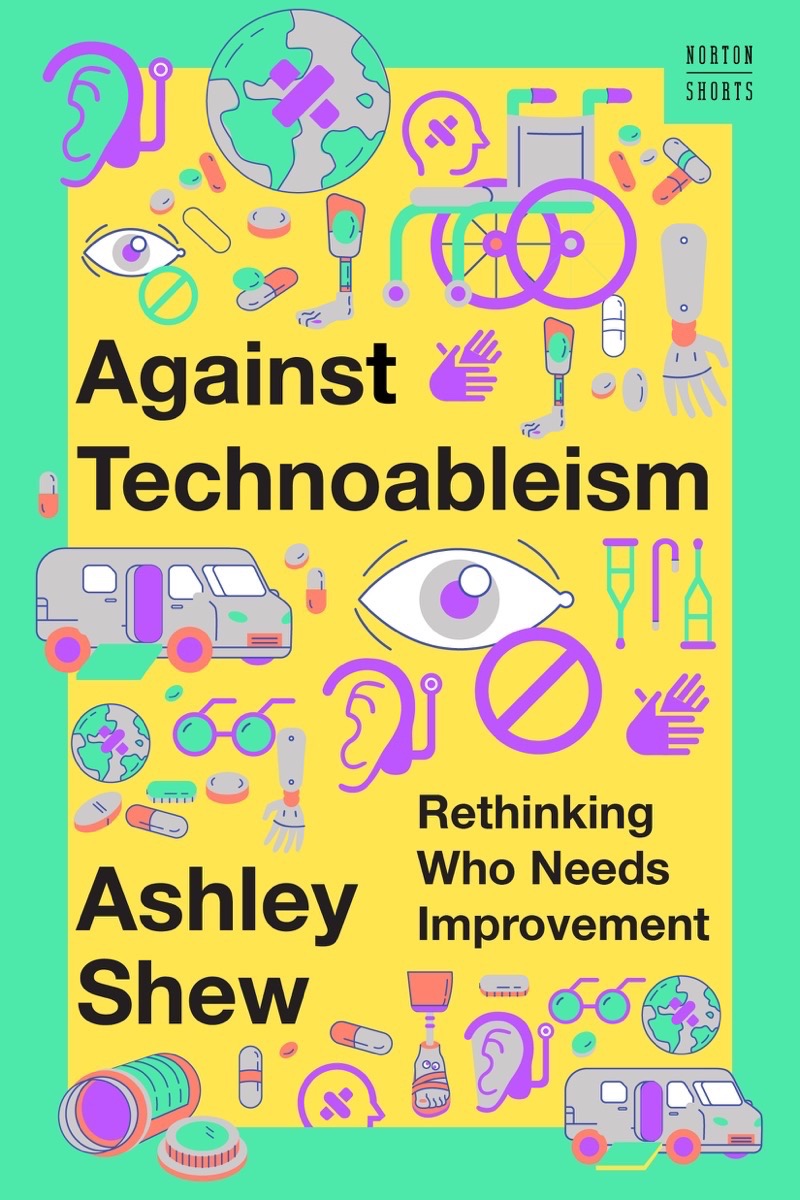
I was delighted to learn that my employer, Purple Communications, has a book club for which we can earn Continuing Education Units (CEUs). I read Ashley Shew’s nonfiction work titled Against Technoableism without much clue as to what it would be about. We were asked questions about the book as part of our participation, so in lieu of a review, I’m giving you my thoughts on technoableism and the connection to interpreting for the Deaf community.
The first question asks that we recall an example of technoableism that stood out to us. Technoableism is defined as technology that is meant to make a disabled person appear and/or function “normally” without consideration of how technology is a tool, not a cure for disability.
MY RESPONSE: I originally thought of the Shew’s prosthetic leg as a tool, but as the book progressed, she mentioned a few times how free and capable she was on her roller, especially the joy of scooting along on hardwood floors. The prosthetic leg also didn’t assist her in joining the protest out in the woods where other activists were sitting in trees and attaching themselves to machinery to stop environmental destruction. What then, is the author’s prosthetic leg but a placeholder, something that makes her look “not disabled”? It surprised me that she described the cost and often pain of being fitted for a prosthesis. Not only that, but I was surprised to learn that an amputated limb will change shape, meaning new fittings, new prosthetics. The impact is that the author is possibly spending money and experiencing discomfort/pain to look like she isn’t disabled without gaining significant mobility.
The second question asked about “disability porn,” which includes those videos you see of disabled people “overcoming” their disability and making non-disabled people feel good.
MY RESPONSE: Disability porn is when non-disabled people get the warm and fuzzies over disabled people managing to look not disabled, as if their disability does not hold them back, and so non-disabled people should appreciate their (currently) non-disabled bodies. The ones that make me the angriest are the “I walked up to my bride/groom” wedding ones. Basically, the disabled person uses a wheelchair down the aisle, and at the last moment, they stand and (painfully, it looks like) walk up to their future spouse. Inspiring people is great because we show each other ways to improve our communities. Disability porn makes people feel good about themselves singularly with no further action taken. Honestly, if you see a person with prosthetic legs run a race, how likely are you to be inspired to run a race? Or wake up every day and think, “Boy, I’m so thankful I have legs!” It’s meaningless, and since it’s called “disability porn,” I would add that the result is a “circle jerk.” Disability porn plays a role in oppressive stereotyping because it suggests that you should be applauded for existing like a “normal” person.
The third question asked about the Gallaudet 11, a group of men who participated in NASA experiments because Deaf people often don’t experience motion sickness. However, because the story wasn’t feel-good disability porn, it’s possible the news wasn’t familiar to us readers.
MY RESPONSE: I had not heard of the Gallaudet 11, and I am shocked because I attended an ITP with a strong emphasis on Deaf culture (regular and advanced classes, plus a class on inventions by Deaf people) and has all Deaf faculty teaching ASL and involved in the interpreting classes. Plenty of times we read about Deaf history and important events, but never the Gallaudet 11. In the case of NASA, the Gallaudet 11 were being used as test subjects, not as explorers themselves—despite the scientists being unable to keep up with the Gallaudet 11 during experiments! I’m not sure what the news for the Gallaudet 11 was like back when the experiments were announced, but today, the only place I see Deaf news is at The Daily Moth or on Deaf vloggers’ posts on Facebook. I can’t decide if the public doesn’t want to hear stories like that of the Gallaudet 11 because it’s not disability porn, or if our news is segregated so much now because there are countless outlets, from the traditional news channels and newspapers, to online do-it-yourself types getting the “real” news out there. Also, the stories that function as disability porn tend to start out as social media postings, like on Facebook when the baby gets the cochlear implant, “hears its mother’s voice,” and reacts. It’s much easier to share our personal lives on social media because there is no one to stop us. If a video goes viral, it’s easy fodder for TV stations to pick up and join the frenzy. I don’t see or hear as much about new technology related to disability, which is another kind of disability porn if the point is to make the disabled person appear normal after overcoming their “terrible affliction.” I saw on CBS Morning News a story about a man who is a quadriplegic, and his son became a physical therapist because he grew up knowing his dad was his hero. Later, the son created a sort of raft that allows a paralyzed person to safely float in a pool, lake, or ocean. The father LOVED it, and what I realized was this was that the story made me feel good, but I felt good because the father was so happy that he had a tool to do an activity that brought him joy both before and after he was paralyzed. He was not made to seem “normal.” In fact, the raft is noticeable, meaning the design didn’t strive to make the father appear non-disabled.
The fourth question asked about how disability actually benefits people. In Deaf culture, this is referred to as Deaf Gain.
MY RESPONSE: One major Deaf Gain is being part of a collectivist culture. I’ve tried my whole life to make a community–volunteering, engaging with neighbors, starting book clubs, etc. It never works out. We’re just not a devoted culture, us hearing folks in the U.S. because we were raised in an individualist culture. I’m very engaged in my local Deaf community, and I see people visiting each other when sick, hosting events so Deaf children can socialize, connecting with the local ITP to help interpreting students, using teamwork and volunteering to get things accomplished, etc. When I hear that Deaf people are lazy and live off of SSDI, I think of all the times I’ve seen a Deaf person donate their last items, time, or money to support the Deaf community.
The last question asks how we could apply what we learned in Against Technoableism in our work as interpreters.
MY RESPONSE: The author being on the first floor away from all her colleagues—same as conference calls in VRS. After the author had an amputation in her 30s, her office was moved to the first floor of the building, but her colleagues stayed on, I believe it was, the 4th floor. She felt isolated.
Deaf professionals are often segregated during work meetings so they can technically follow the rules of VRS (the hearing and deaf callers cannot be in the same room). However, the way the author wrote about her colleagues several floors above her, continuing their work and socialization, having the space to walk over and discuss ideas, which completely leaves the author out, will have an impact on her long-term success and place in the department.
The take away
I’m still seeing phrases like “wheelchair bound” and “blind read submissions” and “tone deaf” in social media, the news, and yes, even blog posts. Consider how the ways in which disabled people use technology — from prosthetics and hearing aids, to wheelchairs and ADHD medication — are tools that support people who have chosen to use those tools to navigate societies not designed for disabled people. If you are on Facebook, consider following pages like Disabled Eliza, Matthew and Paul, Misa on Wheels, A Day in the Life of a PWD: Person with a Disability, and Anthony S. Ferraro. There is a lot of disability pride out there from the disability community itself! Let’s listen to those who know their own experiences.
 Grab the Lapels
This sounds like a great book! And really cool your employer has a book group that also provides continuing ed credits!
LikeLike
Yeah, I was surprised to find out that they do a book quarterly. Typically, if you have to pay to join a book club like this, it’s really expensive. I’m glad that my company covers this cost. Some of the book clubs hosted by private agencies or individuals are like $75.
LikeLike
I am currently reading Nnedi Okorafor’s latest, Death of the Author. And Technoableism is basically what it’s about. A paraplegic author writes a SciFi book about robots after the end of humanity, and its success enable her to buy herself ‘robot’ legs. Her family are horrified. She is questioned on a famous TV news show about ‘abandoning’ her disabled fans. And on it goes. Her legs become famous. I think the idea is that even with these legs she is still not ‘normal’.
LikeLike
Well, that sounds really interesting! I do love this idea that when people change in some way that separates them from the community with which they had identified, it becomes controversial. Thanks for the recommendation, Bill.
LikeLike
This sounds like a really cool read. And like you, I tend to have these awkward reactions when I see this disability porn. Like, is the point of it to encourage others to push past their challenges, (whatever those may be) or is it to make us feel better about being ‘normal’, in which case, why would we need to feel better about that? It just makes me uncomfortable that disabled folks are being ‘used’ as entertainment, and your review has just clarified why I always felt a bit weird about that stuff…
LikeLike
Sounds to me like what you were feeling was pretty spot on, but you didn’t have the validation you wanted. There is a lot more lit about disability now, and I think everyone should read it. It makes you realize how vulnerable all humans are, which isn’t bad, but if society would get it together and plan for that future, it would benefit everyone.
LikeLiked by 1 person
That quotation about disability being a normal and predictable part of the human experience, that felt so true. Only our culture shuns anything related to aging and disability so unless we have someone in our family who experiences a disability, we (non-disabled) often never think about it. I am gaining personal experience with disability through my mother, who is experiencing many health issues and uses a walker and is very slow. This book sounds great.
LikeLike
I like how the approach is to rethink disability as a societal infrastructure concern and not a “poor disabled people” thing. It also really got me thinking about how we feel bad for people with hearing aids but not for people with glasses. Why does one disability seem so much worse than the other in our minds and media?
LikeLiked by 1 person
Great points!
LikeLike
Oh darn it, I read half of this and then must have got distracted and never came back! This is such an interesting post, and I could respond to several things you say here.
But, I’ll just comment on your point that “I’ve tried my whole life to make a community–volunteering, engaging with neighbours, starting book clubs, etc. It never works out. We’re just not a devoted culture, us hearing folks in the U.S. because we were raised in an individualist culture.” I love this about you – and remember your working hard to get to know neighbours when you moved to your new house. I am absolutely a community building person too. It’s why I seem to end up being the one who coordinates nearly all the social groups I’m in – my reading group, my patchwork (now morning tea group), my Jane Austen group – as well as being secretary of an organisation. It’s why I was happy to move into an apartment complex – preferably a small one where I felt there was a chance of developing a community. It really makes me happy. Your comment that the US is such an individualist culture is something I think about a lot. I think the difference between our nations came to the fore during COVID. Australians were ridiculed a bit for being compliant, but a big element of that was a belief in the social good not just doing what we are told. In fact Australians will talk back to bosses more than Americans will, Mr Gums found.(Of course lockdowns did have negative impacts, particularly for people already in difficult situations, but they did keep people alive and they did enable the health system to cope until vaccinations came in). Anyhow I am so glad that you are finding the community you love to have now. And I love that your work place has a reading group.
LikeLike
I’m so glad you were able to circle back to this post and comment because you wrote some lovely things. ☺️ I never realized until now that when you downsized your house, you moved into an apartment. I assumed you got a smaller house for some reason.
LikeLike
I didn’t talk a lot I guess about what I was downsizing to. We ended up deciding on an apartment because we go to Melbourne a lot to see our kids and didn’t want to have to worry about gardens, bins, security every time we went. It’s worked out fine.
LikeLike
An apartment DOES seem like a great option for your retirement years. No mowing, snow plowing (do you get snow??), etc.
LikeLike
Exactly Melanie… we get a very occasional dusting of snow in our city and when it does happen it really stays on the ground stop but we are very happy to be relieved of weeks and weeks and weeks of raking leaves in autumn!
LikeLiked by 1 person
This was a really interesting format to read! I’ve seen this book and was curious to learn more about it.
LikeLike
What do you mean about the format?
LikeLike