
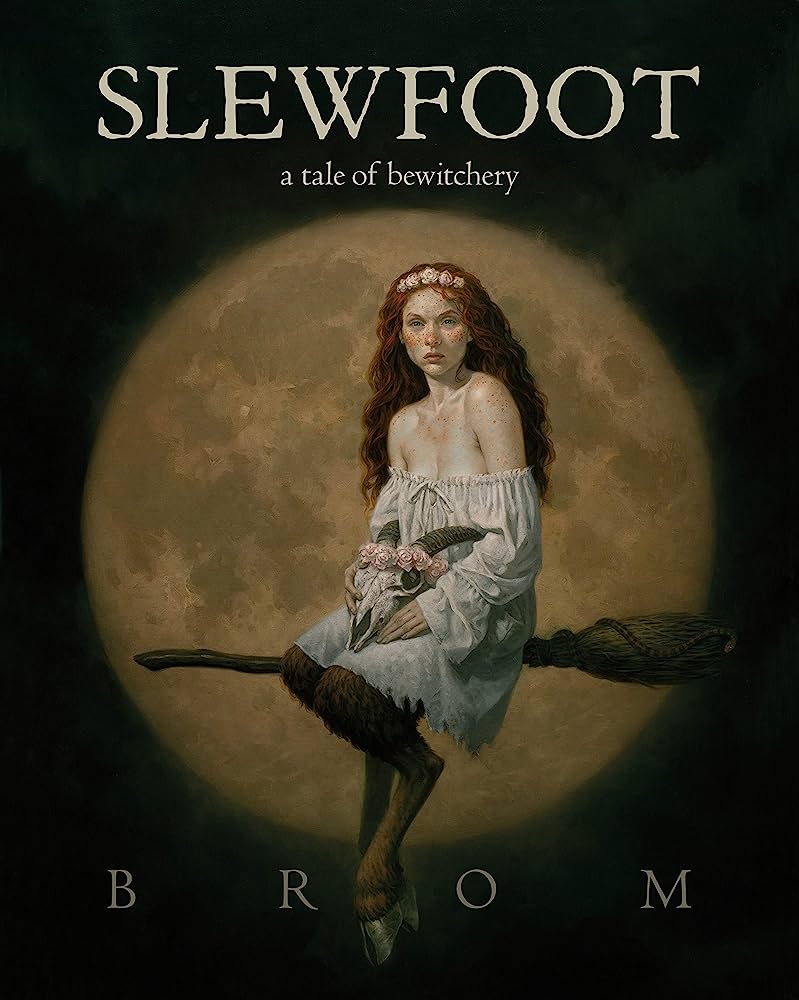
I have seen the name Brom around for a while when I look up horror novels on the Hoopla app, but it was only when a member of my Spooky Book Club chose Slewfoot for our September read did I finally get one of the author’s novels. Brom both writes and illustrates his novels, and my copy had a unique, gorgeous pencil drawing at the beginning of each chapter. I’m told some versions of the book include full-page images, but mine were cropped.
Slewfoot opens in Connecticut, 1666, with a beast asleep in the earth that is beckoned to wake by drinking the blood of sacrifices that, well, whomever owns the voice coaxing him, has left for the beast. Eventually, this beast arises to find forest spirits urging him to slay, to drink blood, to replenish the magic that feeds a particular tree. The beast cannot remember who he is, but struggles with his identity, going through several changes throughout the novel.
Meanwhile, Abitha, a young woman living with her new husband in the wilds outside the village Sutton, is trying to make a go of things. She’s ostracized because she’s from England where her mother taught her how to make and sell charms and potions. After her mother died, Abitha’s father sold her to become a bride to a stranger in what is now America. The Puritans of Sutton are always threatening Abitha with the stocks for not being godly enough, but her husband, Edward, surprisingly for 1666, defends and loves his wife. And, Abitha is no stranger to Christianity — she’s a woman of God.
Early on, Edward is told that he will lose his land for not meeting a debt — a debt belonging to his brother, who legally owns the entire farm left to the brothers by their father, which includes the land and home on which Abitha and Edward live and have cultivated for years. They are one payment to Edward’s brother away from owning the land outright. Edward has always been a pushover due to a disability, but Abitha stands up to her brother-in-law, yet another reason to threaten her with the stocks. Soon, Edward is out of the picture, and Abitha is left alone to face her brother-in-law, homelessness, indentured servitude, and loneliness, if she cannot make the final payment.
Brom brings together Abitha and the beast, creating a magical, immersive plot that takes you out of reality. The author forces readers to look at religion, asking why it exists just so that any practitioner can use whatever part of their faith to justify their wants. For example, a magistrate tells the brother-in-law, who is worried that his house and land could be taken if Abitha does make the payment, “Do not let shadows and echoes put fear into your soul. You are in the right on this. God knows you are. … Angels must often do dark deeds in the name of the Lord.” Even Abitha combines prayers to the Lord with offerings to forest spirits and the ghosts of her foremothers.
If you’re wondering how creepy Slewfoot is, know that the subtitle is “A Tale of Bewitchery” and it’s set in 1666, meaning you can guarantee there is a time when Abitha is accused of being a witch and the Puritans react like they do. In general, readers get a creepy, atmospheric, thoughtful novel that is perfect for the fall season.
Books of Fall 🍂🎃🍵
- Feeding Ghosts by Tessa Hulls
- Rebecca by Daphne du Maurier
- Just Desserts by G.A. McKevett
- Slewfoot by Brom
- The Bloody Chamber and Other Stories by Angela Carter
- Notes on an Execution by Danya Kukafka
- The West Passage by Jared Pechaček
- Quest for the Unknown: Bizarre Phenomena by Reader’s Digest
- The Unmothers by Leslie J. Anderson
- Icebreaker by Hannah Grace
- A Life in Letters by Zora Neale Hurston
- Ask Elizabeth: Real Answers to Everything You Secretly Wanted to Ask about Love, Friends, Your Body — and Life in General by Elizabeth Berkley
- Homing by Sherrie Flick
- No Good Deed by Allison Brennan (#10)
- Bitter Thirst by S.M. Reine (Preternatural Affairs #8)
- Deaf Eyes on Interpreting, edited by Thomas H. Holcomb and David H. Smith
- She Throws Herself Forward to Stop the Fall by Dave Newman
- Compassion, Michigan by Raymond Luczak
- Submerged by Hillel Levin
- Fat! So? by Marilyn Wann
- Syd Arthur by Ellen Frankel


Sorry, but I think I’d rather reread The Scarlet Letter. Though on reflection, that is also Historical Fiction. I wonder if I can find fiction from the 1600s with witches in it.
LikeLike
Are you trying to avoid witches or historical fiction?
LikeLike
Mostly I avoid Historical Fiction because it annoys me authors giving olden times people modern values. I don’t seek out witches, but if they come up in my SFF reading I go along for the ride. for example The Sapling Cage.
LikeLike
That I can understand, especially when it comes to war-era novels.
LikeLike
Man, those Puritans have a lot to answer for.
LikeLiked by 1 person
Oh, I have a copy of this. will definitely read it for sure especially since I now know it’s creepy not give me nightmares kind of horror 🙂
LikeLike
If you are a feminist, and I know you are, it might make you angry in places because, you know, Puritans.
LikeLiked by 1 person
I adore the cover of this book, it’s so cool. I’ve never heard of “Brom” – do they go by just that one name, like Madonna? I love how spooky this book sounds though, it does seem like a perfect October read.
LikeLike
I guess he does just go by Brom. It says in the back that his name is Gerald Brom. He does all his own artwork, so that covers his. It certainly does draw you in, and this is truly the most atmospheric book appropriate for Halloween season. I’ve definitely seen other books by this author pop up on Hoopla when I search in the horror genre, but I’ve just never taken a chance. Someone else picked this novel for our book club.
LikeLiked by 1 person
Your last sentence saves me “a creepy, atmospheric, thoughtful novel that is perfect for the fall season”! It’s not fall here so I don’t need a book perfect for it!! Seriously though, I really enjoyed your post, and the religious and historical issues the book raises (Puritans etc) interest me, but, unlike Bill, I’d go for straight historical fiction rather than horror/creepy.
LikeLike
By straight do you mean non-fiction? Shirley Jackson has a short non-fiction book about the Salem witch trials that I truly enjoyed. I’m…..kinda sad that you guys don’t have fall. It’s a whole vibe in the Midwest. When Nick lived in Los Angeles, he started to feel weird about there being no indication of the seasons outside.
LikeLike
Oh that was probably a loose use of words. I meant maybe “pure” historical fiction rather than that laced with horror.
I was being cheeky. Here in Canberra we have four strong seasons, so yes we have autumn. And it’s pretty much my favourite season except that it’s followed by winter. My silly joke was that it’s not that season here now. I understand Nick. I lived in the LA area for three years and while I loved the climate overall (because I don’t like winter) I did miss autumn!
LikeLike
Ah ha! I remember writing this comment to you before! I kept thinking, this comment seems really familiar, but I’m going to send it anyway. So when you say that you have a fall in Canberra, do you mean that the leaves actually change color and fall down, things get crispy, people buy pumpkins and carve them??
LikeLike
This sounds spooky without being overly horrifying. I’ve come across it a few times but not been super drawn to it though the art I’ve seen is beautiful.
LikeLiked by 1 person
One person came to book club with the hardcover edition, and the art is full page glossy paper. I have the paperback edition, so some of the artwork is cropped and not on that glossy paper.
LikeLiked by 1 person
I think I’ve seen the hardcover at the store because I remember it being quite lovely.
LikeLiked by 1 person
[…] Slewfoot by Brom […]
LikeLike
[…] Slewfoot by Brom […]
LikeLike
[…] Slewfoot by Brom […]
LikeLike
[…] Slewfoot by Brom […]
LikeLike