
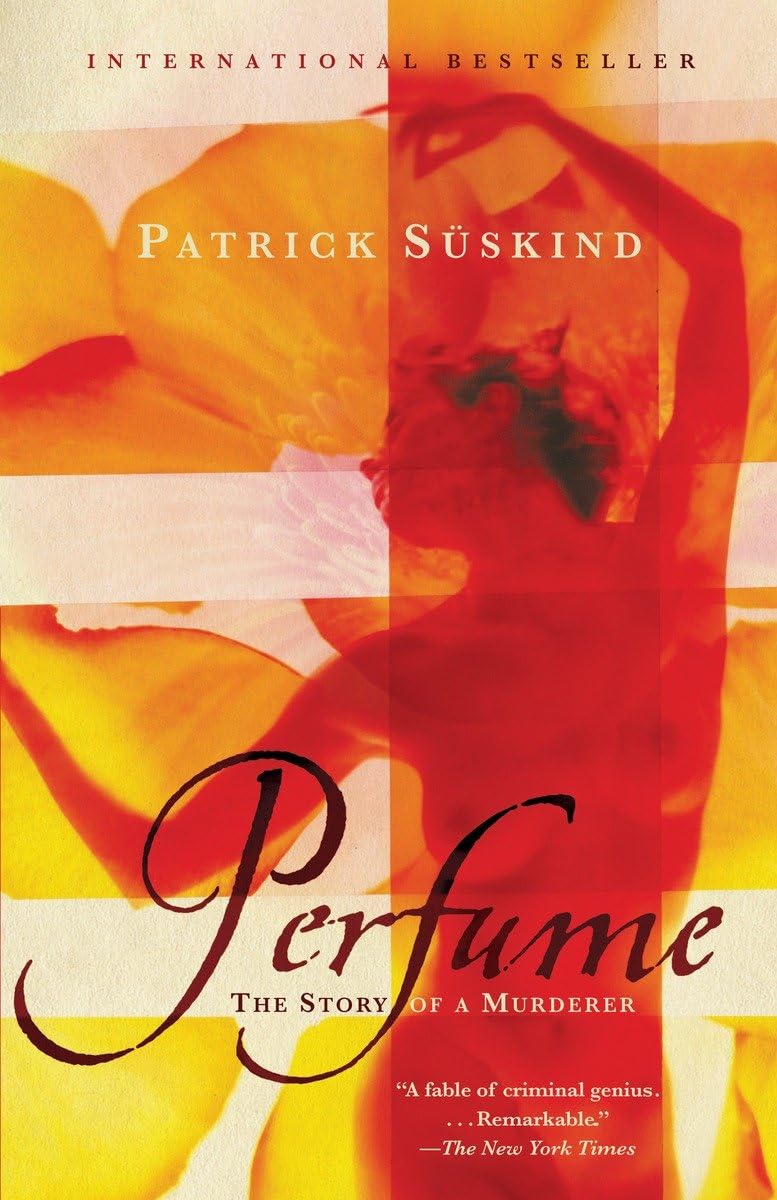
Today, I’m reviewing one of the weirder novels I’ve ever read. Perfume: The Story of a Murderer by Patrick Süskind was published in 1985 and became an international bestseller. It’s translated from German into English by John E. Woods. Someone in my Spooky Book Club chose perfume as our August read, and I can see why; the synopsis includes words like “dark and sinister” and “brutal murders” and “horrifying secret.” However, those of us who finished the novel felt differently. This is mostly a book about a weird fricken guy obsessed with smells.
Süskind’s novel is set in Paris in the 1700s. A baby is born, Jean-Baptiste Grenouille, who somehow survives against all odds, including a mother who leaves him on the ground after she births him, a disease he catches from working in a tannery, and (I think) even the plague. Everyone who takes him on as he grows dies a death they don’t want. Oddly, Grenouille has a precise sense of smell, parsing out the layers in a scent from long distances, but he doesn’t have his own scent. It becomes clear that Grenouille believes a scent is an identity, so if he smells of nothing, he is no one.
From there, the book spends about 100 pages during which learns from perfumers how to extract scents from, well, just about anything. Eventually, he figures out how to extract scent from flesh, and this is there the murder part comes in. The first murder isn’t descriptive until Grenouille smells his victim without clothes. It’s an “ewww” moment. Then, there are 24 murders, none of which happen on the page. A final murder is described more intimately, but again, nothing is graphic. Süskind then details his character’s capture and the result.
For Grenouille, scent is powerful. Süskind writes, “For scent was a brother of breath. Together with breath it entered human beings, who could not defend themselves against it, not if they wanted to live.” For a character that can smell down to the tiniest scent, crafting smells make him like a god designing his kingdom when he creates perfumes. You can perhaps see how this becomes hyperbolic, maybe even satire, which is elevated by the author’s flowery prose. Some readers might need a dictionary, depending on their skills. I know there were tons of words I didn’t know, but I was never a studier of vocab myself.
Overall, I felt the book spent a lot of time explaining how perfumes are made, but the bread of the sandwich was creepy thanks to one of the oddest main characters I’ve ever read. I can’t say I enjoyed my experience, but Perfume is niggling in my mind a week after finishing Süskind’s novel.
 Grab the Lapels
I read this one decades ago and still think about it!
LikeLike
Quite memorable, right? 🫣
LikeLike
This is an unforgettable book I think, though I don’t remember the details of how it all plays out. I think
1. It’s a great example of an unlikeable protagonist in a book you want to keep reading; and
2. If I remember correctly it is about a sad, rejected character who becomes alienated from humanity and obsessive about achieving an ideal, which takes him to dark dark places.
I enjoyed reading your post Melanie. It’s such an interesting book. Did you learn any new words that you really loved?
LikeLike
What’s interesting to me is it took about half the book for me to realize that he was rejected. He just seemed like he was perfectly fine being on his own, even when he was in the orphanage. Therefore, when he wanted to create a scent so that he became “someone,” I was surprised. You’re right, though, it is a great example of having an unlikable character that you want to keep reading about. I would say another book that has a similar situation would be Tampa by Alyssa Nutting. That one, though, is much more shocking because it’s based on a true story of a young, female high school teacher who seduces and sleeps with one of her male students, and how the media sold it is. He was the luckiest boy in the world for getting with a hot woman. Anyway, Tampa aside, I don’t know that I learned any new words because I simply didn’t have the time to look them all up. Isn’t that terrible and unscholarly of me?
LikeLike
This is one of my all time favourite books!
LikeLike
Well, Cathy, you can’t leave me hanging like that. What makes it one of your all-time favorite books??
LikeLike
I really loved the gothic atmosphere, the ambiguous lead character and the descriptions of smells. Also, I read it at a pretty impressionable age – I had never read anything like it before – it would be interesting to see what I would make of it if I reread it now,
LikeLiked by 1 person
[…] Perfume: The Story of a Murderer by Patrick Suskind […]
LikeLike
This is one of those books that I’ve seen many times over the years and have never felt the pull to read. Now I know a little bit more about it, so thanks.
LikeLike
Now I’m curious about where you’ve heard of it over the years. Was it through your library work? I would think that it would have been weeded by now. It doesn’t strike me as a classic in the way that Crime and Punishment or Sense and Sensibility or Bleak House is.
LikeLike
Oh I’m sure there are still copies in the system. I’ve seen it come through now and then for holds. As long as a book is in good shape and still circs every couple of years it stays in the system. Isn’t there a movie based on the book? I could be thinking of something else. Anyway, I see it pop up in blog posts now and then too. Seems like something that has stuck around longer than one might expect.
LikeLike
There IS a movie, but I have not seen it.
LikeLiked by 1 person
I never read the book but I saw the movie which was ok, but not great, but made me feel satisfied enough that I didn’t need to read the book to find out what all the buzz was.
LikeLike
I just looked up the movie; I didn’t realize it came out just in 2006. The actor who plays the main character is known for being handsome, which is weird because in the book that character looks more like a homunculus.
LikeLiked by 1 person
Never heard of this one, but it sounds ultra creepy. Scent isn’t something that gets talked about a lot, but I can see how it could become an obsession for some people. I also like that you mentioned this book was published in 1985 – the year of our birth! haha so that’s a good excuse for me never hearing about it until now I suppose.
LikeLike
I’m amazed by how many people in the comments said that they read it when it came out and it made a big impact on them. This book was chosen for my spooky book club, but then when I started doing a book bingo thing for another group, I noticed that one of the requirements was to read a book from the year you were born. I think in general scent gets skipped a lot in fiction, unless it’s some bizarre combination, like he smelled like cinnamon and wood smoke or something really douchey like that.
LikeLiked by 1 person
This book is SO weird. I read it several years ago and though I don’t remember a lot of it, it’s one I think about every now and then.
LikeLike
I feel like that’s what everyone’s saying! Isn’t it bizarre that this book might be famous just because it’s so weird and memorable? I don’t even know that I liked it, and I don’t even know that. That’s the point.
LikeLike
Read this decades ago and have largely forgotten the detail. But I do remember the vividness of the atmosphere, especially the stench of Paris. They never tell you about that in series like Versailles do they?
LikeLike
Typically, I feel like books sent in France talk about the food. You get all the different beverages, pastries, and heavy cream-filled dishes! I read a book once about the England of Charles Dickens and was surprised to find that people were basically always walking on excrement or attending church just above dead bodies. The stench indeed.
LikeLike