
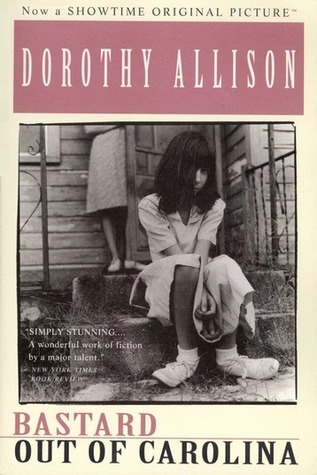
Bastard Out of Carolina by Dorothy Allison is both predictable and unexpected. The story follows Anney, whose teen pregnancy and absent father means her daughter’s birth certificate says the child is illegitimate. For years, Anney returns to the county building to get the shameful remark off her daughter’s legal paperwork with no success. Anney eventually marries and has another daughter, but an accident leave her a widow. Though her family is poor, Anney seems to be supported, her children loved and and fed. Sure, the family is rough; the uncles can’t stop drinking, fighting, and spending time in county lockup, but they’re tightknit.
One day, when Anney is work at her diner job, a man shows up who becomes smitten with her. For a year he spends every lunch break at her diner, waiting for Anney to agree to a date. They finally date for a year, and then Anney and her new man, dubbed “Daddy Glen,” get married. The second they get married, readers learn he can’t keep a job, he’s a child molester, and he beats Anney’s oldest daughter, the “bastard.” Our titular “bastard” is called Bone; I’ve forgotten her real name. She notes, “Daddy Glen’s reputation for a hot temper made people very careful how they talked to him.” I was confused how he hid a temper for two years, but I read this book with Biscuit (hi, mom!), and she agreed that some people change like that.
The predictable part is the climax, the mother’s response to Bone being beaten by her step-father, and the powerlessness everyone feels. The unpredictable part is how much author Dorothy Allison includes outside of the family’s house. Bone finds community for a time in the revivalist church. She spends a summer caring for her deathly-ill Aunt Ruth. Later, she and her cousin use a grappling hook they find in the river to cause chaos in a store after the store owner humiliated Bone years before (her anger burns deep and long):
I was nobody special. I was just a girl, scared and angry. When I saw myself in Daddy Glen’s eyes, I wanted to die. No, I wanted to be already dead, cold and gone. Everything felt hopeless. He looked at me and I was ashamed of myself. It was like sliding down an endless hole, seeing myself at the bottom, dirty, ragged, poor, stupid.
While the writing is excellent and characterization is masterful (Allison’s novel is a National Book Award finalist), the topic is obviously challenging. Child abuse is real, and it is our duty to respond to and stop it, but it’s not our duty to read about it. On the one hand, Bastard Out of Carolina is a banned book because some scenes are graphic. On the other hand, Bone is twelve at the climax, and what happens to her happens to young children. I’m firmly against children and teens reading Allison’s novel, but the topic should be available in public and school libraries, albeit with fewer graphic descriptions, so young readers can process the emotions and injustice without being traumatized by the actions in the novel. No one is suggesting this is a novel for children or teens; this is simply part of the conversation I had with Biscuit around books with hard topics.
I’m curious what the laws are in your area regarding what constitutes child abuse. I’ve lived in Indiana since 2008, and during my time here, the law changed such that if you suspect child abuse and don’t report it, you are just as complicit as the abuser. The change happened after a father was beating his son in the basement and the grandma (the father’s mother) knew about it and let it continue. The boy died. Generally, spanking is considered “discipline” not abuse, though studies show any kind of hitting is an ineffective way of discipling children, no matter how much its advocates may scream that “kids these days” behave as they do because they aren’t beaten enough. I feel disgusting just typing that.
Bastard Out of Carolina was also made into a movie directed by Anjelica Houston and starring Jennifer Jason Leigh (Single White Female), Jena Malone (The Hunger Games), Michael Rooker (Guardians of the Galaxy), and Christina Ricci (The Addams Family).
 Grab the Lapels
Oh, this sounds like a tough but powerful read. It is depressing how often I hear that argument about “kids these days”. I think it’s easy to look back and say things were better in the past and attribute negative changes to the wrong causes. We see the same in the immigration debate and other areas. All the evidence is that corporal punishment of any kind is damaging to a child.
In the UK, spanking is illegal, but parents can offer a defence of “reasonable punishment”, so in practice I suppose only the severe cases get prosecuted. I don’t see it in public as much as I did when I was a child, though, when smacking an unruly child in a supermarket would have been routine. Nowadays I think it would be frowned upon. As for reporting, there’s no mandatory reporting as far as I know, but I like the rule you describe and hope it gets implemented. Abuse thrives on silence.
LikeLike
What a chilling sentence: “abuse thrives on silence.” I do remember seeing kids get spanked in public back in the early 90s. I always wondered, “At which age, exactly, does it go from spanking to hitting another person and now we call the police?” I actually found out when a friend’s younger sister was caught with weed. Her dad spanked her, and she called the police. She was sent to juvie and he was court ordered anger management.
LikeLiked by 1 person
I worry about graphic descriptions of child abuse, although I also worry about people getting desensitized to violence from watching violent movies and tv shows.
What I learned from my work as a court-appointed special advocate for children is that although allegations of abuse are taken seriously, many of them happen because a family is already in the system. I had one mother ask me what to do with her hard-to-handle six-year-old son because she said she knew she couldn’t spank him (since the family was in the system) but she didn’t have other good ideas about how to discipline him.
My answer, in general, is that if we want parents to stop hitting, we’ve got to find ways to teach people what to do instead. Although there are probably always going to be a few who get a sick pleasure out of hitting someone smaller than they are.
LikeLike
I didn’t realize you were a CASA. Jeanne, you are an amazing person. Yes, I agree that most people do not enjoy hitting, they just lose their patience or worry that if they don’t fix their kid now, he/she will have serious consequences. I think there are a lot of children who are undiagnosed with things like ADHD that can make their behavior frustrating without end. I know my nephew was struggling at home and with school before he was diagnosed at almost 7 years old (after my husband and I encouraged his parents to check into it). I also think hitting can just be “the answer” for some people. It baffles me how many times I’ve heard my dad say someone needs to hit their kids only for me to remind him that he never hit us. To be fair, I haven’t heard him say that in many years now, which tells me how he grew up and that he’s a fabulous learner and reflective person.
LikeLike
CASA is a good program and there’s such a need for it; I wish they got more volunteers (and that it didn’t have to depend so much on volunteers). I’m on leave this year while I do my babysitting but not sure I can go back. It’s getting hard for me to get in and out of peoples’ houses, what with exterior stairs and frequent snow and ice around here.
LikeLike
Yes, you take care of yourself. From your end, maybe you can advocate for CASA and convince your friends and community to join simply by bringing it up. ❤️
LikeLiked by 1 person
I got spanked regularly both at home and at school, round the legs with a stick at home, on the hands with a strap at school, up to about age 12. I usually cried but I don’t think it did me any harm. I don’t see any equivalence between being spanked and ‘beatings’ (and I had one of thise too, one time my father lost his temper). I still think kids need a smack sometimes, but I understand no one agrees with me. And I think kids these days have no self discipline because they have no parental discipline.
I have no idea what to do about it, especially kids for whom breaking the law is a rite of passage. In Australia we are anti corporal punishment and yet we imprison children as young as 10. Where’s the logic in that?
Abuse, by step fathers and uncles is any another matter entirely. I grew up in a world where it was ok for men to hit on 13 year olds – boys or girls – but only became aware of the concept of sexual abuse of children as an adult, when I began to meet women who had been abused within their families. How they would write about that I have no idea.
LikeLike
I struggle to delineate between spanking and hitting because we’re saying one is possibly with an open hand and the other is not. Or, as you say, a stick or strap is fine but other objects are probably not. Who decides at what age adults can no longer hit their children in ways they find appropriate? Also, if you were spanked regularly, I’m wondering why you didn’t learn your lesson the first time if spanking is effective? Were there so many lessons to learn?
LikeLike
I wrote you a long comment and WP ‘lost’ it, perhaps it doesn’t like the topic
LikeLike
I see your comment; because you are anonymous, I had to manually approve the comment to make sure it wasn’t just screaming at me, porn, or spam. It’s now posted.
LikeLike
I really appreciate what you say here Melanie; it’s our duty to stop child abuse, but it’s not our duty to read about it. Still, these books are important to have available for the public to read, and discuss.
I’m not sure what the laws around child abuse are here in Canada, although I’m quite sure they are similar in that you have a duty to report child abuse should you suspect it. Especially those who work with children in any capacity, but I believe this rule applies to the general public as well. You can be held liable if you don’t report it…
LikeLike
I know some people say things like, “I don’t like kids except my own,” and I’m never sure if that’s supposed to be funny or if people really think other kids are total shit, but I don’t like that. All children are vulnerable, and the ones that seem like tiny terrorists are that way because something has happened to them…
LikeLiked by 1 person
I must admit I’ve said something like that myself, but I say with the feeling that I’m not really a motherly type person, if that makes sense? On the other hand, I’ve always felt like it’s important to protect kids, and I would hope most people would feel the same way, even if they hate kids, we still have a duty to protect them as adults.
LikeLiked by 1 person
[…] Bastard Out of Carolina by Dorothy Allison […]
LikeLike
This sounds like a hard read. It’s a tricky line of letting books be available for those who may need them but also knowing that not all books are appropriate for all readers. Peter and I were just recently discussing the fact that ourselves and most of our peers were spanked as children and yet it’s extremely rare for children now, at least among the parents we know. He’s a mandated reporter due to his job and sometimes that is a heavy responsibility.
LikeLike
I was just telling Nick yesterday that the author of The Great Gilly Hopkins and The Bridge To Terabithia certainly wrote some challenging books that changed my worldview about everything being good. Although the characters survive their hardships, that doesn’t mean that the hardships aren’t enduring and extremely painful. And honestly, The Great Gilly Hopkins is one of the most influential books that I read as a child. I wish there was more support around those books, though, because I wasn’t really sure what to do with the information. For example, I wasn’t more aware of children in foster care or non-traditional families, just that it had happened to Gilly. I just don’t understand spanking. Do you want your children to be afraid of you? Is the whole point that we make decisions out of fear as opposed to doing what’s right? And then when we get older, what is it that we fear that stops us from doing bad things, especially considering that we haven’t learned that we have to do the right thing because it’s the right thing to do?
LikeLiked by 1 person
I’m trying to write a review right now of a book I read with my kids that dealt with a lot more darkness than I expected. I wouldn’t want it banned because I think there are kids who need stories like that. But I also am glad that we read it together and could talk about it. Books like these ones need support, often even for adults.
I don’t get spanking at all. Personally, I can’t imagine hitting my child without some anger being attached to it. So that obviously seems like a bad idea. But if I were calm and logical, why would I hit my child? What does that teach them? How do I tell my girls not to hit each other if I’m spanking them? I don’t want to be the “because I said so” parent, I want my kids to understand that I have reasons for the rules and boundaries I set. I want them to trust and respect me as their parent but I never want them to fear me.
LikeLiked by 1 person