
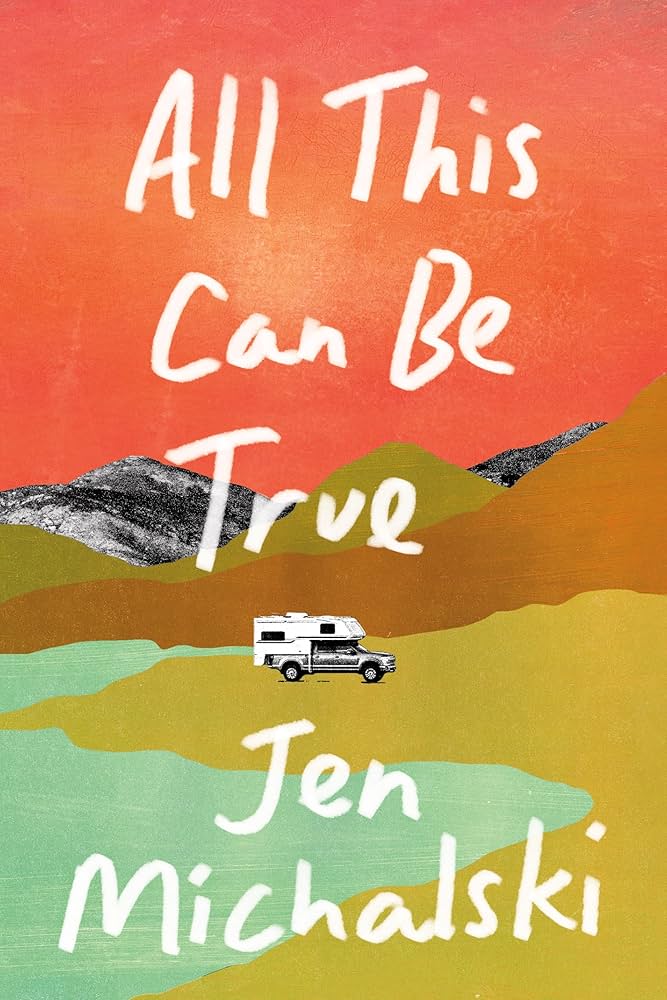
Lacie lives a mundane life with her husband, Derek, in the name of consistency. Yes, he’s had multiple affairs. Yes, their two daughters are now adults. Sure, Derek’s life shapes hers, and the “meaningful” time they spend together is Derek taking Lacie with him on business trips around the globe to support his successful start-up company. This is where we meet the pair: on a plane to another destination. Except, this time the ride ends at the hospital, as Derek has suffered a stoke mid-flight and is now in a coma. Does Lacie even want him to wake up?
Meanwhile, Quinn, former lead singer for a 1990s riot grrrl band, is making her way cross country in a truck with a camper shell from the east coast (U.S.) to British Columbia (Canada), with a quick stop in California. Her daughter, who died not two years ago at age nine, was conceived when Quinn — a vocal lesbian — was on tour and hooked up with a fan. Yes, it’s Derek. She’s going to California tell him about his daughter, so Quinn isn’t the sole vessel that knows the girl existed, before disappearing in a Canadian commune. After learning Derek is hospitalized, she arrives to find him in a coma, and she runs into Lacie. Does Quinn tell Lacie why she’s there?
Jen Michalski, who recently visited Grab the Lapels to write about Pride Month 2025, has written what is on its face a Queer romance, but raises pertinent questions through her subplots. Some reviewers on Goodreads found the novel “too busy,” but a straightforward romance would do curious readers a disservice. For instance, much is made of Derek’s health before the stroke and coma. He was healthy and engaged in frequent exercise: biking, skateboarding, surfing, etc. His activities are his personality, to some degree, and his body is upheld as something special because he does the “right things.” However, disability affects millions of people, and eating vegan or doing strenuous exercise are no guarantee against disability. In fact, the narrative that we need to take better care of ourselves to avoid disability unjustly places the blame for disability on folks who are disabled. We treat sickness the same way.
Also, Derek’s stroke highlights how women are default caretakers. Despite her misgivings about her marriage and tentative desire for a divorce, Lacie feels tethered to her husband because he had a stroke. Is she obligated to be his faithful caregiver and wife? Would he deserve it if she left after years of his infidelity, when just last year he decided they would start again? “But only monsters do that, she thought. Only monsters leave their husbands after they’ve had a stroke.“
In addition, Michalski explores various addictions. After the birth of their first child, when Lacie had undiagnosed post-partum depression, she was eventually institutionalized and prescribed Klonopin, to which she became addicted. While we demonize street drugs, we’re less aware of prescription addictions. Although she needed support through rehab, Lacie’s adulterous husband and thoughtless daughters did not visit her often when she was hospitalized; however, Helen did, which is when we learn Lacie is attracted to women, too.
Quinn’s grief over her daughter’s death leads to alcoholism, which is moderately controlled at times, but not completely. This is a type of addiction we also don’t talk about much — the person with a drinking problem who can stop . . . for a time. Once Quinn and Lacie inevitably discover their mutual attractions after meeting at the hospital, Michalski leads the conversation to people as replacements for addictions, or a “soft landing,” as Lacie’s addiction sponsor calls it. Because this is a romance novel on its face, we want Quinn and Lacie to end up together, and for Derek to get bent. We even have the tension created by Quinn’s secret about having a one night stand and child with Lacie’s husband. But will the narrative sweetly avoid the real issues addicts face with a cute happily ever after?
You’ll have to read to find out.
This book was sent to me by the author as a gift. I did not promise to review it; however, please note my relationship to the author and the free book did not affect my review.
 Grab the Lapels
I like how you’ve teased out the issues covered in this book Melanie. It sounds to me like it’s one of those situations where what one person finds busy another finds rich. Fascinating how differently tuna dance book can be read.
LikeLike
Sue, I do not know what “tuna dance” means 🤣
LikeLike
Nor do I! Where did that come from?!? Did I mean differently as in how different people can read the same book so differently!
LikeLike
How do you find reviewing someone you know? I generally can’t help having a little dig somewhere along the line, but I don’t know what I’d do if I genuinely didn’t like the book.
Michalski sounds like a thoughtful author. You hear of men doing it, but I wonder how many women ‘come out’ after years of marriage.
LikeLike
I’ve never met Jen in person, but I’ve known her for MANY years — pre-Grab the Lapels, even. If I didn’t truly enjoy one of her books, or felt it wasn’t for me, I wouldn’t review it. If there was something small that bothered me (is that how you define a dig?), then I’d ask myself if I would mention it in any other book review, and does my comment help readers decide if they want to get the book.
I don’t often hear about people leaving a marriage because they are gay or lesbian, but when I do hear about it, it’s pretty evenly distributed across male and female partners.
LikeLike
I don’t know, but you are a treat 😂
LikeLike
This sounds complicated in the best way. Complicated in the ways that real people can be. You’re right that these are addictions that are not often portrayed in media.
LikeLike
The only time I can think of when a movie showed someone with an addiction to an OTC medication and how badly things can get was in the movie Requiem for a Dream, which I highly suggest no one watch, ever.
LikeLiked by 1 person
Oh yes, it’s been 20 years since I saw that movie and I still remember scenes vividly.
LikeLike
I….canNOT…believe you saw that movie. I watched it in 2003, so, wow, yeah, it’s been 22 years for me.
LikeLiked by 1 person
It was probably about then that I saw it too. I’m sure it was in first year university. I don’t think I was ever likely to try a lot of drugs but watching that and Trainspotting definitely helped convince me!
LikeLike
Weirdly, I enjoy Trainspotting but felt traumatized by Requiem. They are both totally movies you run into when you start college, though. 😂
LikeLiked by 1 person
[…] All this Can Be True by Jen Michalski: when a wife and mother must face her husband’s possible death, she also explores her romantic feelings for another woman, a stranger with a past that connects them. […]
LikeLike
I Lol’d after reading your comment about wanting Derek to get bent. Just reading this review makes me want him to get bent too. I can see why some would call this too busy, but I think that’s why I generally don’t like romance books – the inevitable romance always seems a bit too straightforward to me. I like how this interrogates a whole host of issues.
LikeLike
Absolutely, this is the kind of book about relationships that I enjoy. You neve read a romance in which anyone has some kind of issue. It’s always a hottie, awesome with sexy, brooding cuz he’s got an emotional boo boo, and then it all works out because he’s mega protective and she’s small enough to be carried around.
LikeLiked by 1 person
Interesting people called this book too busy. It sounds to me like it is more realistic rather than busy. Life and relationships can be complicated, turning them into one-dimensional stories is boring and a disservice in my opinion. So yay for busy!
LikeLike
I do think romance as a genre and label get a bad rap because big companies like Harlequin made it so formulaic. We used to joke during my MFA program that Nicholas Sparks was so successful because he’d figured out which trope needed to happen by which page to keep readers happy (Nicholas Sparks attended Notre Dame, where I did my MFA, though he got an MBA and then went on to write).
LikeLiked by 1 person
[…] All this Can Be True by Jen Michalski […]
LikeLike
[…] All this Can Be True by Jen Michalski […]
LikeLike
[…] All this Can Be True by Jen Michalski […]
LikeLike
[…] All this Can Be True by Jen Michalski […]
LikeLike
[…] All this Can Be True by Jen Michalski […]
LikeLike
[…] All this Can Be True by Jen Michalski […]
LikeLike