
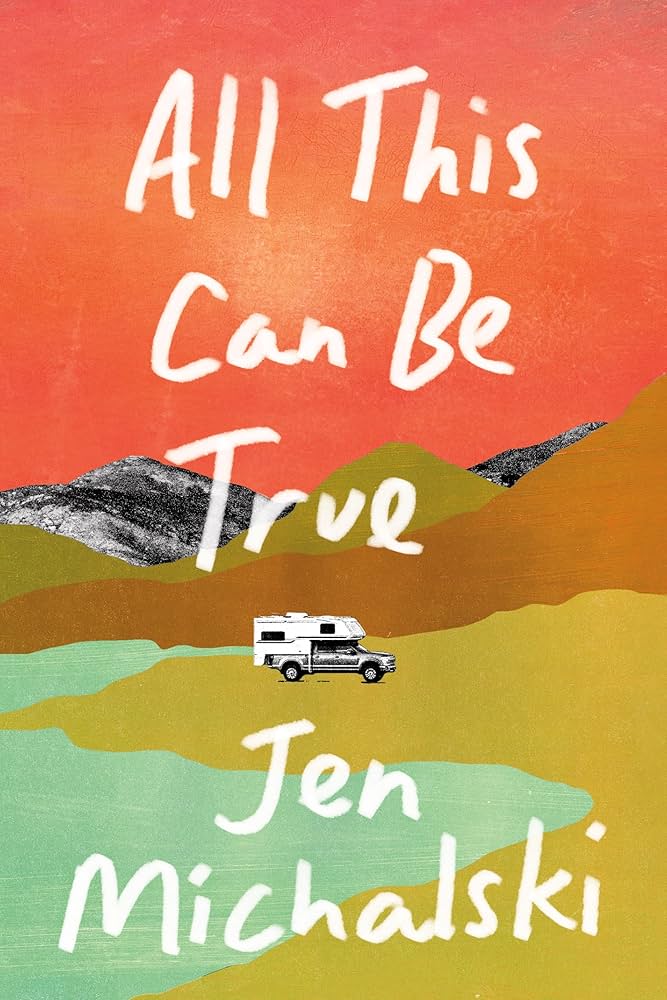
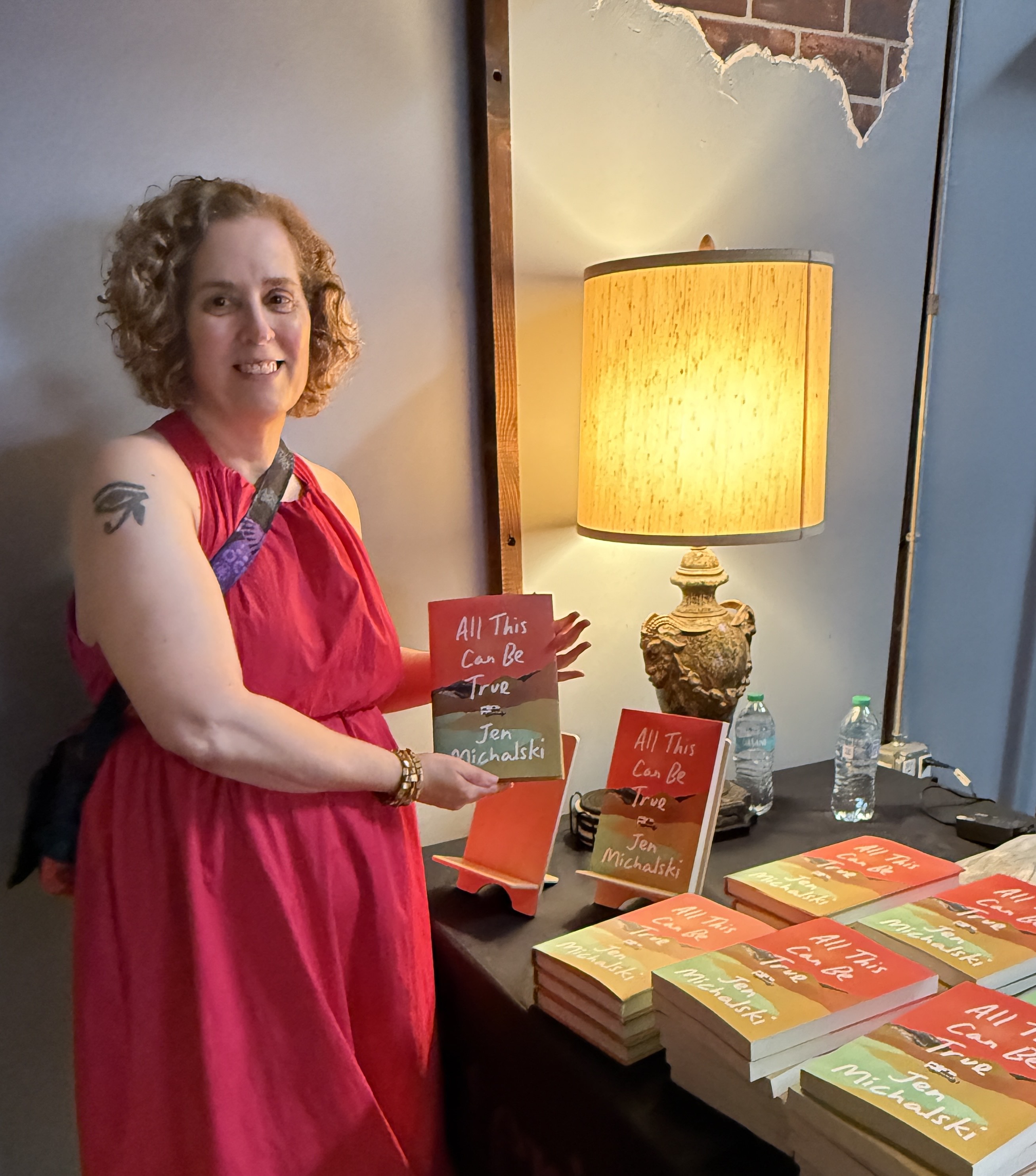
Thanks to Jen Michalski for participating in a Pride month edition of Meet the Writer. Michalski’s newest novel, All This Can Be True, was published this June. Described as “For fans of Modern Lovers and The Seven Husbands of Evelyn Hugo comes a tender queer romance about one woman’s rediscovery of choice, hope, and wild love in the wake of her husband’s coma.”
Grab The Lapels: How has Pride month changed over the years?
Jen Michalski: It’s definitely grown over the years, and more and more cities are recognizing it and planning events. There’s been a great push to celebrate and inform the public of gay icons and gay history, particularly on public broadcasting (oh, I love these documentaries so much!), and for the publishing industry, there has certainly been a push to publish more queer books during Pride month—mine included!
There’s a certain commercialization that’s grown, too—a sign that we’ve “made it,” with Pride Nights at sporting events, the rainbow-ization of brand logos, and pride merchandise at stores. At least until this year. It’s disheartening to see places like Target pull its Pride merchandise without understanding the relationship the gay community has had with corporations. Corporations, for better or for worse, are really in many ways the drivers toward acceptance in mainstream society in the sense that, if middle America sees Pride merchandise next to the Fourth of July merchandise, it has a normalizing effect. For Target to take the risk for so many years, to say, “we see you and appreciate you—you are embedded in the fabric of our lives,” only to act now like they’ve never met us, is a terrible betrayal, and it’s also very dangerous. It’s saying that we’re not worthy of being seen, that our dollars don’t carry the same weight as the non-queer community. That we don’t carry the same weight as the non-queer community. It’s the first step in dehumanization, and it’s a very slippery slope from there.
GTL: How important is LGBTQ+ representation in fiction to you?
JM: Extremely! But not in the way you think. When people think of queer fiction, they always tend to default to coming-out stories or romance tropes. I want a realistic representation of LGBTQ+ people in fiction—maybe they’re just an ancillary character in a story, a coworker at work, or someone’s brother. I think, much like the idea of Pride merchandise next to Fourth of July merchandise, queer people should appear in fiction the same way they are in everyday life. I think, as writers, we are creating the oral history of our times, in some way, and I think it should have an accurate portrayal of our lives during these times.

GTL: Have you ever seen a character who you really related to?
JM: Growing up, I really identified with Harriet M. Welsch from Harriet the Spy. She’s a sixth grader who wants to be a spy, and she’s spying on everyone in her Upper East NYC Neighborhood and keeping tabs on them in a marble composition book, the kind you used to have when you were a kid. And some of what she’s written is mean and hurts people’s feelings when it’s discovered, but they’re just raw and honest, her observations. She’s just trying to make sense of people, and the world, in a way that any twelve-year-old would. And that’s also what writers do—make sense of their world through their writing. As a child, reading about an intelligent, curious, flawed (and I presumed gay) Harriet was groundbreaking, permission-giving for me. I’d never seen characters presented that way in middle grade fiction; ever since, I’ve always been really interested in the imperfections of people but how we can love them so fiercely all the same.

GTL: What kinds of stories about LGBTQ+ lives would you like to see more of?
JM: I think we’re sort of already at a great zeitgeist in queer literature—we’re seeing a lot trans characters take center stage in a way that’s completely unapologetic, whether they’re genre romance or even something as extraordinary as A/S/L, which features three trans women in the late nineties designing a video game. I can go into any bookstores and there’s an entire section of queer YA. Right now, if you open Goodreads, the banner is a link to their LGBTQ+ recommendations for Pride month. I try to remind myself that even ten years ago, it would be rare to see this level of saturation. I only hope that we’ll have the same saturation, same access to so many voices for the next four years.
GTL: How do you feel about non-LGBTQ+ authors writing LGBTQ+ stories?
JM: This isn’t a question I’ve ever considered before! Do they? I suppose they do! I know all writers struggle with cultural, racial, and identity appropriation, and I’ve certainly written in perspectives, for instance straight male characters, that were not in my experience. I think it depends on the writer and the intent. I mean, we’re all trying to put ourselves in each other’s shoes to advance understanding—our own understanding and our readers’. At the end of the day, all people want the same things, I think—to love, to be loved, to be respected, to feel needed, to feel safe, to create a legacy of some kind—our differences are really on the surface level. And, I think, in order for writers to have realistic portrayals of the times in which we live, they may have to include a character who’s gay. I think it’s kind of a compliment that non-LGBTQ+ authors want to write stories about us!
GTL: Thanks so much, Jen! Be sure to look for my forthcoming review of Jen’s new novel, All This Can Be True. In the meantime, check out my reviews of other LGBTQ+ books to read during Pride month and all year round.
Jen’s other books reviewed at GTL


 Grab the Lapels
I really enjoy it when interview questions elicit thoughtful answers and that was definitely the case here. As an old straight (Australian) white guy I not only don’t look out for gay fiction, but I’m sometimes made very uncomfortable by it – eg. our own Chris Tsiolkas. And I’m afraid the YA shelves where I shop for my grandchildren don’t have gay sections.
I’m interested that Michalski mentions Target, but doesn’t directly point the finger at the current (US) administration, let alone at the bigot-in-chief.
LikeLiked by 1 person
Interesting you mention Tsiolkas because I quit reading The Slap after he wrote toxic, predatory straight men so well that I couldn’t continue. I actually forget he’s a gay man.
LikeLiked by 1 person
[…] this Can Be True by Jen Michalski — check out Jen’s interview for Pride […]
LikeLiked by 1 person
Great interview! I wasn’t aware that Target had pulled their Pride merchandise, that’s so awful. I hope people boycott their store, shame on them. There’s a big section of Pride merchandise at Shopper Drug Mart’s across Alberta, and presumably across Canada. They are our biggest pharmacy store, they are massive, so I take that to be a good sign they haven’t backed down!
LikeLiked by 1 person
I guess Target missed the target on this one. It’s such a fun, funky store that I’m surprised they don’t support the Queer community. It makes me wonder if some stores are apolitical in their mission statements, but try to ride waves of whatever is popular. Like, since Trump actually did win with 51% of the vote, is it better to pull their Pride merchandise? I don’t think any business can truly maintain credibility by riding trends.
LikeLiked by 2 people
You’re right actually, it does surprise me Target went that way. They’ seems so progressive…
LikeLiked by 1 person
[…] Michalski, who recently visited Grab the Lapels to write about Pride Month 2025, has written what is on its face a Queer romance, but raises pertinent questions through her […]
LikeLike