
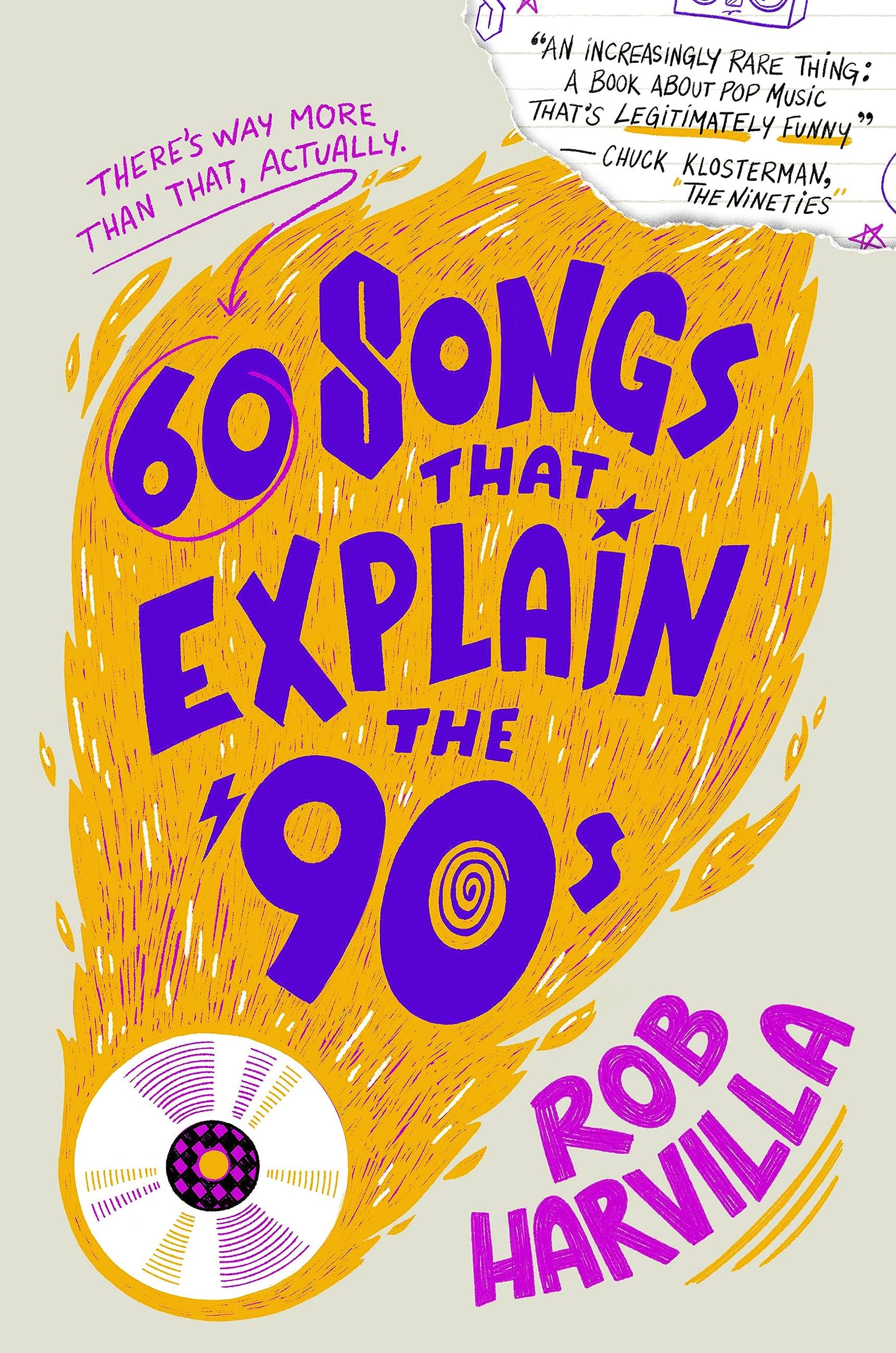
Because I was made in the ’80s, all my formative years were in the ’90s. Therefore, why not grab a book that claims it can explain the ’90s via music? I agree with the premise of the title, that music can explain that shapeshifting decade. We started with apathetic, shiftless grunge, slide into much-too-happy pop music almost as an antidote to flannel, and had a proliferation of rap music that defined an era. The ’90s don’t seem terribly unified to me, either in memory or after reading this book, and I’m getting tired of people in their twenties telling me what the ’90s were like! You were not there, thankyouverymuch.
Author Rob Harvilla was likely born in 1978, given how many times he mentions his age when a song came out, meaning the experiences he remembers in college are those I recall from high school. For example, I know this feeling he describes: “. . . back then, paging through somebody’s CD book was the single most intimate activity you could engage in with another human being.” Now that folks have thousands of songs on their Spotify account, the most similar experience we have is that end-of-year wrap thing that everyone Tweets about, sharing screenshots of their results and adding droll comments about how they didn’t think they were that depressed/into the Vengaboys.
Harvilla captures some ubiquitous moments from ’90s music, such as Céline Dion’s hit from the Titanic soundtrack, which Harvilla claims “is like drinking rosé from a fire hose.” The fun thing about reading this book is I can hear the songs about which Harvilla writes. It absolutely helps to know the songs, because when the author suggested, “If you ever need to teleport to a strip club, just put on a ’90s Pantera record and crouch,” I knew what he meant despite not having visited a strip club. Music is a vibe, and there’s something sleazy about Pantera that Harvilla captures in his humor.
A lot of that humor feels like hanging out with a person who has ADHD and is doing nothing to stop their internal-to-external flow. He jumps from song to song with what I consider tenuous transitions, but I can see the “bunny trail,” as some folks with ADHD call it, happening. Similarly, his humor is sharp because is hyperfixated on the topic and knows everything about it. I’m not saying Harvilla has ADHD, but Harvilla probably has ADHD. That’s part of what makes his writing style charming and fluid enough to cover over sixty songs in one reasonably-sized book.
Some readers may wonder what authority a white man has to write about the effect of rap created by Black men and women in the ’90s, but Harvilla never puts on academic glasses and sucks the life out of that musical genre. Instead, he writes what I was also thinking:
“No Scrubs” is also my personal favorite TLC hit for the admittedly selfish reason that the song defines the word scrub immediately: “A scrub is a guy that thinks he’s fly,” Chilli advises, “And is also known as a busta.” Incredibly helpful. I’m serious. Every pop song that uses slang in the song title should be required, by law, to define the slang term within the first four lines of the song.
The only true “ehhh” aspect of 60 Songs that Explain the ’90s is all the footnotes. Because they are unnecessary. Don’t you just hate footnotes that interrupt you mid-sentence, so when you come back you have to re-read the sentence? It’s like that, but add the disappointment that the footnote added nothing relevant, with the exception of two. I know there were two because they were, ahem, noteworthy.
I can see younger folks reading Harvilla’s book and thinking they learned about the ’90s from it, but Harvilla is really asking you to remember the ’90s with him. The feeling, the school dances, the way we used music to express what we could not say, what was happening socially, how women got angry and then cutsey, the towering artists we lost in that decade, and so on. Things really aren’t the same because Wi-Fi and smart devices changed all that. Could you imagine breaking up with someone today and demanding back your hoodie and a Spotify song? No, you cannot.
 Grab the Lapels
I could read ’60 songs that explain the 60s’ because they would be the songs I grew up with and can still sing (hum). So I know what you mean about songs for the 90s. If was listening to any new music by then it was of the singer-songwriter type, a very long way from Celine Dion!
LikeLike
Whenever I hear the name Celine Dion, I know I’m supposed to think about Titanic. However, all I can think about is this really funny memoir called Sounds Like Titanic. I reviewed it here when it came out, and I still can’t believe that it’s a true story. If you’re interested, see if your library has an audiobook copy.
LikeLike
Ha, “noteworthy”!
I like the idea of a book to remember the music of the 90’s. I was just out of college and living with friends in the Washington, D.C. area and the world seemed big and full of possibility except that we occasionally had the sense that we were about to veer onto a patch of black ice.
LikeLike
Oooooh, does that mean that you were a part of the apathetic Gen X? Well, The stereotype of generation x is that they didn’t believe anything would ever be good again and that nothing was worth doing. If you were full of hope and possibility, that’s not in line with what they were feeling
LikeLiked by 1 person
I’m Generation Jones, the anonymous generation that grew up after the boomers and deeply resent being lumped in with them. They had the “summer of love” while I was in elementary school.
But yeah, I was in graduate school and we were going to remake the world. Sigh.
LikeLiked by 1 person
How about 80 songs to explain the 80s? Now that was a time! I am always surprised that I still know so many of the words to songs when I hear one. They just don’t go away! 😀
LikeLike
Nick and I are totally awesome when we play music bingo and the 80s category comes on. Very bizarrely, we are also skilled at the country category 🤔 Any time after 2005, and I am lost.
LikeLiked by 1 person
OMG my parents listened to loads of country music when I was a kid and I still remember the words to Johnny Cash songs among others.
LikeLike
What I remember is all the peak 90s country 😬
LikeLiked by 1 person
This sounds fun! Does he stick very strictly to the 1990s or is there a bit of leeway on either end? We didn’t listen to much music at home when I was growing up so it wasn’t until the late 90s when I started high school that I really started exploring what was out there. I saved my birthday money and bought Destiny’s Child and Lauryn Hill CDs. I can remember hours in my room listening to my clock radio!
LikeLike
Totally 90s, though he might mention a band for a hot second outside the era, such as my Metallica quote. The chapter is broken into interesting sections, such as villains of the 90s. That would be people who were total dicks in the 90s, and maybe you didn’t even realize it.
LikeLiked by 1 person
This sounds like my jam. The 90’s were my musical era, middle school (early), high schoo,l and college.
LikeLiked by 1 person
Drinking Rose from a firehose! LOL
Because we are the same age, I can definitely identify with this book too. I love 90s music, and for some reason, when I think of the 90s, I think of that movie, Empire Records. Which I never actually watched, but the cover and movie posters of it? Feels like the 90s to me.
LikeLiked by 1 person
Anne! You should watch Empire Records! I loved that movie so much – my friends and I must have watched it a dozen times!
LikeLiked by 1 person
Quintessential 90s right up there with The Craft. Weirdly, I keep seeing on Facebook people saying Spice World is required re-watching for the 90s.
LikeLiked by 1 person
But where would I even find it now! hahaha it’s probably like $100 on some weird corner of the internet
LikeLiked by 1 person
Naaaah, it’s a cult classic. It has to be somewhere.
LikeLiked by 1 person
Empire Records is so 90s. The actors, the clothes, the attitudes. The special appearance by Gwar, for pete’s sake. You should watch it; I highly recommend.
LikeLiked by 1 person
two votes for me watching it! Now I’ll have to find it..
LikeLiked by 2 people