
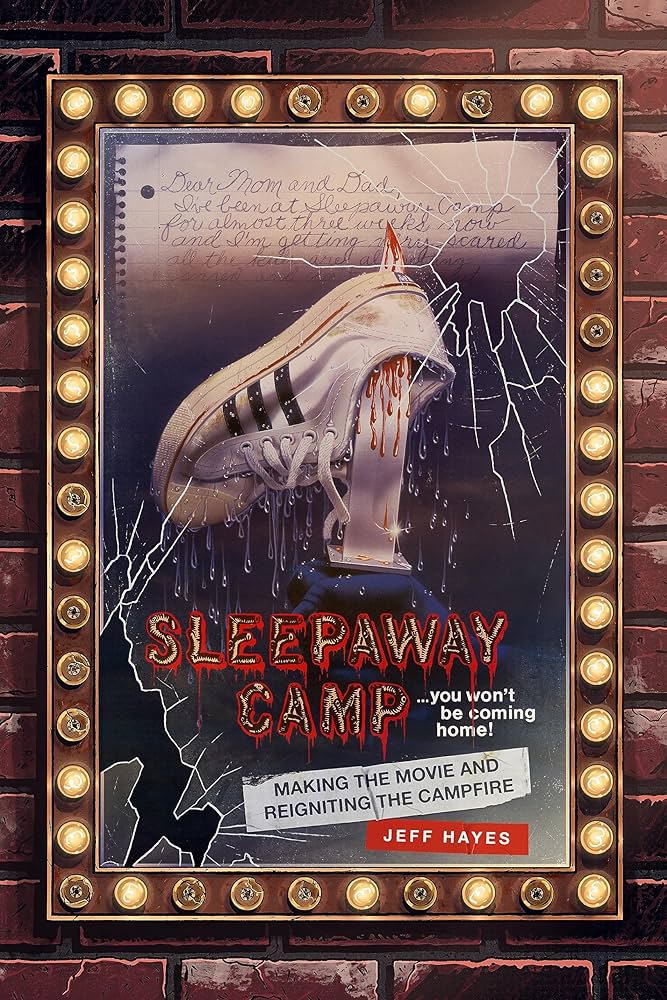
Most of us know the 1980s were crammed full of teen slasher movies in which those who have sex, use drugs, or drink are then impaled (typically) by the hulking figure in a mask. There were also loads of boobs, because some dude crew back then decided all viewers of horror were young men, and young men want boobs. Well, in 1983, writer and director Robert Hiltzik gave the world Sleepaway Camp. Based on his own pleasure for sleepaway camps when he was a youth, Hiltzik did something we hadn’t seen before: populated a teen slasher with actual teens. While endearing, that fact isn’t what made eager teens copy the movie on VHS and pass it around to their friends in the school hallways. No, it was the ending, the very last shot that surprised everyone, including me when I first saw it at a sleepover.
Now a cult classic, Sleepaway Camp continues gaining new fans, partly in thanks to superfan Jeff Hayes, who co-created the website Sleepaway Camp Movies in 1998. Hayes gained friends and fellow fans from all over the world, and from there he reached out to the cast and crew of Sleepaway Camp. Because the stars were literally teens (the protagonist was only fourteen, for example), they were “nobodies,” kids who made a movie with a Hiltzik, himself a mere twenty-five at the time, and not movie stars. Thus, around twenty years after the movie was made, Hayes interviewed the cast and crew, organized festivals, and facilitated a DVD commentary, rocketing the film back into the consciousness of today’s horror fans.
The book is broken into short chapters covering the making of the movie, funding, reuniting actors, bringing the movie back into the public eye, the effects, the soundtrack. Also, we learn about the two sequels — if you have the paperback version of the book, which expanded information about the movie sequels and is not seen in the original hardcover book. It’s nice to know the cast and crew had fun making the movie despite the tight budget, and, at times, it really was like a sleepaway camp: 100 kids just running all over the place. My favorite part was reading more about how the memorable special effects were created, such as when the camp chef has boiling water dumped on him, or when one camper’s body is found in the lake and snake swims out of his mouth. Practical effects in horror movies in the 1980s were an artform, one I worry is lost with today’s reliance on CGI instead of art and engineering.
Hayes includes many photos, pulled out of old boxes by the cast and crew, and newer photos from the tour for fans at the camp where the movie was filmed. There are images of the actors all grown up at movie conventions, too. It’s especially fun to see the “costume” photos — in quotes because there was no budget for costumes, so the actors wore their own clothes from that era. A memorable red jogger suit comes up repeatedly, and thankfully that actor saved his outfit for fans to see at horror conventions.
I love the Sleepaway Camp films, even though director Hiltzik had nothing to do with parts 2 and 3, and he didn’t like them. Therefore, reading the behind the scenes on Hayes’s book was a real treat. Obviously, it would have been better if Pamela Springsteen, who plays the infamous Angela in parts 2 and 3, had agreed to an interview. Now, she’s a photographer and keeps to herself. Of course, you need to be a fan to follow along with the book. Hayes doesn’t spend loads of time rehashing the plot or who’s who. He is a superfan; it shows in the writing at times, which can read a little college freshman, but makes up for it in his love and respect for the material.
And if I’ve had a rough week, you know this is what I’m thinking on Friday night:

 Grab the Lapels
I love how this book is a love letter from a super fan. It’s been awhile since I’ve sat down to watch a movie with a commentary track, but you know I used to love those because you would get the story of the movie as opposed to the story in the movie. The idea that one super fan could bring so much new life to a movie is amazing.
As for that last image, if that is supposed to be you, it would have to say let’s watch Sleepaway Camp again… or Big Trouble in Little China. Do I have time for both? 🤣
LikeLike
Honey, you know I will make a living room fort and put on the whole Sleepaway Camp trilogy, and when we wake up, we’ll watch Big Trouble with our breakfast 💜
I also love that this is a love letter. Small fandoms are so interesting. The big ones–like Harry Potter–I can ignore. That’s like if you were alive in 1998 and not still shitting in diapers, I assume you saw Titanic. No biggie. But these little fandoms are neat because you can meet the people you’re excited about, and they’re excited to meet you, too. Maybe we should get the DVD and listen to the commentary!
LikeLike
Your capacity for imbibing horror never ceases to amaze me, though I guess this book is the fan experience rather than the actual horror. I’m afraid it’s not just special effects that a re being lost, soon it will just be a matter of telling the AI what you want to see and there it is. And no, I’ve not even heard of the movie, let alone seen it.
LikeLike
This is such a small, low-budget indoor movie that I’m not surprised you haven’t heard of it, although I was surprised that Jeff Hayes’s co-creator on the blog is Australian. What’s funny is new horror movies all use the same blood splatter, and Nick pointed out to me that it’s part of a free, open source thing, so now it’s in all the movies. I watched an interview with the director of Interview with the Vampire, and his thoughts on special effects stuck with me. He said the art always has to come first, and the computer is just clean up around the edges. I’m always surprised by your capacity to read so many bush stories! When a topic gets you, it just gets you.
LikeLike
I write about bush stories because they are a central part of our identity as white (Anglo) Australians. I read more SF than I do bush stories but I don’t write about it as much. Hopefully my other reading and writing – of women’s and Indigenous Lit. in particular – queries our (Australian’s) male focused ‘bushman’ identity.
LikeLiked by 1 person
Ok I’m not familiar with this movie, but it sounds like I would love it. I’m going to search for the trailer right now, and If I don’t see hairsprayed blonde hair and pastel track suits I’ll be disappointed LOL
LikeLike
Ha! If you have Tubi, which is a free streaming service, which I use exclusively, all three movies are on there. I hope you do watch it! Just not with the kids.
LikeLiked by 1 person
What Bill says! I have never heard of Sleepaway Camp. I was sort of aware of teen slasher movies, but the 80s were when I had my kids, so I was otherwise engaged and not really focusing on the youth zeitgeist!
I’m inclined to say that practical effects in horror movies have always been an art form. The question is, what art? CGI and AI creators would still, I’m sure, call it an art form, as would those who created effects back in the first days of film?
LikeLike
I learned from my Nick, who has a degree in broadcasting, that there is free software to create special effects, so now everyone just uses that. There isn’t even a person creating the effect like we might expect.
LikeLiked by 1 person
I’m sure he’s right, but I expect that not everyone uses it. That there are filmmakers who have their own ideas about what they want – even if sometimes it’s just programming the software to achieve special, special effects. Which is not to say it’s all hunky dory. I’m sure that for many filmmakers, where they can get away cheaply they will. But then, I think that’s always been the way to some degree? Some will take the cheap and easy way and others will push the boundaries.
LikeLike