
The library closest to my Crash Pad has a group called Bite-Sized Book Club that meets once per month. They only discuss books under 250 pages to accommodate people who “don’t have time to read.” Isn’t it interesting that we’ve reached a point in book history when 250 pages is considered “bite sized”? Anyway, for the first part of the year, they have a theme of Queer Speculative Fiction. Given what’s going on in the U.S., I think we could all use more Queer stories.
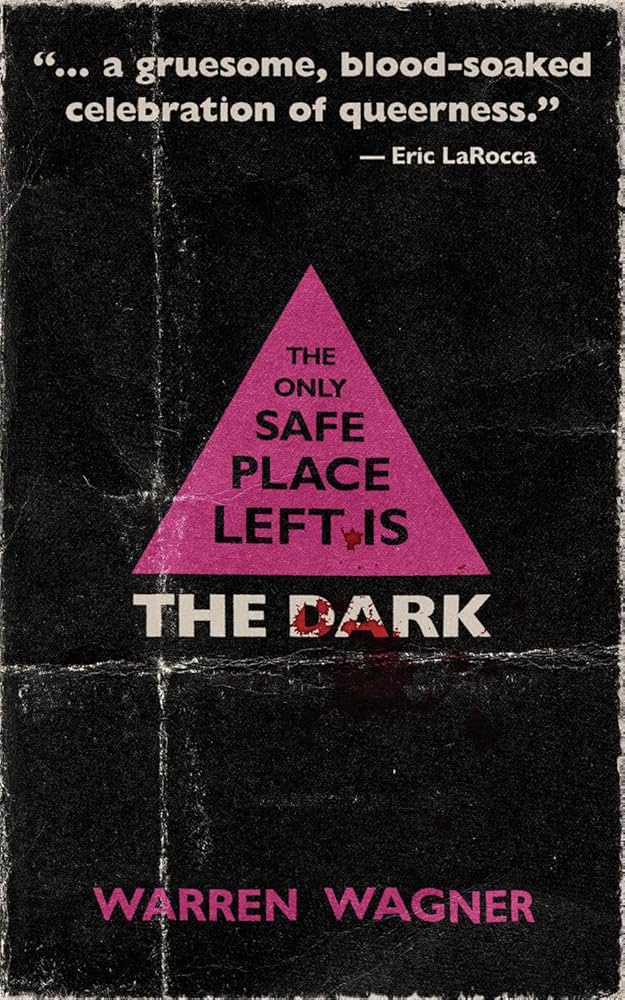
The Only Safe Place Left is the Dark by Warren Wagner comes in at a bite size 92 pages. There are two timelines, though the older one reads more like flashbacks than an actual separate timeline. It’s the 1980s, and our protagonist, Quinton, is comforting his lover, who is dying of an AIDS-related illness. Quinton is HIV+ himself. There are some complicated feelings Quinton has about serious love for his boyfriend and the short length of their relationship: a mere six months.
Shortly after the boyfriend’s death, science has advanced, and now medication is available to keep HIV from progressing to AIDS. Quinton is depressed, so he hides out in a cabin in the woods where he is oblivious to a pandemic that spreads, turning those who exchange bodily fluids into zombies. Cut to thirty years later. Although Quinton has been able to find medication in abandoned pharmacies and stock up, a group of men take over the cabin and destroy his stash, leaving Quinton to sit tight and die as the HIV virus progresses, or go out into a world filled with the walking dead.
Okay, I know 99% of you don’t read horror, but hear me out. During the 1980s AIDS epidemic in the U.S., folks who were positive were labeled “the walking dead.” I’ve said it once, and I’ll say it again: horror is a vehicle that drives us through real life and shows us the scary stuff, but we know we’re safe because the windows are up and the car doors are locked. From that vantage point, we can analyze the horror that’s happening around us safely.
Therefore, author Warren Wagner isn’t just calling the zombies and the victims of the AIDS epidemic both “the walking dead.” True, he does write the following about HIV/AIDS-positive patients: “Those who weren’t killed were left waiting. Waiting for a cure. Waiting for the end. They weren’t dead yet, but they weren’t alive either. They were zombies.”
No, the comparison goes deeper. The actual zombie-zombies still have all their human thoughts. The zombie virus only affects their bodies, meaning the virus compels people to do things to help spread the virus (like biting, of course), all while the carrier thinks like they would normally. When Quinton is chased by a hoard, one zombie shouts, “Please run, I’m coming! . . . I can’t do this again!” I’ve read books about the AIDS epidemic and noted how apologetic some patients were — sorry that someone else had to care for them because they couldn’t control the often gruesome deterioration of their bodies.
Furthermore, the living can essentially be “zombies.” Quinton is so grief stricken from his boyfriend’s death that he hides from the gay community, avoiding new opportunities to, he assumes, lose someone. Finally, Quinton realizes, “They lived for those they lost. Until they could live for themselves again. This isn’t the place for him anymore. He needs to stop being a zombie and start living.” Is self-isolation a way to avoid danger, be it grief or a virus, or is it another form of zombieism? After COVID, this is a sticky question, but I do know folks who were still self-isolating in 2022.
Quinton does meet another survivor, whom he learns to trust, and discovers something new about the zombie virus. Of course, it wouldn’t be a zombie book if they didn’t run into a cult where the leader is taking advantage of all the followers. My only “problem” with the book is Quinton and his new companion supposedly walk 300 miles in 48 hours to find more life-saving medication. Here’s hoping they were on roller skates.
 Grab the Lapels
Champion speed walkers! Seriously though, sounds like a lot of interesting stuff packed into a short book. Have you had the book group meeting yet?
LikeLike
I did! There were a lot of things I noticed that other folks didn’t, but I have an extensive background in how horror stories go, how horror can be a vehicle for looking at societal issues, and there is also my MFA, which has caused me to look at stories through a more analytic lens regarding craft than an enjoyment lens.
LikeLiked by 1 person
Thanks Melanie … I completely understand your understanding of horror. My thing is though I have always preferred realism from when I was very young readers. Don’t give me fairies or zombies or whatever the genre is, just give it to me straight! I can take it! That said this discussion of AIDS and of epidemics/pandemics in general sounds well done.
BTW I liked this comment, “There are two timelines, though the older one reads more like flashbacks than an actual separate timeline.” I sometimes wonder about this with books. It can be a fine line.
LikeLike
Now that you’ve said it in a straightforward fashion, and I sit and think about it for a moment, I realize that you really don’t have other genres on your blog aside from realistic fiction. It seems like whether we’re talking about sci-fi, fantasy, or maybe even romance, you aren’t drawn to those genres. Even romance isn’t straightforward realism.
I felt kind of silly when I wrote that there were two timelines/flashbacks, so I’m glad you understood what I meant!
LikeLike
Whoa, sounds like there’s a lot going on here, even if it’s a short book. I do appreciate how a more genre-style fiction like this can delve into some real life heavy issues
LikeLike
Yes! I love that you wrote that, Karissa. It’s something that I’ve been saying for ages, but in the end, most people view the horror genre as trash or violent. In so many horror books, there is no violence, only a mirror reflected back at us, and we don’t like what we see.
LikeLiked by 1 person
Your last sentence made me LOL, even though this a pretty dark book! Yes, I totally agree with you that horror mirrors quite a bit back to us, and it can ‘hide’ between a supernatural filter so it doesn’t become didactic, but still very thoughtful. I love the fact that this book club is focusing on queer stories!
LikeLike
Hahahaha, well, I suppose a more modern imagination would have chosen wheelie shoes or a Segway or….something, lol.
I’m so glad that my readers are starting to acknowledge what horror can do for us that is positive. I am the first person to point out when horror exists only to be gratuitous — I recently read a book that was so bleak and without much reflecting back at me from real life that I didn’t even review it. It was not a book that I would recommend to… well, anyone.
LikeLiked by 1 person
yah gratuitous horror is definitely it’s own thing, and it’s fine I suppose, but so many horror stories are way more than that, which you point out
LikeLiked by 1 person
That’s cool that you’re able to join a book club while you’re there! And what a progressive theme they’ve picked.
LikeLiked by 1 person