
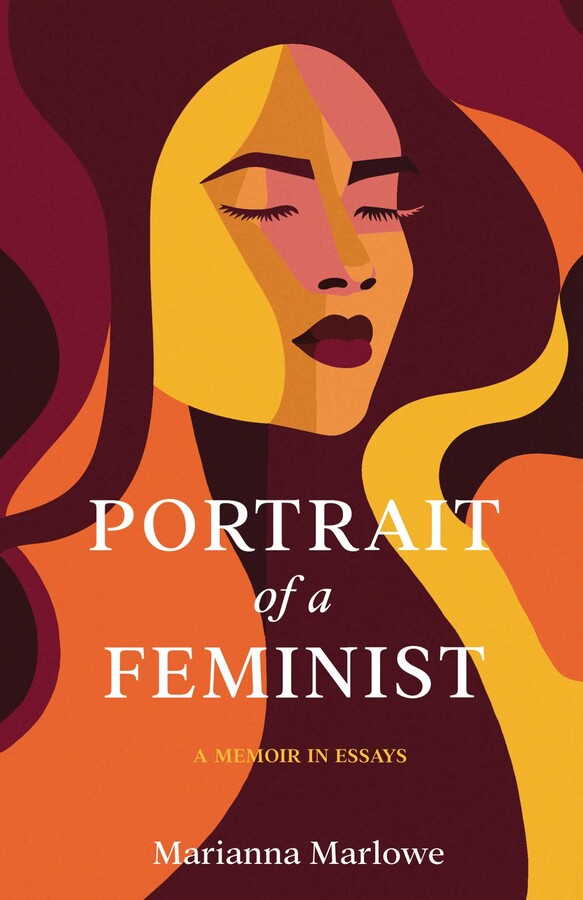
Portrait of a Feminist is a collection of short essays by Marianna Marlowe organized into four sections. She begins with “Seeds Planted,” followed by “The Growing Years,” then “Maturation,” and finally “Harvesting.” Basically, each section contains about a dozen short essays demonstrating Marlowe’s thoughts, feelings, and actions through a feminist lens. Sometimes, she is the defender of women’s rights; at others, she’s on the side of the oppressor and reflecting on what made her choose patriarchal viewpoints.
Because her father is Anglo, Marlowe spends a good deal of time in the U.S., specifically California, but her mother’s family is South American, so she lives at times in Ecuador and Peru. The essays contain multi-lingual, multi-cultural interrogations of feminism. For instance, an older male cousin from South America has six children from multiple women through betrayal and charm. His family, especially the women, dote on and excuse his behavior because a rakish man cannot be blamed for his behaviors. When did he learn to prioritize himself, and why do women in his culture support him?
In all countries Marlowe faces a variety of sexual harassment, such as the time a man in South America saw her through the window of her school bus and made a suggestive kissing face at her that made her extremely uncomfortable. Or, the time she was raped while sleeping naked next to her boyfriend, who knew she did not consent to having sex with him. At what point, she wonders, is she a guilty party? Who sleeps naked and really means “no”? Is it his right, as her boyfriend, who was invited to stay over, to take her body? Such a variety of sexual harassments gives the reader lots to think about — what “counts” as sexual harassment or assault?
Many essays pivot on hair; Marlowe describes hers as frizzy and unmanageable, positioning her in opposition to sleek, polished women who attract suitable (i.e. monied and handsome) partners. However, her Latinx (the word she uses to describe herself) family support elegant wives who stay in their lane: wife, mother. While Marlowe rails against women without careers, herself earning a PhD and becoming an adjunct professor, she eventually leaves the field to stay home with her two sons. Thus, while she has ideas about feminism being “more than a mother,” maturity teaches her that feminism is choice and equality. She clarifies:
“My feminism that is not about an automatic hatred of all men, or a blind idealization of all women — which is a form of objectification itself — but a humanizing feminism, one asserting that no one can be truly free until everyone is free.”
Although the collection is 261 pages, I never felt Marlowe repeated herself or beat a point to death. Instead, I cherished her honesty, such as when she judged a young PhD student for breastfeeding in public, and her growth, deciding that motherhood fulfilled her more than academia.
*I received a copy of this book at no cost and from She Writes Press and received no payment, which in no way affected my review. Portrait of a Feminist is available for purchase starting February 25, 2025 as an e-book or in paperback.
 Grab the Lapels
I love that quote Melanie because that is exactly my feminism. I worked part-time from the moment my children were born until the end of my career because of child care then having time for the oldies. At a personal level I see feminism as essentially being courtesy (in its fundamental meaning not culturally constructed meaning) and respect, which translates politically and legally as freedom to choose and equality as in equal rights. If we all respected and treated each other as human beings everything else should fall into place.
As for “His family, especially the women, dote on and excuse his behavior because a rakish man cannot be blamed for his behaviors”, why do women so often go for bad boys? I do not understand it and I’m always astonished when some of my Jane Austen friends want some of her heroines to marry the bad men and change them. Can’t understand it … but it makes me feel boring!
LikeLike
I think if life feels mundane, seeing the giant stretch of mundanity ahead of you can be terrifying, especially if you are a teen girl with parents who don’t really show affection and the old adage that the fastest way to kill your sex life is getting married. These old ideas taint us, in a way. Thus, someone who doesn’t live by the rules seems like a more exciting option. Any time I see something like a rom-com in recent years, the love interest tends to be more steady, bookish maybe, has a job, etc, but he’s a romantic. The bad boy thing sort of faded after the 90s, which I think is connected to the rise of feminism and women having self-esteem.
LikeLike
Interesting perspective Melanie that makes sense. Having parents who always made me feel loved and supported was I know very lucky but hopefully not too unusual!
LikeLiked by 1 person
Milly worked part time (weekends, evenings) for as long as the kids were in school. I never considered doing the same, even those years when I was working from home.
It has always seemed unfair to me that bad boys got the most exciting girls. I don’t regret being a ‘good’ boy, and I often wonder how many ‘exciting’ girls were actually dealing with stuff and that was one way of coping (doesn’t explain Lydia – you really should read Pride & Prejudice, Melanie).
I don’t want permission to force myself on women who say no, but I do wonder if there are degrees of rape, if wives feel violated by being forced into sex or sometimes at least, just resigned or annoyed.
LikeLike
Sue was also saying she worked part time, and I know another blogger friend who is my age works part time. At first, I wondered why the mothers worked part time, but then I realized how much the full-time folks need help along the way, whether the kids are sick at school and must be picked up or if an adult must be present when the school bus arrives.
Gaaaah, I’ll try Pride and Prejudice again, along with Wuthering Heights.
“Resigned” and “annoyed” are not “no.” No means no, so no, I don’t think there are degrees to rape. I do think that resigned or annoyed can stem from wanting to avoid an argument, and if someone is arguing with you about having sex with them, that’s a form of coercion, which is also illegal.
LikeLike
Working part-time is a complex thing of which income – and flexibility for those things you suggest – are part (though not all part-time work allows flexibility). A big part of working part-time can be for intellectual and social reasons. A great value of working part time was that I had lunchtime to myself or that I could spend it with friends/work colleagues, just talking about adult things. As much as I loved my children and being with them, I also needed that different stimulus and break. And then of course if you love the career you chose you want to stay in it in some way.
I agree with you re rape … no is no, but I appreciate the nuances Bill is talking about. Between NO and an enthusiastic YES is a wide spectrum. The problem is if the yes is the result of coercion … if you say yes because you can’t say no. That’s rape to me.
But, I think a woman can be resigned without its being an argument/coercion situation. Exhausted mothers might be happy to go without sex for a week but they know that doesn’t work for their partner so they resign themselves out of love and a spirit of give and take. A commentator here on sexual relationships, Bettina Arndt, made this sort of point, if I remember correctly, a few years ago and it created quite a furore. (She was not talking about the sorts of coercion young women are facing these days … like if you don’t have sex with me I’ll share that photo you sent me or I’ll tell everyone this about you etc. That is not negotiation. That’s blackmail or coercion.)
LikeLike
Thanks for the detailed and nuanced reply, Sue. I really appreciated reading your thoughts.
LikeLike
In my experience, it’s really hard to have young kids and two parents who work full time. It actually requires both of you to have jobs that pay very well so you can pay for childcare. For many families, it’s just not worth it. Even when kids are in school, the school day doesn’t line up with a full work day. And then there’s the constant struggle of who stays home if a kid is sick? Who leaves work if your kid starts puking at school? Or if they need a ride to a school sporting event at 4pm? For better or worse, this usually falls on mom. My husband literally works at my kids’ school and I’m still the one who gets the call when one of them gets sick at school.
LikeLike
I think at one point a niece or nephew was sick at school, and my brother and his wife were like, “Yeah, you’re gonna have to keep them.” I don’t understand why school sports line up so badly with parent availability. I want to say just push events to later, but then kid bedtime is super early. It all seems like a cluster to me. Maybe no activities until the kids have a license! Yeah, that would be more rule. (JK I HAVE NO IDEA WHAT I’M SAYING).
LikeLiked by 1 person
School sports also require a ton of parent involvement! Like, they’re part of school but they’re also after school and sometimes they’re places other than school! And you inevitability have kids who need to be in different places at the same time! But also school extracurriculars are so important because they provide opportunities for kids who might not get them otherwise!
LikeLiked by 1 person
This sounds fascinating. I love what you say about her learning that feminism actually means choice and equality. I feel like a lot of time people don’t understand or see it that way.
LikeLike
I knew before that feminism meant choice, but I think a lot of the folks who choose to be stay-at-home moms instead of career moms also espouse a lack of choices, deferring to their husbands instead. Actually, reading about you and Peter and the girls is refreshing and reminds me of what choice AND autonomy look like.
LikeLiked by 1 person
That sounds like a very old-fashioned form of stay-at-home mum and not one I saw much of in my circles. I don’t know any women who defer to their husbands! Dare I say that might be more common in fundamental religious circles or am I being unfair there.
LikeLike
You’re totally fair. I appreciate religious sects that talk about husbands as leaders meaning a huge responsibility to those under your care, but I hear that less than “I’m the head of the house, period.”
LikeLike
I don’t hear that at all but it’s probably partly the circles I move in and the city I live in? We are a progressive voting city and that probably says a lot about how we think and relate to each other.
LikeLiked by 1 person
I have SO many thoughts about this! I’ve been in a lot of Christian spaces where feminism is a dirty word and yet inevitably when I explain to someone why I identify as a feminist, they don’t disagree with me. And then outside of those religious spaces I sometimes feel like a poor feminist because I exist in a pretty traditional female/wife/mom role. Yet it’s the freedom I have to choose that role (and the support my partner gives me in that choice) that is the real win of feminism.
LikeLike
And as long as I’ve known you, which was when you had one baby, you’ve wanted this life that you’ve built. It’s an absolute win for feminism! Oddly, I don’t remember Rose being born or any pregnancy pictures, but I remember your blog pre-Rose.
LikeLiked by 1 person
That’s really key – that Peter and I get to choose this life together. And I have the freedom to choose something different down the road. It’s easy to take it for granted but my grandmothers did not have all the freedoms I have now.
I didn’t share about my pregnancy with Rose until she was born. I didn’t even tell people I saw in person until I physically couldn’t hide it anymore! It wasn’t a secret exactly but I had a lot of anxiety when I was pregnant with Rose and that was what worked for me at the time. I hid under big sweaters and things until summer hit and suddenly I was 6 months pregnant!
LikeLike
I’m glad you did what made you comfortable with your pregnancy. We have a weird culture where people think they have a right to pregnant bodies, and I don’t just mean politically. I mean the people who think they can rub a pregnant lady’s belly, or ask about due dates and names, and the two don’t even know each other.
LikeLiked by 1 person
People are so weird about pregnancy! The questions they will ask! I’m pretty open to talking pregnancy, birth etc with my friends but some of my stranger interactions when pregnant were unhinged!
LikeLiked by 1 person
Hair is such a flashpoint for standards and beauty, feminism, and race. It seems crazy arbitrary to assign straight hair to the pinnacle of beauty but the again, straight hair is “white” and curly/frizzy/kinky is “other.” Even today these dichotomies persist. I read how a local young female TV news person was let go on part because of her naturally curly hair – at least that was the allegation. I started paying attention to all the female news and weather people and sure enough, they all have straight hair or look like they straighten it. It’s bizarre.
LikeLike
I used to go to a hair salon where everyone working had straight hair, which I did not realize until my stylist was relating to me curly problems and I noted her hair is straight. She said it’s salon policy that all hairdressers must straighten their hair. I quit going there.
LikeLike
[…] their lives affect their writing. Today, please welcome Marianna Marlowe. Marlowe is the author of Portrait of a Feminist, which I recently reviewed. Learn more about Marlowe and her work on […]
LikeLike