
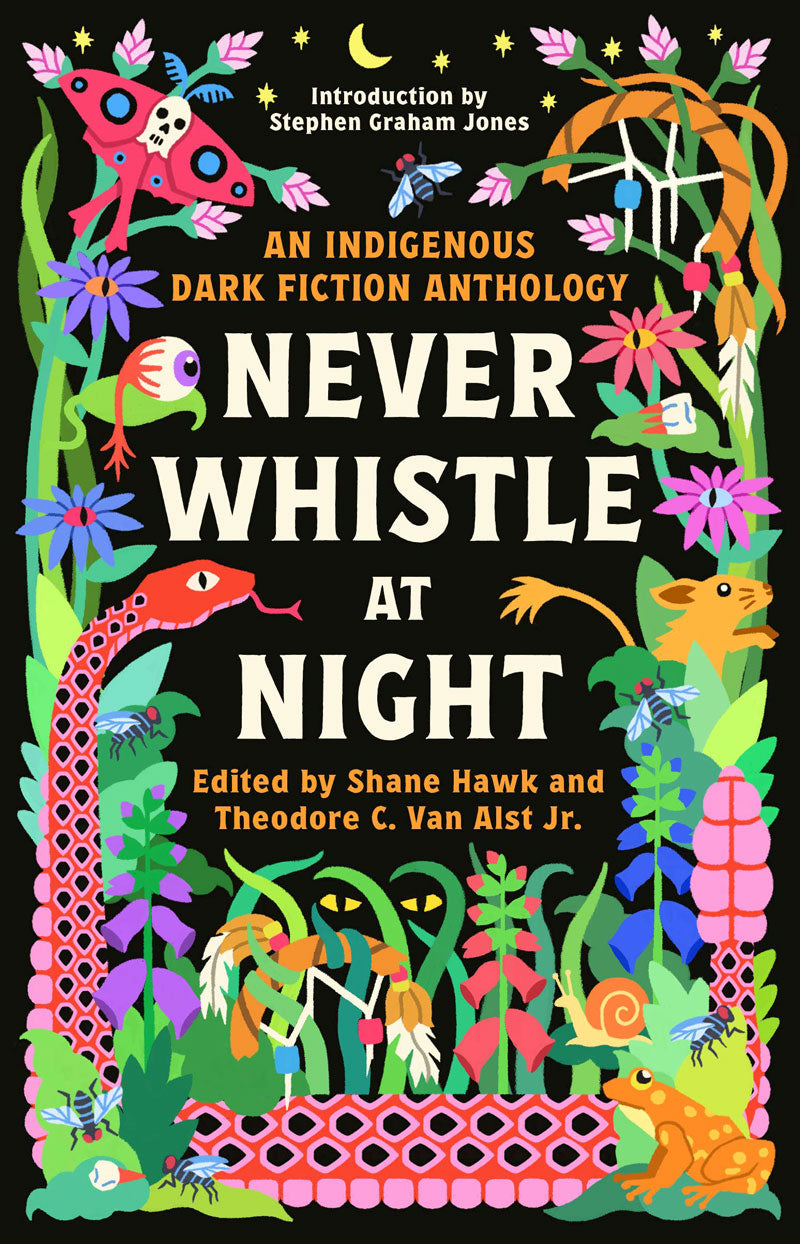
As one story in this collection so cleverly points out, most Native people, and pretty much all white people, can only name about two indigenous authors, typically Louise Erdrich and Joy Harjo (I noticed Sherman Alexie was carefully left out of the list…). And so, would an indigenous person sell their soul to become famous? Like, James Patterson famous? That is the premise of just one story in Never Whistle at Night: An Indigenous Dark Fiction Anthology, edited by Shane Hawk and Theodore C. Van Alst Jr.
Given that language is always evolving and I am a white reader, I’ll note here that I do not know which terminology the subjects and authors of this collection prefer: indigenous, Native, Indian, original people, tribal. All are used within the book, though I noticed “Indian” was never used positively, though some tribes in North American do identify that way.
The collection includes some well-known authors, like Rebecca Roanhorse, Morgan Talty, and Tommy Orange, though a story by Stephen Graham Jones is conspicuously absent. He does write the forward, though. Within, readers get 26 stories, the majority written by women, which stood out because horror has notoriously been a boys’ club. Although Never Whistle at Night has been celebrated as horror, notice the subtitle says “dark fiction.” Some entries are more unsettling than scary, while others engage with the demons and evil spirits of specific cultures that are there to teach people a lesson about respect and remembering.
Largely, the question hanging around the entire book is “Who gets to be Native?” Throughout are comments from white characters suggesting a person isn’t Native because they have blond hair or freckles. That question, “Who is Native enough?” is most prominent in the short story “Quantum.” A mother has her sons, infants about ten months apart in age, DNA tested to see if she can get tribal money, or “on the roll,” as she calls it for each son. One son has just enough Native blood for her to start getting money. The other does not. What follows is hyperbolic…to an extent. The infant “worthy” of tribal money is doted on. His mother buys him tiny moccasins and calls him her little Indian. The older child, a young toddler, is neglected, becoming more like the family dog or a creature skittering around the corners of the house.
On the flip side, a reoccurring theme is how someone is just so Native as to be viewed as a commodity by white characters. In a final story, a professor hosts an end-of-semester party where she introduces Meg, whose full named is Megis but no one can commit to getting right, to all the taxidermized heads on her wall. Human heads. Much like a big game hunter, the professor is on the lookout for a unique, hard-to-find trophy…
Overall, there wasn’t a lousy story in the entirety of Never Whistle at Night. I can think of one or two that weren’t quite as interesting to me, but in general, it is a strong collection by a variety of Native North American authors. The bio for each writer is at the end of their story, so you may find yourself bulking up your TBR.


Oh, this is on my TBR and I’m so glad to hear how much you liked it! Short stories are not my first choice so I have been skipping over this for other things. But since you talk so highly about it, maybe next time I will be more likely to pick it up. 🙂
LikeLike
I felt like each was its own immersive world. Typically, the inability to achieve that tiny world is what turns folks off from short story collections.
LikeLiked by 1 person
I’m also more inclined to pick up this book now. Short stories aren’t my favorite either, but you’ve gotten me interested.
LikeLike
Absolutely, this one and Jordan Peele’s Out There Screaming I would HIGHLY recommend as immersive little worlds that you can enter.
LikeLiked by 1 person
I love short stories and as you know have been reading – just finished in fact – an anthology of Native American (the editor used that term) short stories. Terminology is an issue. I noticed that Alexie used Indian but I wasn’t sure whether there was some sort of ironic self-deprecation in that. In Australia now I tend to use First Nations, and a think Canadian people might like First Nations too. I have heard it used in the USA too but less so, so I more often use Native American. It really is problematic as we want to be respectful don’t we?
This issue of ‘“Who gets to be Native?” Throughout are comments from white characters suggesting a person isn’t Native because they have blond hair or freckles. That question, “Who is Native enough?”’ is a bit of an issue here but in a patchy way. It’s been controversial among First Nations people in Tasmania. Anita Heiss wrote a memoir “Am I black enough” in response to a white journalist’s comments which resulted in a court case.
So this book sounds interesting despite the dark fiction tag.
LikeLike
I absolutely was thinking of that short story you wrote about that had the basketball teams, and one team had membership cards while the other did not.
LikeLike
Oh good memory Melanie … yes that was a great story on that issue. And showed me it wasn’t just an issue here.
LikeLiked by 1 person
We’ve sold quite a few of these at my store so I’m glad to see you review it! It sounds like an interesting collection.
LikeLike
Oh, good! Shane Hawk is a fairly new writer if you look at publication history, so it sounds like he was passionate about this project.
LikeLiked by 1 person
This sounds like a great collection! I think we may have discussed this together before, but as a Canadian reader, I am aware of many more Indigenous writers (at least in Canada) than likely most Americans are, as we have a large amount of Indigenous writers hitting our bestseller list quite regularly, it’s fantastic. I’m familiar with your bigger names (Orange, Erdrich, Jones, Alexie) but I’d love to learn about more!
LikeLike
Most of the native American books that I’ve read in recent years were your recommendations. Thank you so much for providing that information to me. I think I did one called something about a chicken dance and then another one about a blanket. I would look it up, but I don’t have that information available right now, LOL.
LikeLiked by 1 person
Oh yes the chicken dance by Dawn Dumont! I loved that one.
I’m so glad I can help introduce more Indigenous authors to you, we are so lucky here in Canada 🙂
LikeLiked by 1 person
I could name more than 2 Australian Indigenous authors, maybe only 2 Canadian – I’ve just finished an Eden Robinson – but maybe not 2 from the USA. However, my next Audible read is Council of Dolls by Mona Susan Power, so I’m getting there.
I used to see Black Australians on twitter getting annoyed when people brought up white discovered a Black ancestor and insisted they were instantly Indigenous.
LikeLike
Your comment reminds me of the author of American Dirt, a story about Mexican immigrants written by a white lady. She immediately changed her Twitter bio to say she’s 1/16 Puerto Rican, or something like that. And still everyone read her book. I worked at the library at the time, and it had a waitlist.
LikeLike