
*This is the 11th book for the 13 Books of Fall.
I’ve become a devotee to a bookstore about fifteen minutes from my house. Not only are you greeted by two dogs, and even better that they have Spooky Book Club once per month, buy they occasionally have a Nature-themed book club. This month, they’re reading Owls and Other Fantasies: Poems and Essays by Mary Oliver. At a total of sixty-five pages, each entry is connected to birds — not just owls. According to the acknowledgements page, most of these poems were published elsewhere first before being collected thematically.
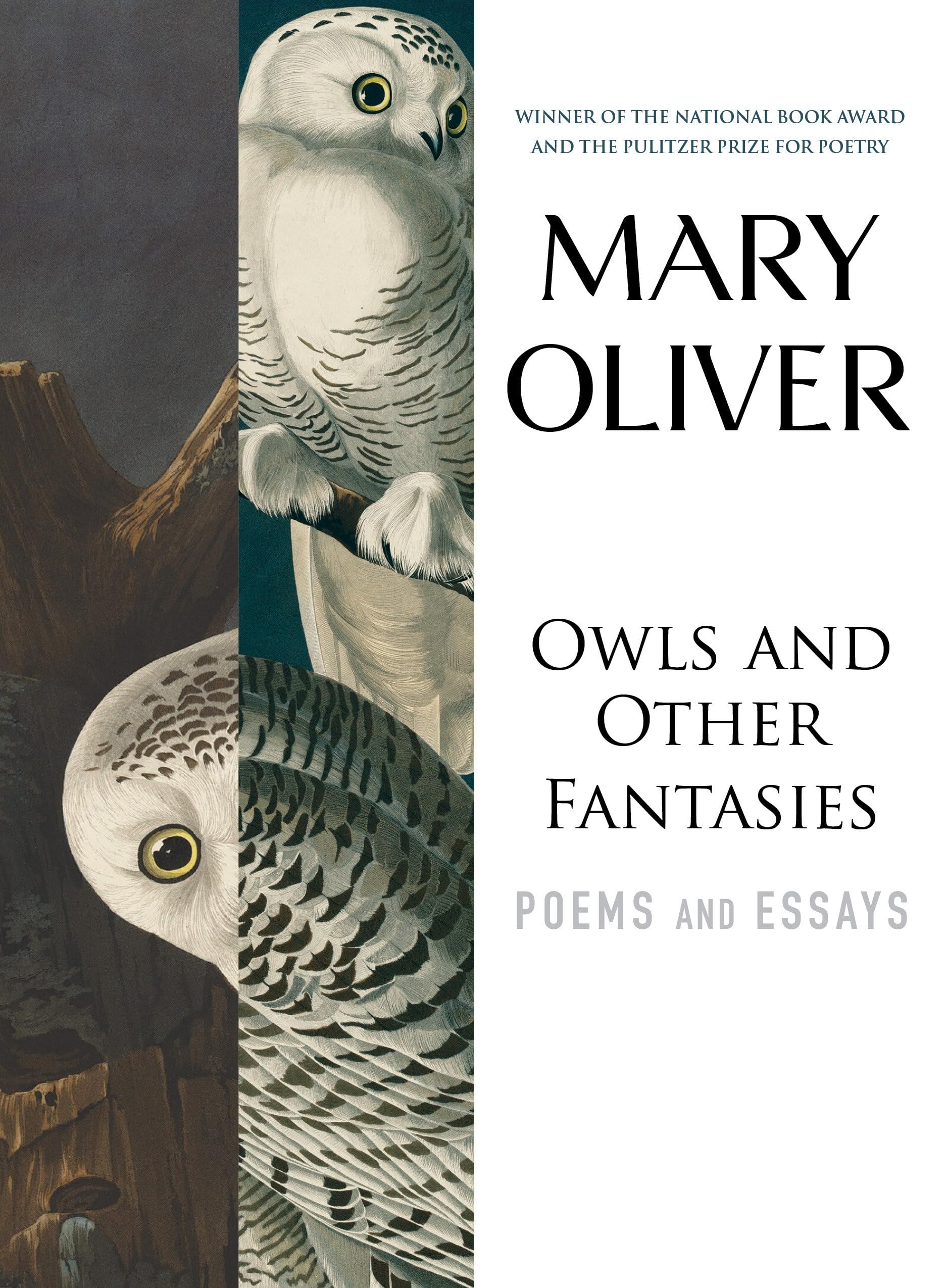
As much as I have enjoyed my newfound appreciation of birds thanks to reading first The Bird Way by Jennifer Ackerman and later What an Owl Knows, I was surprised by how lifeless these tiny, mysterious, and fascinating creatures were on the page in Oliver’s hands. Right on the cover it says Owls and Other Fantasies won the Pulitzer Prize for Poetry, yet at times, Oliver describes what she literally sees: “A single swallow glides in the air above the water.” Okay. Or this opening line: “The female, and the two chicks, / each no bigger than my thumb, / scattered . . .” Repeatedly, she uses the image of a bird dipping its head into water. I once had a poetry professor ask us why we should write a poem of something a person could easily see themselves. I had this same question for Oliver.
Finally, near the end she had two pieces that did credit to the wonder of birds. In “Catbird,” the author first describes birds in a mating ritual before twisting the poem into a comment about capitalism:
"Will I ever understand him [the catbird]?
Certain he will never understand me, or the world
     I come from.
For he will never sing for the kingdom of dollars.
For he will never grow pockets in his gray wings."
This subtle suggestion that asks why birds sing versus why humans do got me thinking about our performative culture, one in which we must turn our joy into side gigs, something that pays, while birds do it for mating, warning, enjoyment. Unfortunately, this was the only poem that engaged me beyond just picturing a bird.
One interesting, heartfelt essay grabbed my attention as well, one in which the speaker rescues a nearly dead seagull and takes it home. Slowly, the bird falls apart, literally, but it does not die. Instead it enjoys the water and food it is given, the view of the water outside the window and, in turn, the view of the people in the house. Quietly, the bird dies, and it’s somber because Oliver gave the bird so much life without personifying it. And I wonder, why had she not done the same for her poems?
 Grab the Lapels

I very much like Oliver, though I haven’t read this particular collection. The cover is really pretty 🙂
As to “why we should write a poem of something a person could easily see themselves,” because hopefully the poet is able to offer a new way of seeing.
LikeLike
Yes, I grappled with that comment the poetry teacher made and never could figure out what to write afterwards.
LikeLiked by 1 person
Yes, Stefanie, that was my response to that question too. It may also be to enable the reader to simply recall the bird when they are nowhere near birds. Or it may be that by describing the bird in a certain way the poet wants to engender a feeling in the reader? Do we look too much for hidden meanings and messages in poems? I know I do, fearing I’m missing a point but maybe I shouldn’t?
I wonder if the teacher wasn’t being critical, as in why on earth would we, but saying, rather, if you are going to write about something people can see, think about why you are doing it? But I wasn’t in the room so I wouldn’t know what was intended.
LikeLiked by 2 people
I agree with you WG that we do tend to look too much for hidden meanings and messages. To be sure, there are some poets who write in such a way that demands we parse out the metaphors into broader meaning, but I’m pretty sure most poets aren’t trying to hide things from their readers. I tend to blame my high school education for instilling in me the belief that there are secret messages in poetry. And I thank my wonderful university senior seminar prof for breaking me of that notion and teaching me to be a better poetry reader and helping me fall in love with poetry.
LikeLike
I wish my university lecturers had disabused me of that feeling Stefanie. I said the above because I believe it, but I am still always anxious about poetry.
And here’s an idea, I wonder if the best poetry readers are those imaginative readers who grew up loving fairy tales and fantasy. I never did. I’m more grounded in reality which I fear makes me a more prosaic reader. (Though I do love rhythmic writing.)
LikeLiked by 1 person
What an interesting thought regarding fairy tales and fantasy WG! I was not much of a fairy tale reader when I was a kid, but fantasy, oh yes! And I still love a good fantasy (and science/speculative fiction) novel. Also love magic realism. Are you thinking that being more grounded in reality keeps you from making the leaps and associations that poetry often asks for? Because I don’t consider you unimaginative at all. You seem to do just fine making connections in novels and short stories. Perhaps it’s just anxiety and a need for practice, because it does take some practice just like reading any other genre does.
LikeLike
Yes, I was thinking that Stefanie … maybe you’re right or maybe it’s that I only make logical connections! I do in fact like looking for connections. I’ll keep trying.
LikeLiked by 2 people
PS I do enjoy magical realism more than fantasy …
LikeLiked by 1 person
I also love magical realism, and I don’t understand the hate that it gets in the U.S.
LikeLiked by 1 person
What your college professor said is unusually, so I’m wondering where he/she got that idea and felt strongly enough about it to share. I tend to lean toward poetry for the working class because it doesn’t seem there is much in the way of tricky messages hidden in the text, but I think my perception comes not from a poetry professor or teacher, but from being in an MFA program and reading through the AWP magazine, in which poets and writers explore their own work. Many of the poets would go on and on about this one complicated idea they had that they parsed out, and basically the poem makes zero sense without a manual. Then again, these are the folks who believe most poetry is too “simple” and not “innovative” enough.
LikeLiked by 1 person
It wasn’t any one thing my prof said. The class was a semester long seminar on the poet Adrienne Rich and the entire semester was a lesson in how to read poetry. I ended up a few years later writing my master’s thesis on Rich and that professor was my advisor 🙂
LikeLiked by 1 person
Sometimes a person isn’t in the mood for a volume of poems. Maybe some of these images are part of a bigger picture that you’re not ready to see? I’ve come back to poems I’ve loved and wondered where my previous love came from!
LikeLike
Possibly. I didn’t feel transported or particularly literary as I read her work.
LikeLiked by 1 person
Oliver is one of my favorite poets, but I do think that the quality of writing got less interesting as she got older. Also, I think the awards on the cover were for other books she’d written and not this particular one. If you want to try her again, I’d suggest her New and Selected Poems as a good place to start. That said, I’m sorry this one didn’t inspire! And the essay about the seagull would have wrecked me.
LikeLiked by 1 person
Yeah, if you have a tender heart, chances are good you’ve tried to save an animal that, looking back, was clearly meant for death, but you had hope otherwise.
That’s good to know about the difference in her writing when looking at her overall body of work.
LikeLiked by 1 person
Yes, the quality of her writing got less interesting as she got older. (A discouraging thought, for us older writers.) You remind me that I actually wrote a post about how disappointing I found one of her late volumes: https://necromancyneverpays.wordpress.com/2018/10/21/blue-horses-and-the-rain-in-portugal/
LikeLiked by 2 people
Did you express your disappointment in the meeting? What was the response?
I found a Mary Oliver poem online, Wild Geese, and thought that she was not describing birds so much as using the things we commonly know about them to compare with our own behaviours.
LikeLike
I believe I did express how I wish she did a bit more than describe the birds, and folks would point out a line where she did something with a bit of metaphor, but it wasn’t enough. I want to be transported by a poem, and that didn’t happen.
LikeLike
See, that’s my problem, I don’t expect anything of poetry and just read it, when I can be persuaded to read it, as oddly shaped prose.
LikeLike
Well now, that sounds like when people put their pets in clothes. You can put a hoodie on Mr. Mittens, but he will not become a tiny person.
LikeLike
I haven’t read a lot of Mary Oliver’s work but I find her a mixed bag. Some of her writing is really elevated beyond what’s on the page and some is, as you say, more like a description. Though maybe there’s value in simple description sometimes and being reminded of and celebrating beauty in the world.
LikeLike
If a poet is going to do more description, I’d like an emotion paired with it. I once read a poetry collection about this woman’s journey through breast cancer, from diagnosis to recovery. A lot of it was descriptive but paired with her emotional state, and I found it highly effective, though her humor elements means no one would ever take it seriously as “literature.” I’m not so sure I want “literature” if it tells us nothing about what it means to be human.
LikeLiked by 1 person
What a great discussion!
LikeLike
Agreed! I think I’m going to add more poetry to my reading in 2025 thanks to this conversation. And, I absolutely must go back and read some more Poe because his stuff speaks to my heart — literally, I think, because his rhyming scheme seems to match my heartbeat.
LikeLike
I must check out Poe, then.
LikeLiked by 1 person
hmmm, admittedly, poetry about birds, only birds, is sort of a niche topic in my opinion. I don’t think I would have picked up this book in the first place, but I love that you’ve found a bookstore that’s close to you, and that you love! Bonus points for spooky book club 🙂
LikeLike
The spooky book club meets monthly, but this nature one seems really laid back. They don’t have a group page, nor do they have the next book picked at the meeting (or if they did, I do not remember).
LikeLiked by 1 person
laid back is good too! They’re too busy immersing themselves in nature. Now the spooky folks – they are on it, and eager to read more haha
LikeLike
When I read “immersing themselves in nature,” I immediately picture the group eating special mushrooms. 😵💫
LikeLiked by 1 person
hahaha
LikeLiked by 1 person
[…] OrlandoWeek of November 10: Sweet Valley High: Power Play by Francine Pascal Week of November 17: Owls and Other Fantasies by Mary OliverWeek of November 24: Thanksgiving Horror Anthology by Allisha McAdooWeek of December […]
LikeLike