
*This is the 9th book in the 13 Books of Fall.
Another Goodwill find! Don’t you just love pocket-sized books? I was telling Sue @ Whispering Gums recently that though they look small, like a quick read, the font is equally small, and the words are squished together, likely to to save paper. Really, truly, Scarecrow House by Jeanne Hines is pulp fiction.

One thing I love about pulp fiction is the stories were written to appeal to exactly what readers wanted in that moment. Scarecrow House was published in 1976 out of (surprise!) Indiana. Though the tagline on the back cover reads, “SEEDS OF FEAR, HARVEST OF TERROR,” this is not a horror novel. Notice that the top of the book says, “A Queen-size Gothic.” Inside the pages, the publisher defines that as “. . . the very best in novels of romantic suspense, by top writers, greater in length and drama, richer in reading pleasure.” Well now, who doesn’t like pleasure?
What the publisher really means by “terror” is simple. The Pritchett family is known for their bad luck. Our protagonist, Penelope, is dubbed Bad Penny. After a series of tragedies, including the deaths of both parents in her childhood, she leaves her woodsy homestead, called Scarecrow House for all the realistic scarecrows in the fields surrounding the house, to go to New York City and get a job. While in the city, she follows the tabloids to keep track of a serial killer and tries to solve the mystery by keeping track of the clues.
Penelope keeps losing jobs through no fault of her own before returning home defeated. Before she left home, she was madly in “love” with a cute guy in high school, who accidentally asked her out because he was drunk and she looks similar to her sister, Phillipa. Woops. However, the guy doesn’t pursue Phillipa after Penelope leaves town because Phillipa swears she sees the scarecrows in the field moving, has a nervous breakdown, and is institutionalized. The Pritchetts were historically the big name in town. When they first arrived in the country, the owned tons of land and wealth, but over the generations, land was sold off and wealth evaporated. The current batch of Pritchett siblings are lucky to have a roof.
Penelope arrives home to find people where they were when she left: her oldest sister is still playing “mom” to everyone, her brother is still disabled from a childhood accident and believes he’ll never start his own family, and sister Mary Ella sits around all day with her louse of a husband complaining they’ve got no money. The big news is Phillipa is coming home from the institution.
Meanwhile, Penelope tries to find that boy she “loved” only to learn he married a heroin addict, so she starts dating another guy who keeps asking her to marry him. Instinct causes her to say “no,” and soon he drinks too much and reveals he really loves Phillipa, but she’s institutionalized. Dammit, Phillipa! Not again! The entire novel is full of small mysteries and weird accidents, and once Phillipa is home the scarecrows start moving again — even other people see it, including Penelope. Then, an intruder breaks into the house each night, scaring the siblings, even bashing them on the head and trying to throw them out the window. The police are barely involved. Definitely dramatic! Also, lock your front door??
The disabled brother introduces himself to their new neighbor, whom Penelope immediately suspects is the serial killer. The brother says, “We’re a mite precipitous in our family. . . . Always go off the deep end when there’s no need for it.” It’s a self-aware moment that made me smile. In general, it’s hard to believe such dramatic situations would all happen in one family, especially tragedies that are not of their own making. Of course, behind the scenes someone is terrorizing the Pritchett family with moving scarecrows and is trying to knock people out, so all the bad luck of the past might make more sense once you learn who the culprit is.
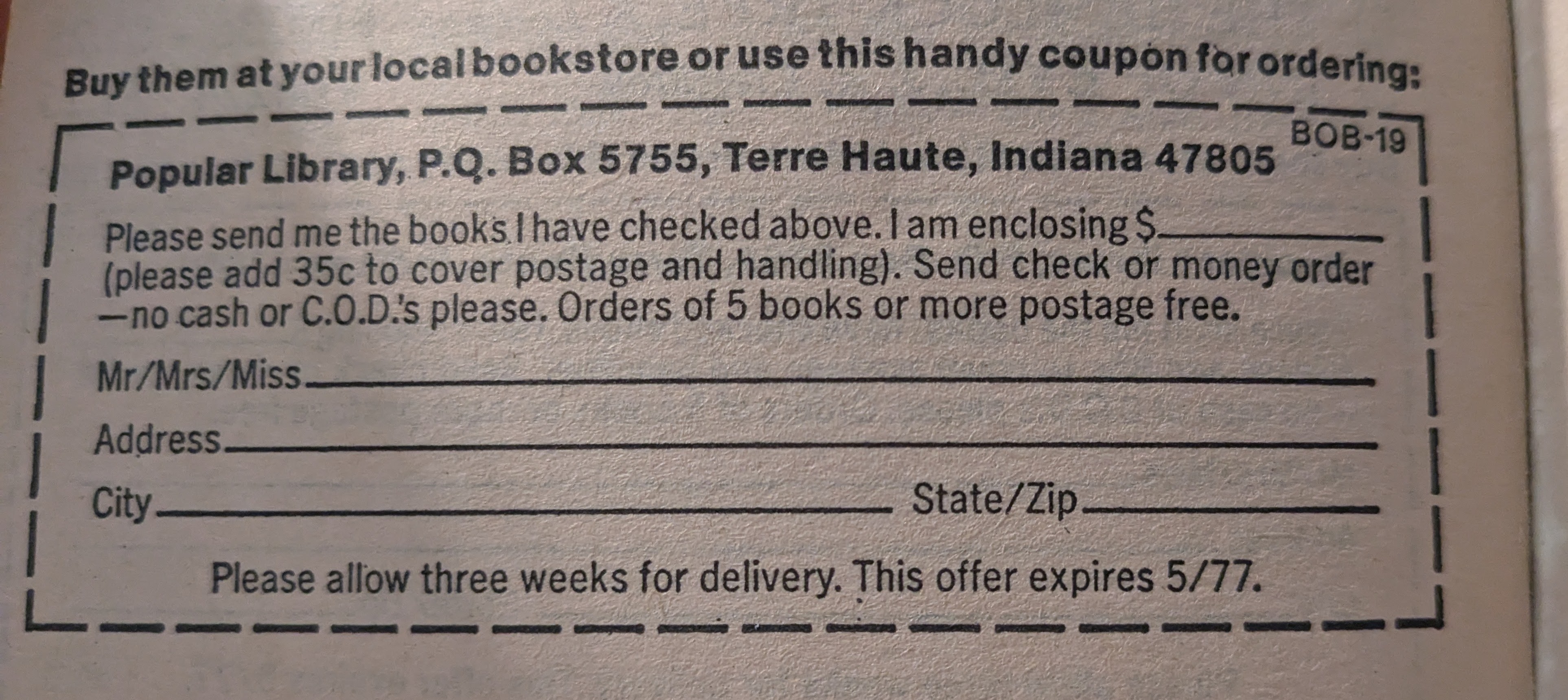
Joanne Hines’s novel was a fine way to pass the time without engaging in social media or doom scrolling the news because it’s easy to set down and pick up without losing your momentum. I enjoyed understanding what kinds of books folks wanted in the 1970s in my area. Here is a fun extra tidbit: this coupon in the back of the book that shows postage and handling was 35 cents, and the coupon expired in May of 1977.
 Grab the Lapels
Ah those were the days when mass markets were abundant and cheap! Also, I remember when a postage stamp was ten cents and an international stamp was an expensive 40 cents and I had to write my international pen pals on thin paper so I didn’t need a second stamp 😀
LikeLiked by 1 person
Oh, how nice! A pen pal! It just occurred to me that book blogs just might be a new form of bookish pen pal 🤔 I remember writing to my friends after we left dinner camp. I spent about 12 out of the 14 days of camp homesick and sobbing only to get into it the last two days. Then it was time to go home where I was extremely bored all summer.
LikeLiked by 1 person
Who doesn’t like finding something in the mail that isn’t asking for money?
LikeLike
After we bought our house, I got so much trash mail that was about updating my furnace. Let it go, people!
LikeLiked by 1 person
I still have pen pals 🙂 What is dinner camp?
LikeLike
Oh, oops, summer camp.
LikeLike
I actually found a comedic “Twilight Zone” episode about a guy who hated living in the 1890s who steals a “time helmet” and moves into the 1950s. It turned out the 1950s was even more expensive and loud than the 1890s, so he spends most of the episode trying to get back home. A scientist from the 1950s who for unexplained reasons prefers the 1890s catches a ride back and soon discovers he misses the 1950s. What made it even funnier was that the 1890s scenes were filmed like an old silent movie.
LikeLike
I don’t think I’ve ever seen that Twilight Zone episode. It sounds awesome. I’ll have to see if I can find it online somewhere 🙂
LikeLiked by 2 people
Oh, wow! I don’t remember this episode, and I’ve seen every single one except for that season that had zero affiliation with Rod Serling. Season 5, was it? Anyway, I don’t remember this one, but that’s a great story. Thanks for sharing!
LikeLiked by 1 person
I love those end-of-book coupons, book subscription clubs etc in old books. When I was young, most of my books came from jumble sales (a lot of stalls would sell you a box of books for £1!) so they were from the 50s and 60s. I was much drawn to the book subscription clubs and meetings advertised on the back covers – my mum spent a long time fruitlessly explaining to me that I would not be able to join in those clubs because they were long since closed. I think in the end she gave in and let me write to one just so that I could see for myself that I didn’t get a response!
LikeLike
Oh, my gosh, that is adorable. I love that you were very argumentative with your mom, so she just let you have it your way. It is funny that I look at these coupons and think, I wonder if they’d still honor these because they exist. I’ve noticed that some have expiration dates, but I’ve owned many books that did not.
LikeLike
I do love pocket-sized books. Why are new books so big?
LikeLike
And heavy! I know some people absolutely love hardcover books, but they are not for me. In fact, their lack of flexibility tends to hurt my wrists, in addition to the extra weight.
LikeLiked by 1 person
Absolutely fantastic cover and I also love the pocket books!
LikeLiked by 1 person
There used to be a publisher in Detroit called Broadside Press that made sure all their books of poetry (for they published poetry) were pocket size so that the automotive workers could keep the books in their back pockets while they worked, and read them on break. Don’t you just love that? These days, we never think of poetry as being the literature of the working class, but it used to be in some places. I think we need to bring it back. I think a lot of poetry has too much academia steeped into it and has become disconnected from the human experience.
LikeLiked by 2 people
I’ve been working on getting readers and some academics to think better of more “accessible” poetry.
LikeLiked by 2 people
My pulp fiction is nearly all SF, even a few back to the days when the covers really were paper and not cardboard. Though Milly and I did go through a phase of reading Mills & Boon. At the second hand shop you’d get half of what you paid back as a trade in, so I haven’t kept any.
Scarecrow House sounds like fun. Also, lock the back door!
LikeLiked by 1 person
I’m not sure what it’s like in Australia, but it used to be where I grew up, people didn’t lock the back door ever. I’m pretty sure my folks do know, and I feel awfully panicky if I find out that one of us forgot to lock the back door. I’m technically not in the city limits, but I feel like I live in the city because it’s so close. Perhaps we’ve all grown paranoid? Or are we accurate to batten down the hatches?
LikeLiked by 1 person
I have such a soft spot for books like this because my grandmother’s house was full of them. I wasn’t supposed to read them but sometimes I would sneak one. Love that coupon in the back too!
LikeLiked by 1 person
Wait, so what kinds of books was Granny readings? Were they saucy romances, or were they more mystery, like this one?
LikeLiked by 1 person
That coupon expired when I came into the world, LOL!
LikeLiked by 1 person
Are you as dusty as the book? 👀 I’m kidding 🤣
LikeLiked by 2 people
LOL some days more than others.
LikeLiked by 1 person
🤣🤣🤣
LikeLiked by 1 person
I feel like publishers should bring physical coupons back. It’s a great way to encourage readers to purchase from local indies, and we are just the kind of people who would enjoy clipping a coupon and physically bringing it to a store.
Wow, lots of drama in this one, seems like much of it could be avoided by a sturdy lock, as you mentioned, but where’s the fun in that? And this Phillippa must be very special considering how many ppl fall in love with her…
LikeLiked by 1 person
I recently read Dracula, and I completely forgot that Lucy’s whole thing is that she has three men who want to marry her. She picks one, but then the other two who are in love with her still stick around to give her blood transfusions and chop off her head when she becomes a vampire. Of course, it’s out of love because they want her soul to go to heaven.
As for the coupons, in Canada, were you able to take them to a physical store? The books in the US are specifically coupons that you mail in with your money, and they would send a book back.
LikeLiked by 2 people
Oh no, it was definitely still mail here in Canada too, but how fantastic would it be if there were in-person coupons? Maybe smaller local presses do that kind of thing (like an in-person coupon), but I haven’t seen it…and now that we have the Canada Post strike on, no one can mail anything!
LikeLiked by 1 person
I just get discount codes from small presses for when I check out online. My local bookstore will take 10% of book club books. Sometimes you can enter a drawing for a $5 voucher.
I was not aware Canadian mail is at a standstill. If your old folks are like ours, there are some people angrily waiting on paper checks.
LikeLiked by 2 people
Oh yes, the postal service has been on strike for…two or three weeks now? It’s brutal. No doubt some people are waiting on paper checks, but businesses and the gov’t have been good about direct deposit or e-transfer whenever possible
LikeLiked by 2 people