
*This is the 3rd book in the 13 Books of Fall.
My first Rachel Harrison book, Black Sheep, opened with a clear setting in a chain restaurant — basically an Applebee’s. We meet Vesper, a waitress who hates her job, which is never much of a surprise when Americans are reading about chain restaurant waitstaff, but her mindset and personality were immediately clear. It was a great start to the novel, and I was pleased.
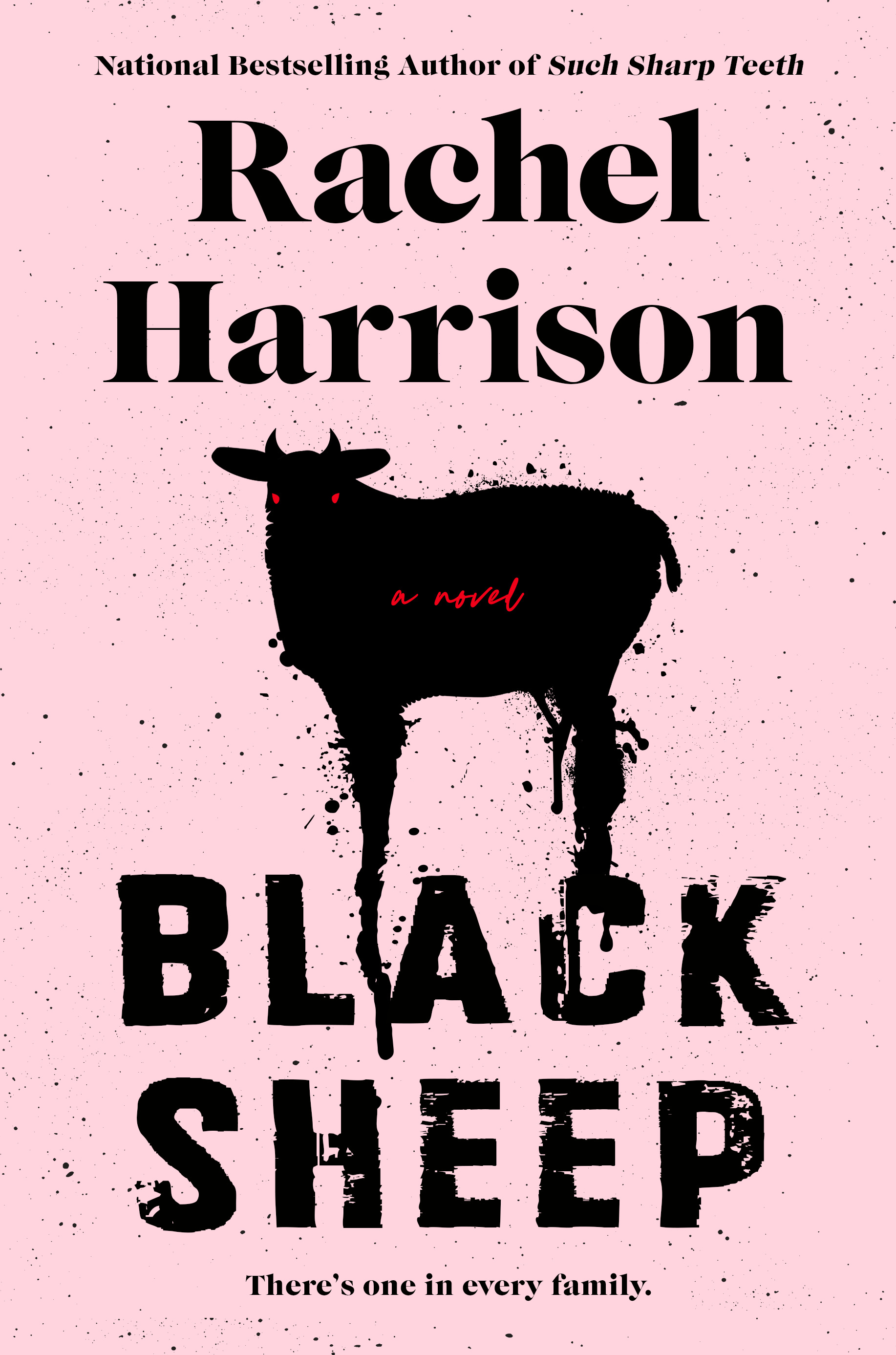
The book synopsis claims, “Vesper left home at eighteen and never looked back — mostly because she was told that leaving the staunchly religious community she grew up in meant she couldn’t return.” I’m picturing one of those Christian “cults,” the kind you read about in Brian Evenson’s books, or see in Kevin Smith’s Red State. Basically, the “Christians” who mix up the Bible, Republicanism, and violence. However, that’s not what Harrison wrote at all. The spoiler comes in about fifty pages, so I’m not sure if it’s a spoiler. Because the details aren’t mentioned in the synopsis, I’ll leave it hidden. Let’s just say there is a strongly-religious, hyper-faithful community, but it’s not what you think.
One night, after Vesper’s last table at the restaurant stayed well past closing, the customers Vesper personal questions and grabbing her — that is, until a bowl of cheese sauce is so hot it erupts in the grabber’s face, resulting in Vesper getting fired — she returns home to find an envelope on her doorstep. It’s an invite to her cousin’s wedding, her favorite cousin, who is marrying . . . Vesper’s first and only love. Can she fault her cousin? The religious community is small and insular. Should she go, just to see how this all came about? She goes. FYI, in the horror genre, you never go back because you won’t come out of it unscathed, whether it’s an encounter with your creepy uncle or a ritual sacrifice.
Harrison does not spend the entirety of the book at the wedding or the days leading up to it, which surprised me. The way everyone kept saying, “Welcome home” held some real weight behind it, making me think the family may kidnap Vesper. Unfortunately, although the wedding scene was shorter than I expected, much of the novel was predictable. Harrison necessarily adds in clues, because if she didn’t, readers would say she blindsided them; however, as a long-time fan of the genre, I know too many tropes. Or maybe your nice aunt giving you tea and then you feeling loopy would cue anyone into what that smiling old lady is capable of? I guessed things a sold thirty pages before Vesper wised up. The result? At times, my feeling was Black Sheep read closer to new adult fiction than adult fiction.
 Grab the Lapels
[…] by Audrey CouloumbisWeek of September 29: Only the Astronauts by Ceridwen DoveyWeek of October 6: Black Sheep by Rachel HarrisonWeek of October 13: Pretty Girls by Karin SlaughterWeek of October 20: […]
LikeLike
Ah, this is a shame. I was disappointed by her collection of four short stories, Bad Dolls, as well.
LikeLike
Did they have a younger vibe to them? More like young adult or maybe even new adult?
LikeLiked by 1 person
I can’t really remember – my problem with them was that they felt more like psychological thriller than horror, I think.
LikeLiked by 1 person
[…] by Audrey CouloumbisWeek of September 29: Only the Astronauts by Ceridwen DoveyWeek of October 6: Black Sheep by Rachel HarrisonWeek of October 13: Pretty Girls by Karin SlaughterWeek of October 20: […]
LikeLike
Oh this sounds very mysterious, you’ve actually piqued my interest simply because I’m dying to hear the spoilers now haha
LikeLike
I think this is a horror novel that you would enjoy. It’s not violent or gory, and I know you love a good secret revealed!
LikeLiked by 1 person
I certainly do!!!
LikeLiked by 1 person
This sounds sort of interesting but even from your review now I feel like I could guess a lot of the plot.
LikeLike
Ha, clever girl. 🦖 Let’s just say it doesn’t villainize Christians.
LikeLiked by 1 person
I read this. It was okay. I enjoyed her book Cackle much more!
LikeLike
Did that one feel kind of young adult-ish? Also, look at you, reading more and more horror! 🥰
LikeLiked by 1 person
Cackle didn’t feel like YA. The main character was much more appealing than the one in Black Sheep. But take my opinion with a grain of salt that I’m a new horror “lite” fan.
LikeLiked by 1 person
You have written this up well, in that you had me intrigued until you got to the point where you reminded me this really was horror, and not my thing at all. Still, I enjoyed hearing about some of the tropes, like how you shouldn’t go back. I guess that is a general saying that we all know, but that horror has taken as its own – to prove right?
LikeLike
To be honest, I’m intentionally leaving out the word “horror” unless I have to when I review books, because so many of them are not really horrifying. Yes, there might be a tiny bit of something not human (like Satan, for example), but I’m not sure what people picture when we say “horror” matches a lot of the books I read that are in the horror genre. Like right now; I’m reading Dracula, but plenty of non-horror people read it. As I’m reading it (for a second time), I’m realizing that has some seriously terrifying moments! So, what is in a name, I suppose.
LikeLike
Ah interesting Melanie … you know I hadn’t really even thought of the fact that horror includes something not quite human. As you know, I can enjoy stories in which the narrator can be something not human. What I think of when I hear that a book is horror is something that is aiming to terrify me, and I don’t want to be terrified. Now you have reminded me that that terror is often coming from something not quite human. How silly am I not to have really thought through that this is what this genre involves. It doesn’t really change my overall attitude to horror though as it’s the idea of physical/psychological terror that I am just not interested in. For this reason I also avoid psychological thrillers. The sustained fear is the point for me, not the something not quite human bit.
I guess it’s like speculative fiction … I’m not interested in complex other worlds with their weird characters and pew pew (have I got that right!?) stories but I do enjoy certain types of speculative fiction. I wonder if any of this has made sense.
LikeLike
Pew pew is more sci-fi with laser guns 🤣 I love it. Speculative often seems more fluid to me. Not quite sci-fi or fantasy, but something not real, either. I always thought the name was developed for those stories that don’t quite fit. I recently read that it’s easy to tell sci-fi from fantasy; if it’s fantasy, the earth is called Gaia. If it’s sci-fi, the earth is called Terra.
LikeLiked by 1 person
Ah, for the Australian Women Writers challenge we did a lot of thinking about “genres” and we used Speculative Fiction as the umbrella term for sci-fi and fantasy. I’m not sure that I would normally include Fantasy under the umbrella, but I I do see it as an umbrella term for sci-fi, most dystopian fiction, and any fiction that has some sort of “futuristic” element. That’s loose, but I guess mu point is that I see it as the encompassing term.
I love the Gaia versus Terra definition!
LikeLiked by 1 person